A Different Kind of Occupy
On Friday, Caroline and I visited The United Church of Canada’s partner, Surplus People Project (SPP). Their office is located close to the B&B where we stayed, so first Herschelle Milford, the Executive Director, picked us up and brought us to the office. Katherine Zavala from International Development Exchange (IDEX) based in San Francisco also joined us, as IDEX recently made a grant to SPP and were there to do a site visit.
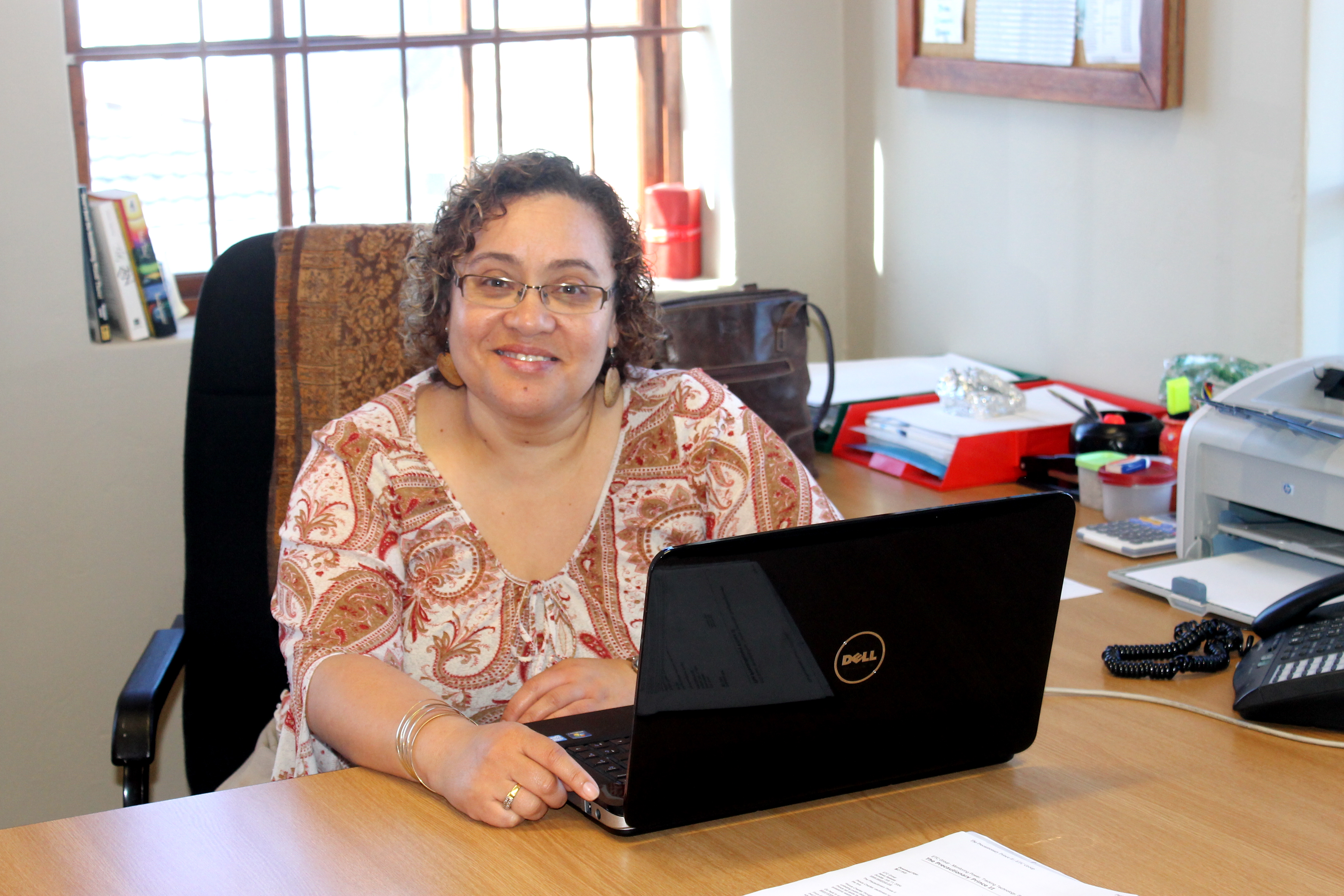
Herschelle Milford, Director of SPP
The office was very nice, with an amazing view of Table Mountain. We met a few of those who work for SPP, and then Ricado Jacobs (also with SPP) arrived to take us on our exposure visit up the Cape, to meet some of the farmers that SPP work with. Ricado told us that 42% of South Africans are food insecure, and the majority of these are women. SPP does both advocacy and practical assistance for farmers in this situation. They don’t necessarily have a relationship with individual farms, but they more engage with them and advocate on their behalf over a specific issue, such as water.

Proof I was there!
First, Ricado took us to Citrusdel, in Cederberg municipality, where two members of a farmworkers’ forum were meeting with municipality officials over the lack of water on their farm. Petrus, the chairperson of the forum – which has The Right to Agrarian Reform for Food Sovereignty Campaign – was there, along with other SPP employees, to advocate on behalf of Wilhelm, a small-scale farmer, who does not have access to enough water to keep his farm viable.

Wilhelm, a small-scale farmer
After the meeting (hopefully Wilhem will have water by Monday, today), Wilhelm took us to his farm to show us the conditions he was facing. All of these small-scale farmers are working land that is owned by white farm owners. And these white owners are not ensuring that there is adequate water for the farmers. Additionally, South Africa has one of the most advanced constitutions in the world. However, this does not mean that the rights outlined in the Constitution are upheld. The right to an acceptable standard of living is enumerated in the South African Constitution, as is the right of access to water. After seeing Wilhelm’s farm, it was clear that the government did not uphold this right, and was obviously also not being held accountable.

Wilhelm showing us the seriously low water supply on the farm
We travelled on to a second farm, where we met Gert. Gert is part of a seasonal workers’ union. It is a women’s union, called Sikhula Sonke; this means that men can be part of the union, but they cannot take a leadership role. All of the farmers we met on Friday talked about the importance they place on not using fertilizers or other types of poisons. However, they obviously have no control if the white farm owner chooses to fertilize other parts of the farm. This happened to Gert. There are citrus trees right beside his house and his plot of farming land, and these were recently fertilized by the land owner. His 3-month old daughter was in hospital, and Gert believed it was because of complications caused after these fertilizers were sprayed.

Gert (left) with Petrus at Gert’s vegetable garden
Gert took us to his vegetable garden and proudly showed us the different crops he was growing. Right now, he grows just enough to support his family, but he hopes to expand his farm so that he can also make some profit by selling produce in the market.
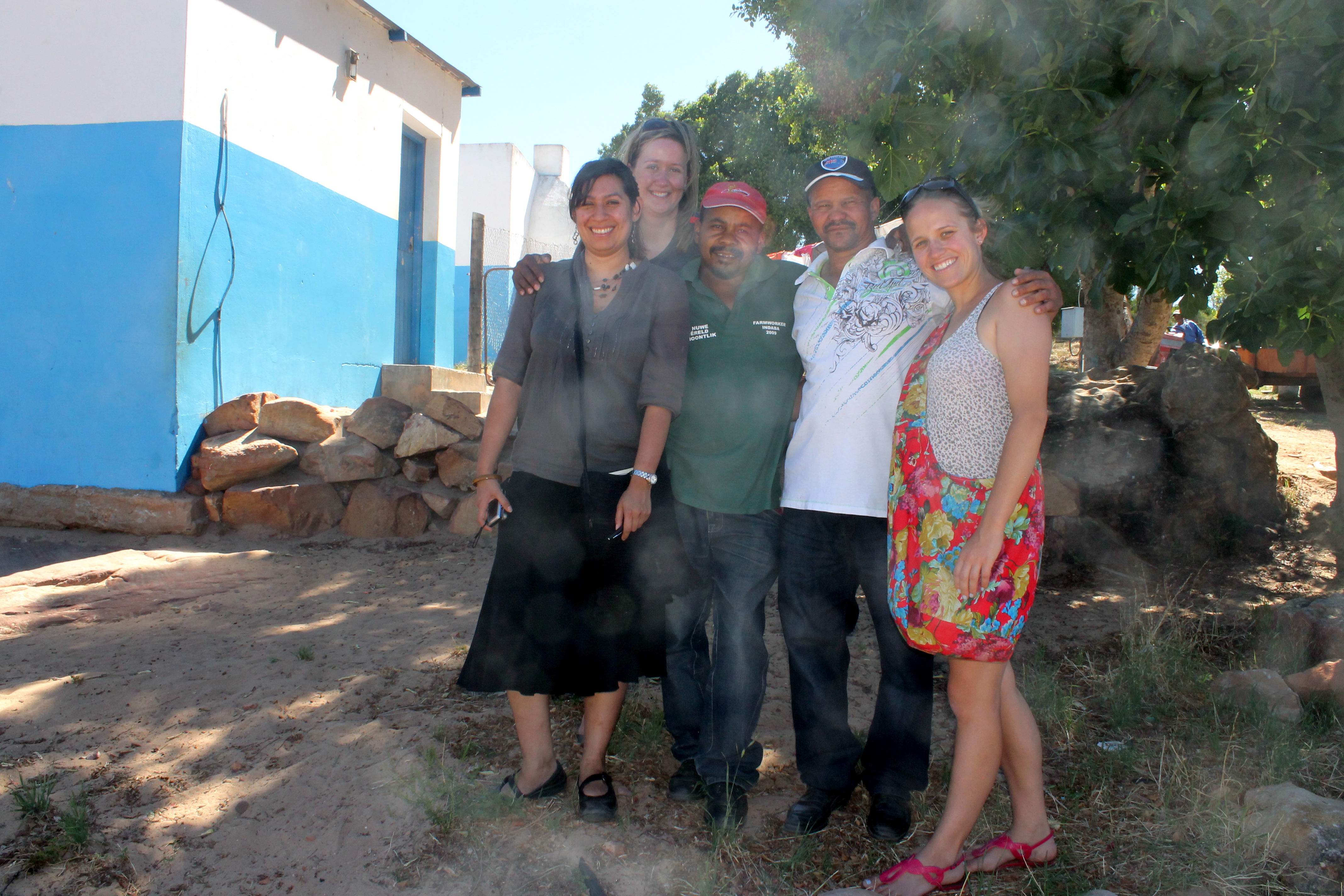
A kinda grainy photo of Caroline, Katherine, and I with Gert and Petrus
Petrus then took us to his farm, where we finally met some women farmers. Petrus’s work as chairperson of the Forum is a volunteer position, making his wife, who farms the land, the breadwinner of the family. This situation, however, illustrates the sexism that is still rampant in South Africa (and elsewhere around the world). If Petrus was farming the land, the farm owner would have provided a toilet for him. But because it is a woman who is farming the land, there was no toilet. Petrus had to construct a makeshift toilet for his wife, because of this, and he said that he hopes to make it nicer in the future.
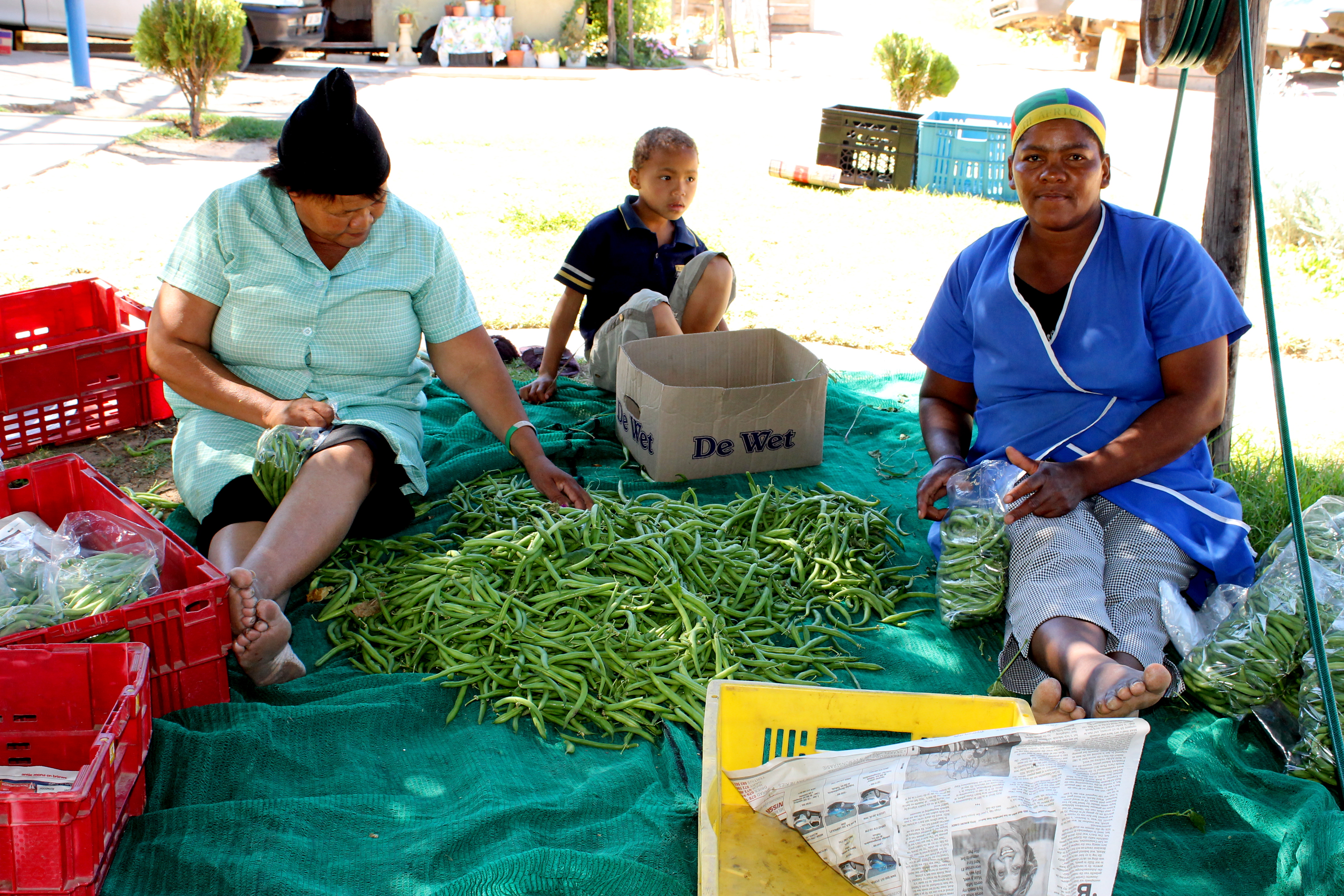
Farmers with harvested beans
Petrus also took us to the back of his farm, to see the pigpens. Many of the pigs seemed pretty interested in us. Methinks they just thought we had food.
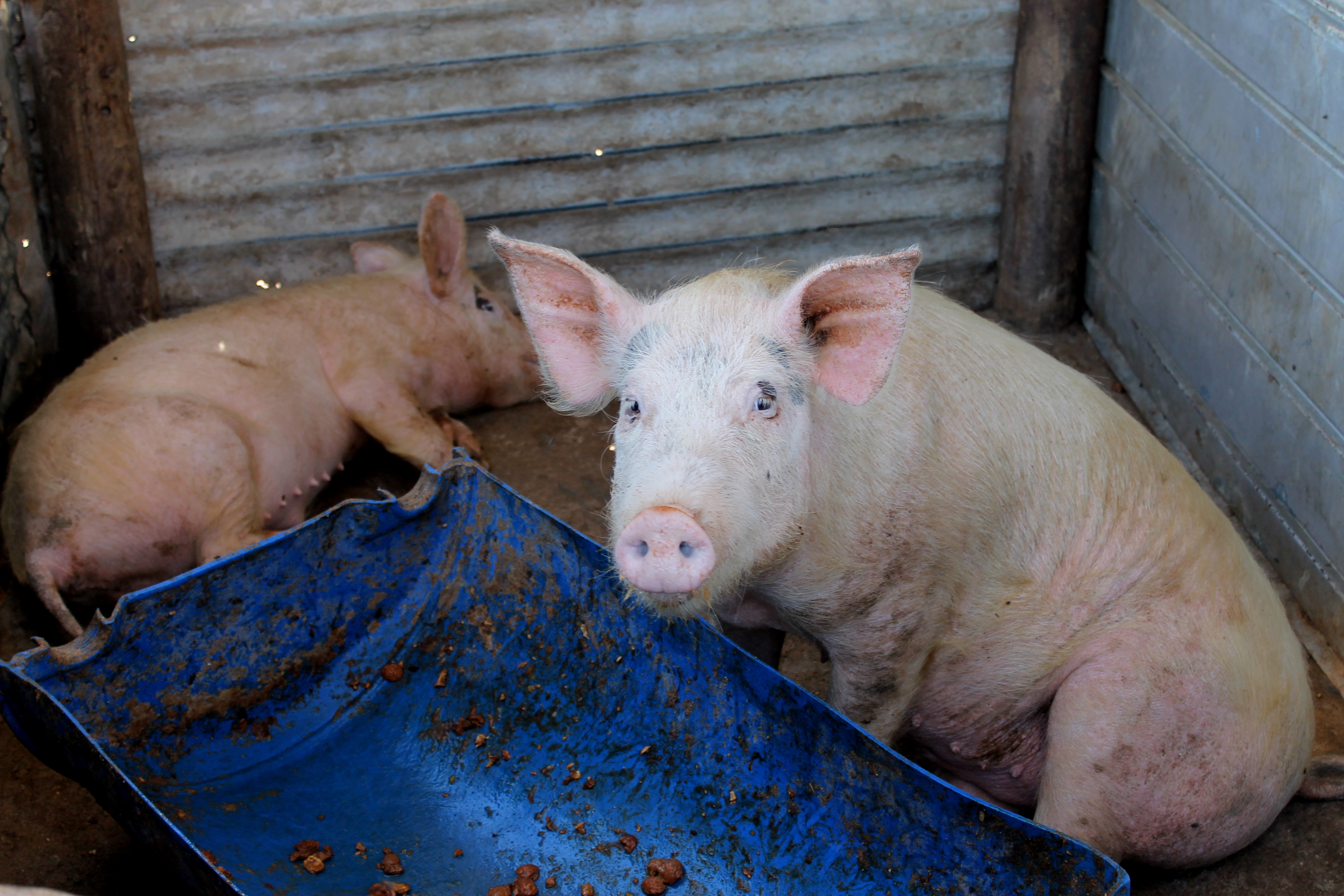
Pigs!
As it was getting late in the afternoon, we then drove south back to Cape Town, traveling to a plot of land that’s been occupied by farmers for 27 years. There are approximately 300 people who live there. Land is often occupied by people who want to live on it, but rarely by those who want to farm it (some of the farmers live there, but some do not; some also just leave one person there at night to guard the farm). As the land there is not that fertile, the farms are mainly animal farms. We saw pigs, cows, geese, chickens, and goats.
At the Occupy site, we met Patrick and Rosaline of Itemba (“Hope”) Progressive Farmers. They explained why and how they were occupying the land. In South Africa, the law says that if someone constructs a structure on a piece of land that they are occupying, and it remains there for 48 hours, the government then has the responsibility, if it wants to evict the tenants, to find alternative accommodation for them. The government is currently in talks with the farmers there to move them to other, better land.
Some people will be left behind. Because the land is not their land, they have no say in who can live or farm there with them. And some pedophiles and criminals have latched on to the site. But since they are not part of the association of Itemba Progressive Farmers, they will not be part of the group that is moved to the other site. Patrick also told us that there were a couple of farmers who had jobs outside of that farm, some making more than $60,000 a year. It was unclear why they were also occupying the land.
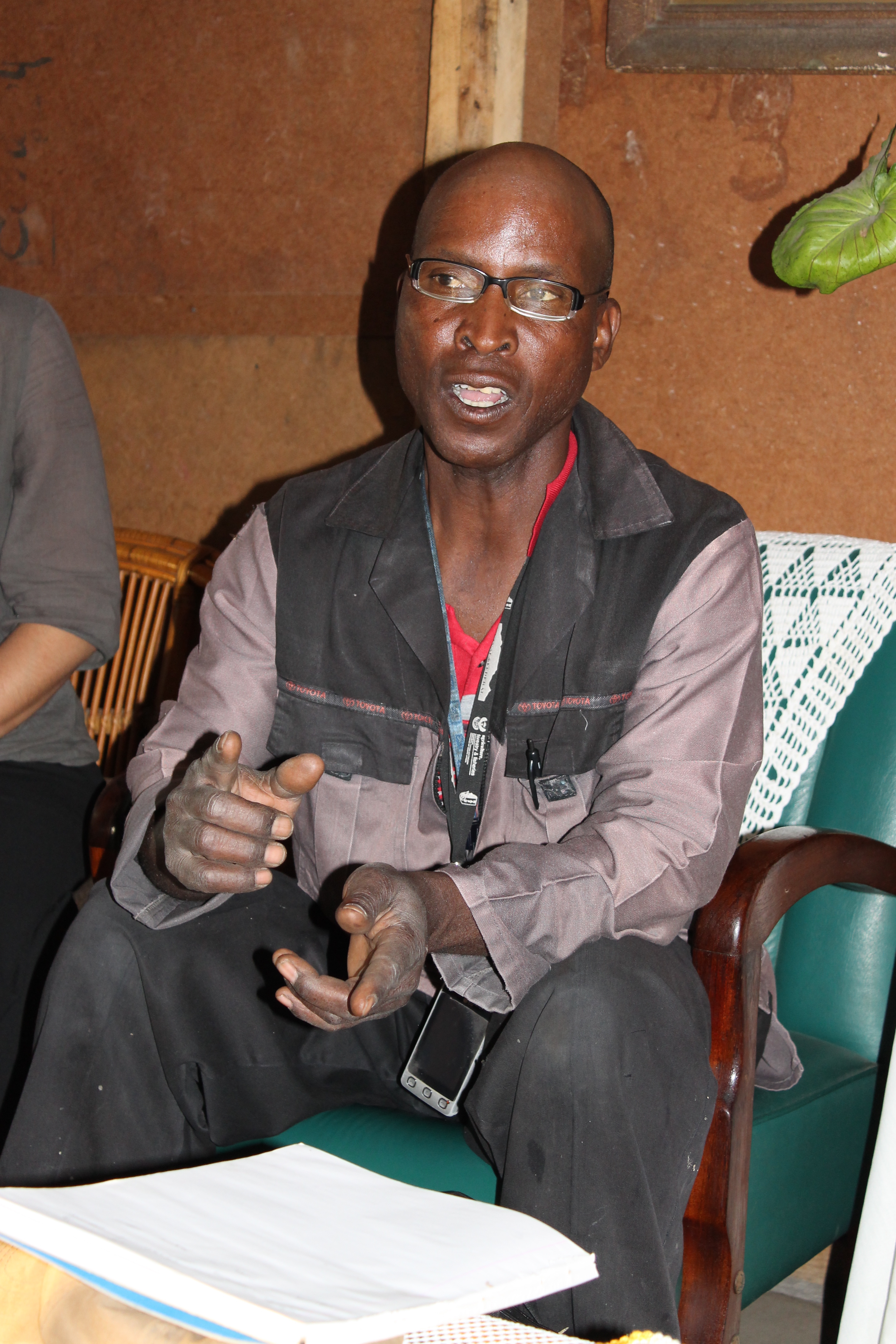
Patrick of Itemba Progressive Farmers
We visited several farmers’ plots, and met both male and female farmers who had been farming the land for various lengths of time.

One of the “occupied” farms
After having visited Occupy Calgary and Occupy London over the past 2 weeks, it was really interesting to see this other type of Occupy movement. It truly felt like an example of the 99% confronting the 1%.
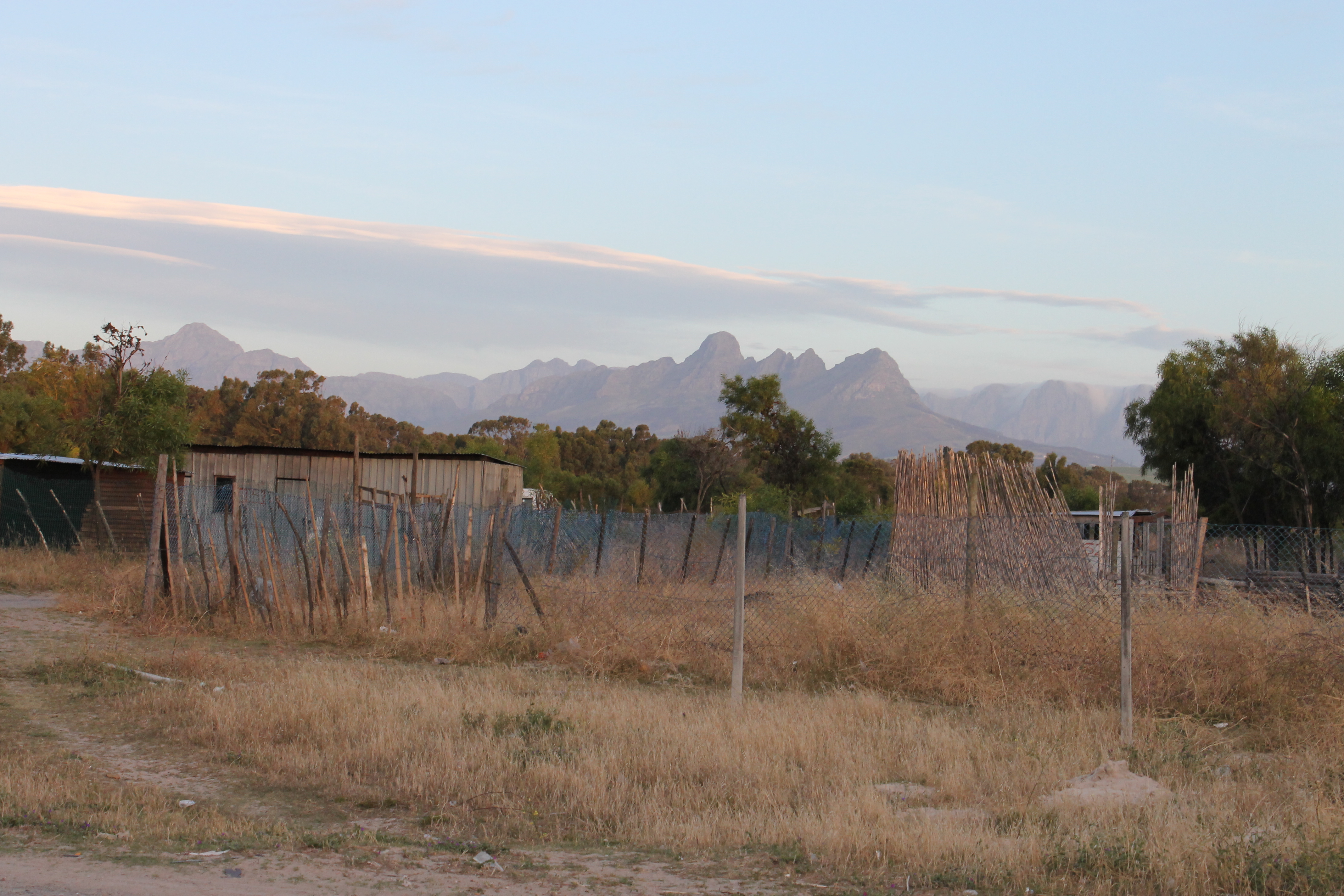
This farmer has been here for 27 years

Cows belonging to the same farmer
Caroline and I went back to our B&B for our last evening in Cape Town, getting ready for the work we’d have to do in Durban!
Cycling to Cape Point
I know I’m seriously behind in this blogging, but in my defence, the place we’re staying in Durban has very limited Internet access. We’re getting WIFI tomorrow, so I’ll be able to update more then. In the meantime, here’s some more lovely photos.
So, I left off on Thursday. That day, Caroline and I went on a tour that took us down the Cape and all the way to Cape Point. It was a beautiful day – nice and sunny. A perfect day in South Africa. Our first stop was “seal island” (or seal rock, really, as someone else said), which we visited by boat. I was very excited to see some seals after spotting a couple of them in the harbour of Cape Town the day before. And it was pretty awesome. There were so many of them, some sunning themselves on the rocks, some swimming alongside the boat, and some timing their jumps into the ocean just as a wave crested. Brilliant.
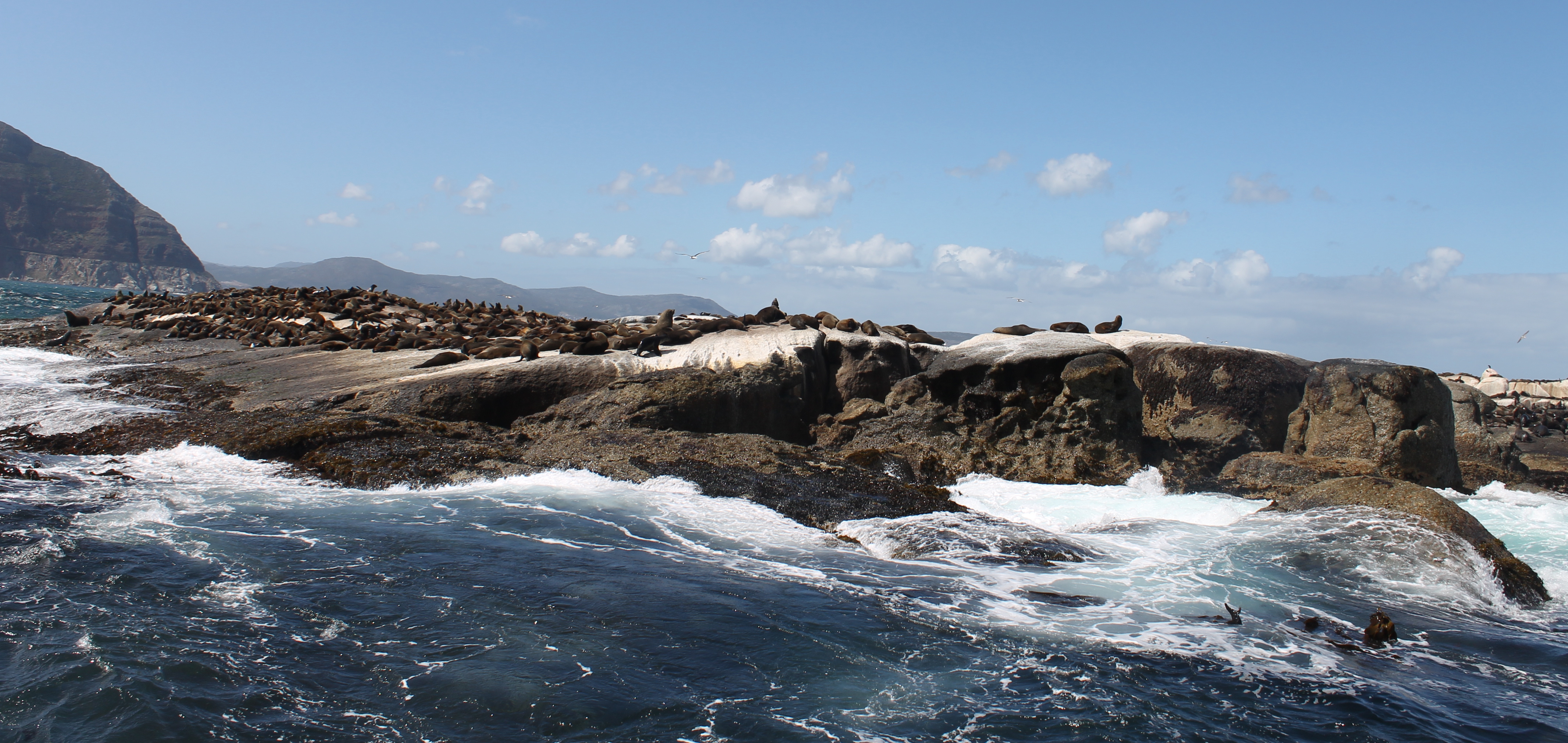
The seals!
From there, we drove to Simon’s Town and then onto Boulder’s Beach, where a group of African penguins (known as the Jackass penguin. And no, I’m not making that up) have a colony. They were so cute!! Waddling around, all adorable. I think I could’ve watched them for a few hours, and I took WAY too many photos. But I’ll spare you – here’s just two of them. It’s the first time I’ve seen penguins in their natural habitat, and it was pretty spectacular.
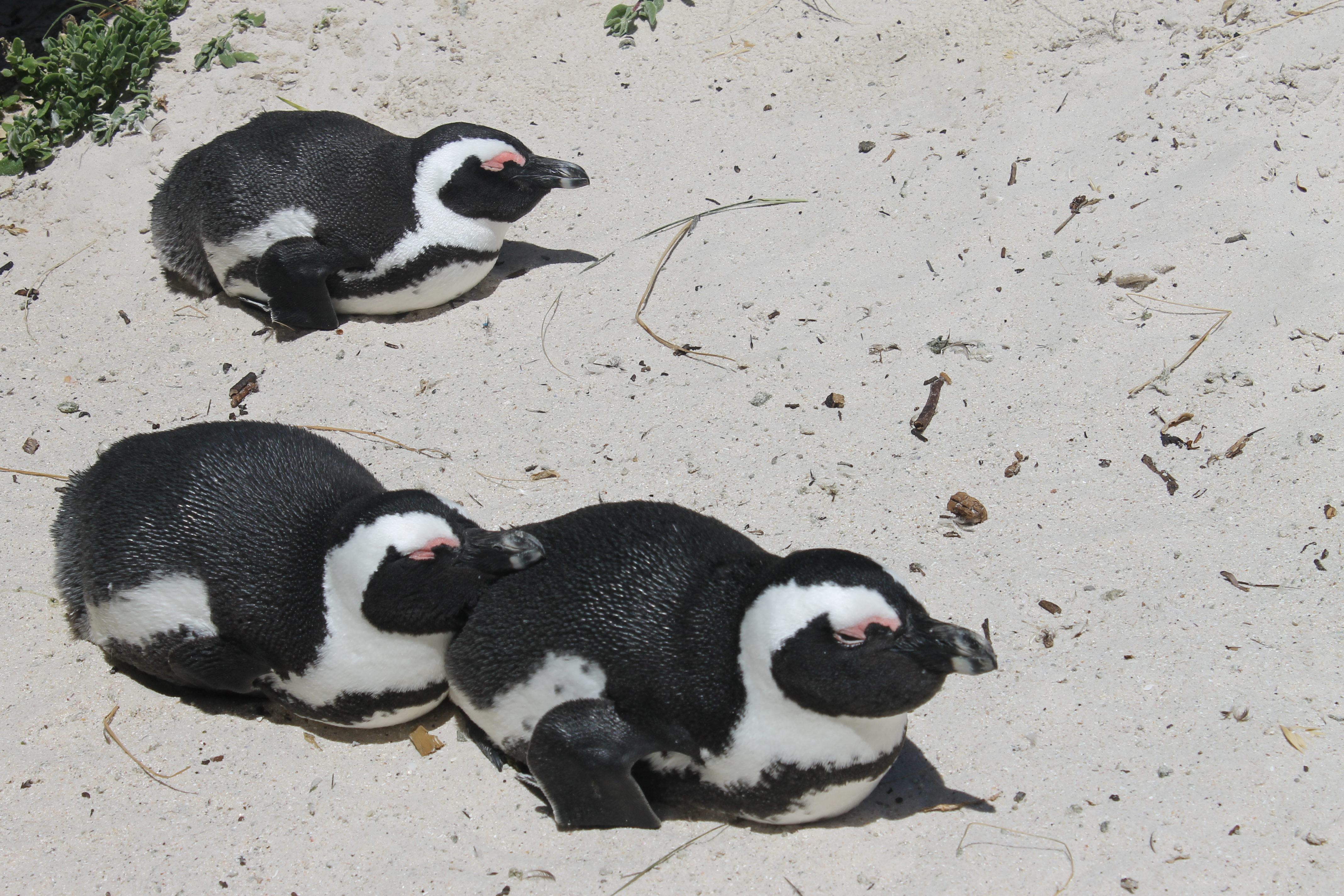
Super cute penguins

Lazing around on the beach
Back in the bus, we spotted our first family of baboons! Our driver had told us it was likely we would see them, and that they are dangerous. I already knew this, having been on safari in Kenya and Tanzania. In fact, baboons border on being evil. They will grab your bag, dumping out the contents to find food. And they’re really quite bold. In Kenya, a baboon attempted to enter the bus I was on; luckily, all the girls screamed and it quickly rethought its journey.
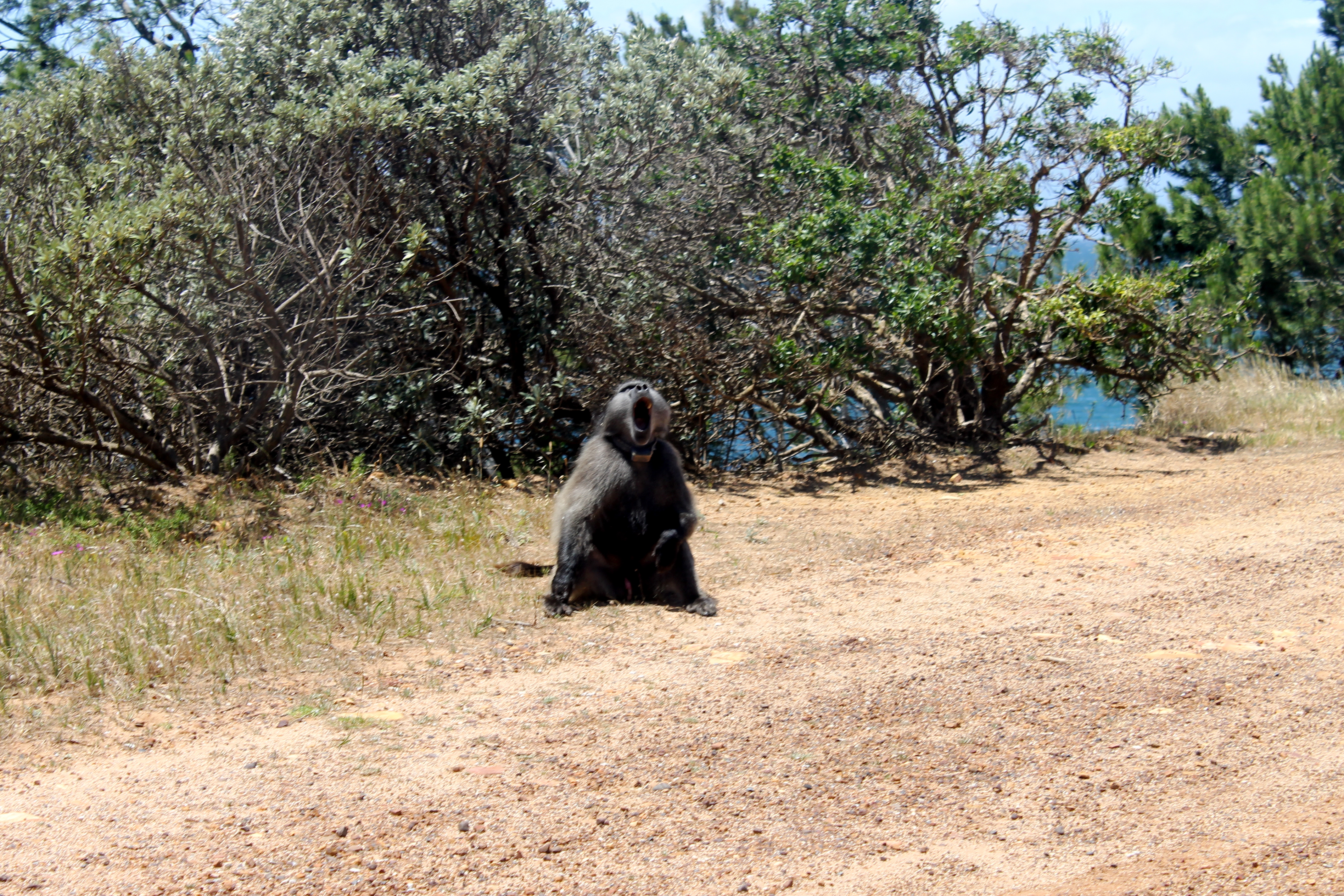
Yawning….
They’re not as evil as hippos, mind you. Those things will kill you even if they’re not hungry. Kinda like humans, I guess… Anyway, I digress.
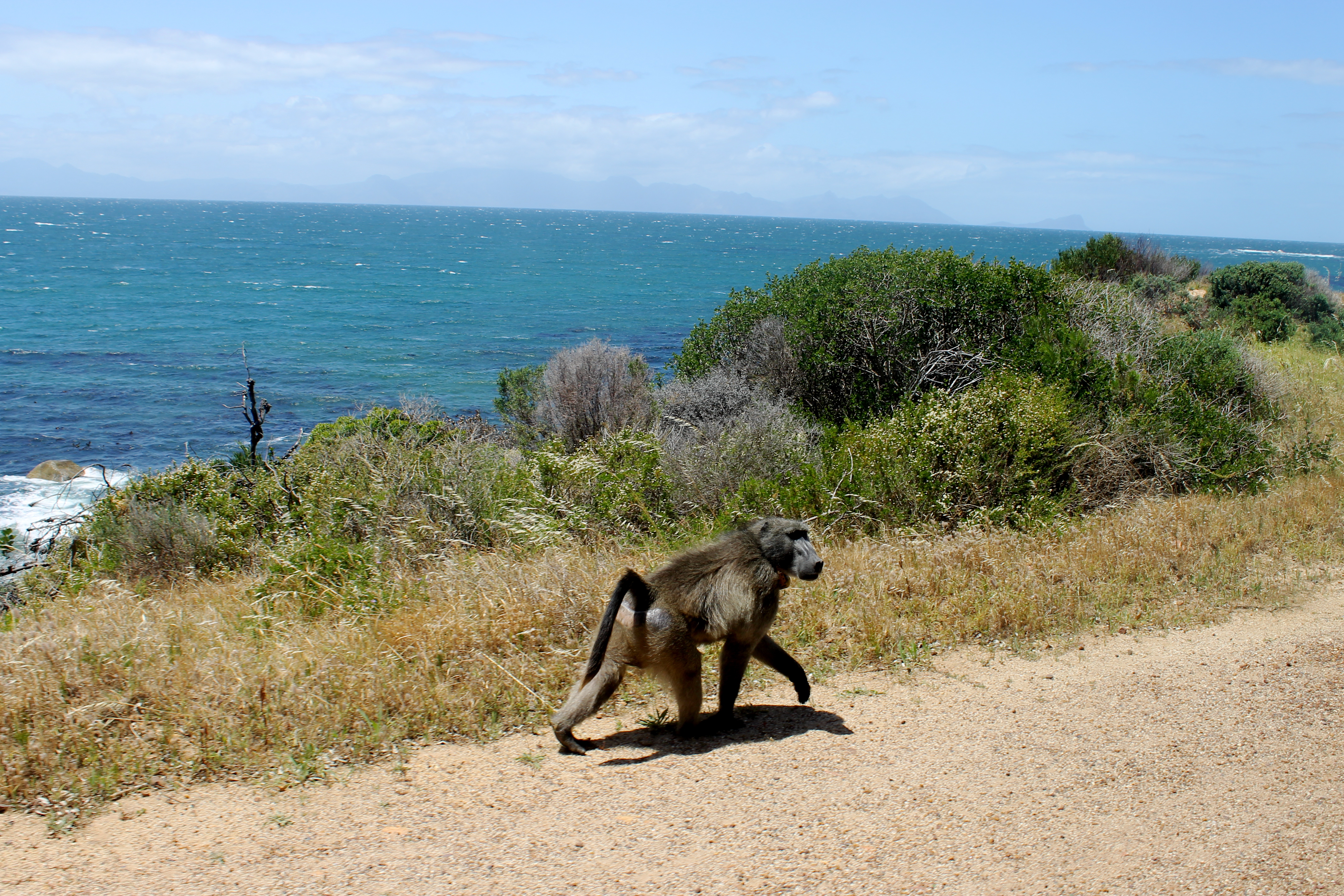
He looks like he owns the place!
It was nearly time for lunch at this point, but before we could eat, we had to cycle 7 km, nearly reaching Cape Point. Caroline and I had not been told about this portion of the tour (the tour was just recommended by the B&B where we were staying), so we were not exactly dressed appropriately for athletics. Think sundresses and sandals. My shoes were especially not suitable for this type of thing – I’m just glad I only lost one shoe once and was able to go back and get it!
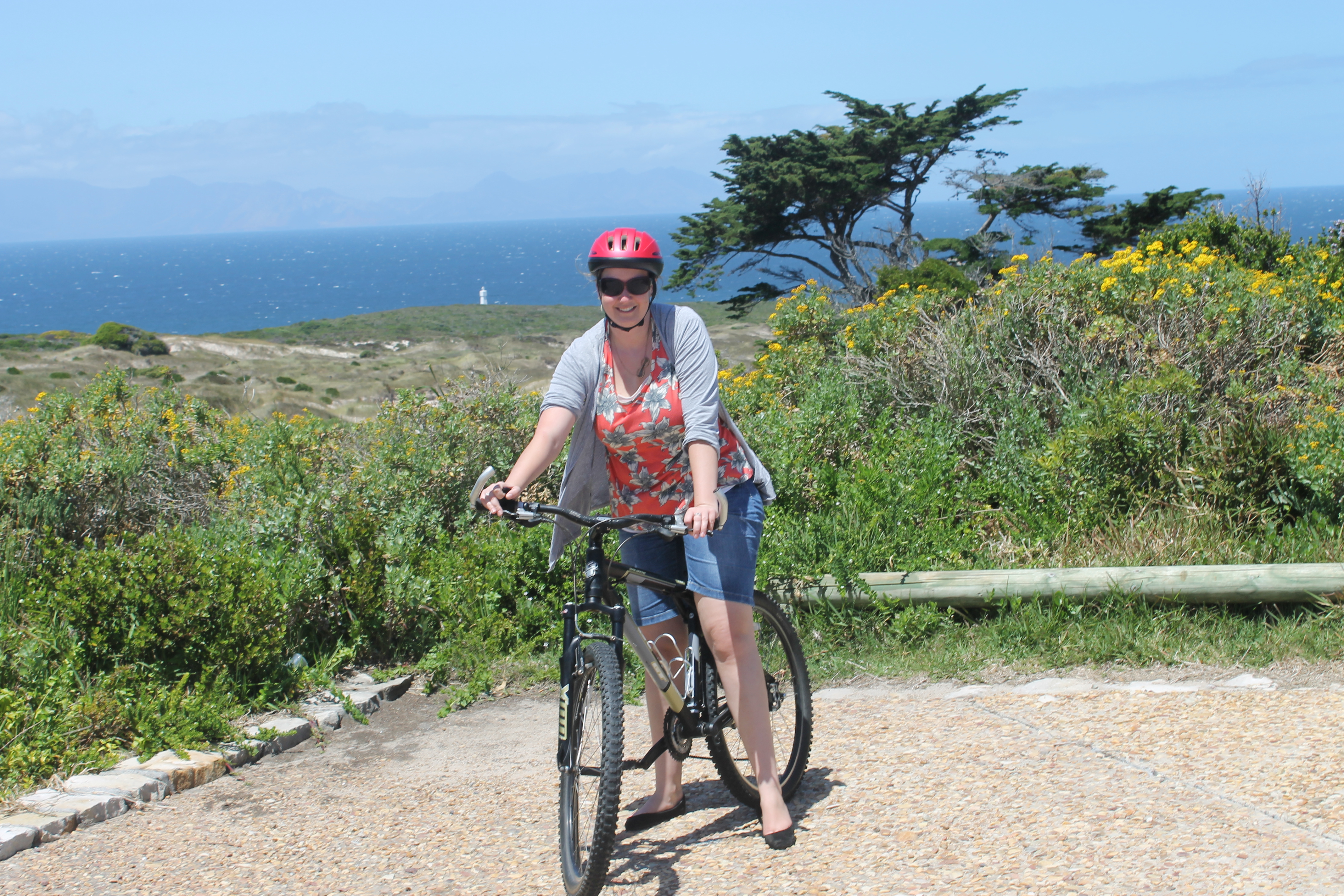
Look Ma, I made it!!
But despite our lack of proper footwear, and my having not ridden a bicycle for years, we made it all the way!! I was proud of us. 🙂
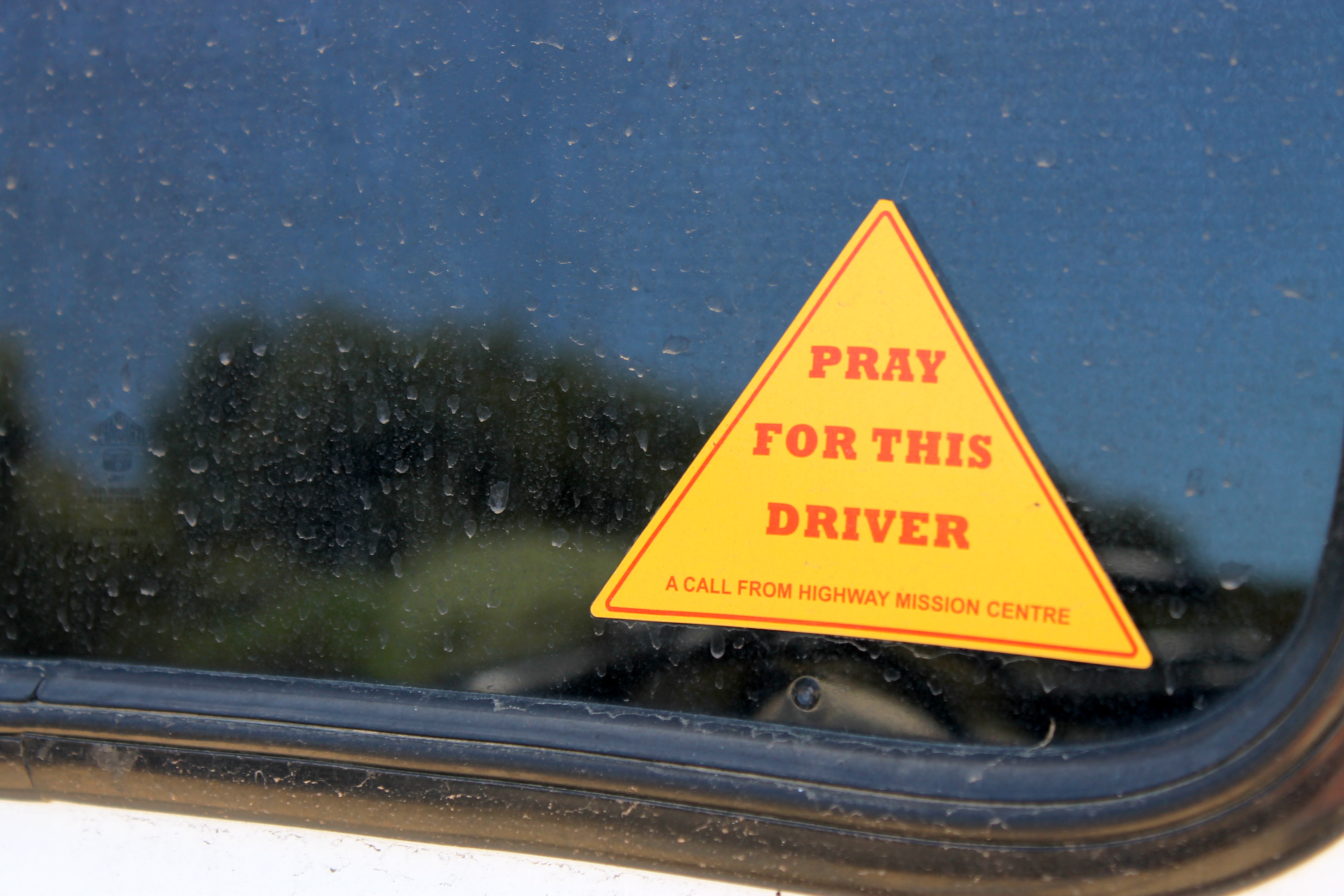
This really did not reassure me. Was there a REASON we should be praying for our driver?!?
We made it to our destination and had a very filling lunch. We were quite jealous of the group from India beside us, who had an amazingly-smelling hot Indian lunch. We asked if they wanted to train, but they smartly declined.

Caroline lying on the bottom jawbone of a whale after lunch
Next, we actually made it to Cape Point and walked up to the lighthouse on top of it. This was some of the most beautiful scenery I’d seen yet in the Cape.

Gorgeous Cape Point

Caroline and I at Cape Point, with the Cape of Good Hope behind us
From there, we travelled down to the Cape of Good Hope. Another stunning location!

Me at the Cape of Good Hope
It was a great, full, touristy day. Snoozing on the way back to our B&B, we were ready for the big day we’d have on Friday, visiting Surplus People Project.
Destination: Robben Island
Yesterday, Caroline and I went to Robben Island. Robben Island (meaning “seal island”) is the island that housed the infamous Apartheid-era prison, where former president Nelson Mandela, former president Kgalema Motlanthe and current president Jacob Zuma all served sentences, along with many other political prisoners.

A pirate ship we spotted while waiting to go to Robben Island
Once we arrived on Robben Island, we took a bus tour to see various sites, like the leper cemetery from the 1800s, the lime quarry where Mandela worked, and various WWII buildings. After the bus tour, we toured the main prison, where we were led by a former prisoner.

The main prison on Robben Island
We also met a former warden, who was fascinating. He’s a friend of Mandela’s and he told an amazing story about Winnie Mandela coming to Robben Island and smuggling one of their grandchildren over. Children and infants weren’t allowed on the island, so he (the warden) told her that she had to leave the child with one of the other visitors while she saw Mandela. Mandela himself asked him if he could just see the baby though the window, but he said no because he could’ve been fired for that. Later, Winnie also begged him to let Mandela see the baby, but he refused. He then saw his superior and told him what Mandela wanted; his superior said that as long as Winnie didn’t know, he could make it happen. So the warden went over to Winnie and told her that Mandela wanted to see her about one more thing (he needed to tell her about applying to visit at Christmas) so she should leave the baby with him. It was the first time he’d ever held a black child, he said. He locked the door behind Winnie, then went around to the other side and called Mandela over. Outside the visitor’s room, he handed the baby to Mandela, who got to hold him for a few minutes and kiss his cheeks. Winnie, meanwhile, was knocking on the door on the other side, having found it locked. The warden took the baby back, went over to Winnie’s side, and opened the door and gave the baby back to Winnie. She went back to the mainland and told the press that she had smuggled the baby over to the Island but that Mandela had not been allowed to see him.
Wow. I was very touched by this small act of rebellion against the Apartheid government, by a man who had a lot to lose if he was caught. He could’ve been charged with treason, as was the case with guards who were kind and seen to sympathize with the prisoners. It’s amazing that both former guards/wardens and former prisoners now live and work on the Island.

A former warden (left) and former prisoner
Inside the prison, we visited the different blocks. Block A is where the new prisoners were kept. Block B was where the political prisoners were kept, like Mandela, and block C housed the prisoners who broke prison rules. Blocks D & E housed other prisoners, like the coloured and Asian prisoners (the rest of the prisoners were Black male prisoners, many political and some criminals, who were used to try to break the political prisoners. Other prisons around the country housed the white political prisoners and women prisoners).
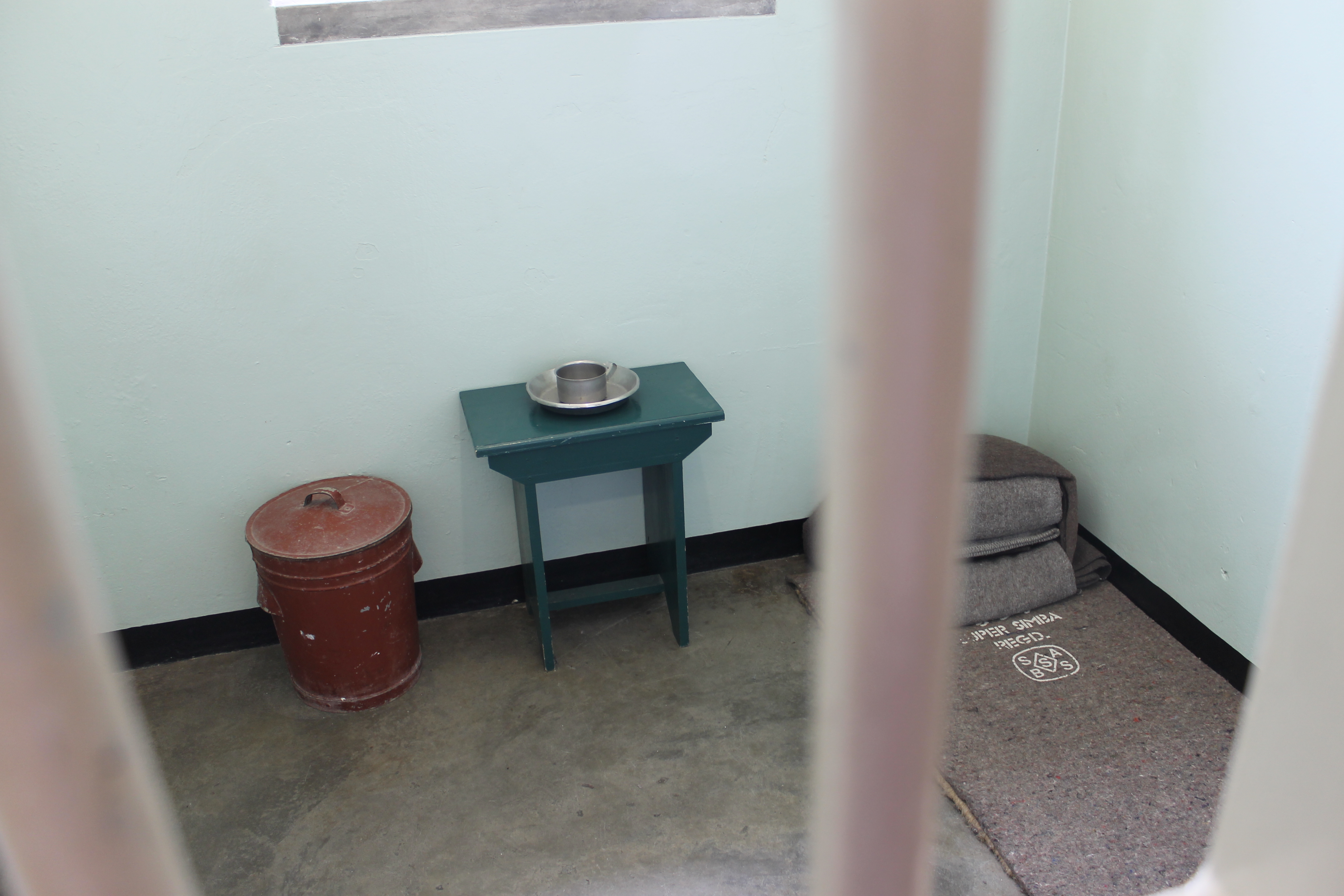
Nelson Mandela’s former cell. He was imprisoned here for 18 years
It’s funny, being on Robben Island was much less creepy than being in Alcatraz (I think it was the fresh coats of paint), but it made me think a lot about the terrorism & rule of law course I took at LSE. Mandela was considered a terrorist 40 or 50 years ago. My maternal grandmother’s uncle was in the IRA in 1910s and 1920s Ireland. He fought for independence for his country, and would’ve been considered a terrorist, and still would’ve been considered that, had they not won. Ireland is now an independent republic with good relations with Britain, and members of that early IRA (not the one that developed in Northern Ireland) are considered heroes and freedom fighters. The same happened with Mandela and other members of the ANC and its armed wing. But Mandela actually participated in bombing campaigns. He carried out violent dissent. So why is he now considered a national hero – a man who stood up against the evil of Apartheid – all around the world, when those fighting for their rights in Palestine are continually being labelled evil terrorists? Will there be a time, 50 years from now, when they’ll also be considered freedom fighters and heroes around the world, for fighting for equality and human rights? Does using violence to achieve peace make that peace any less real, or worthwhile, or valid? I don’t have the answers to these questions…does anyone else? 🙂
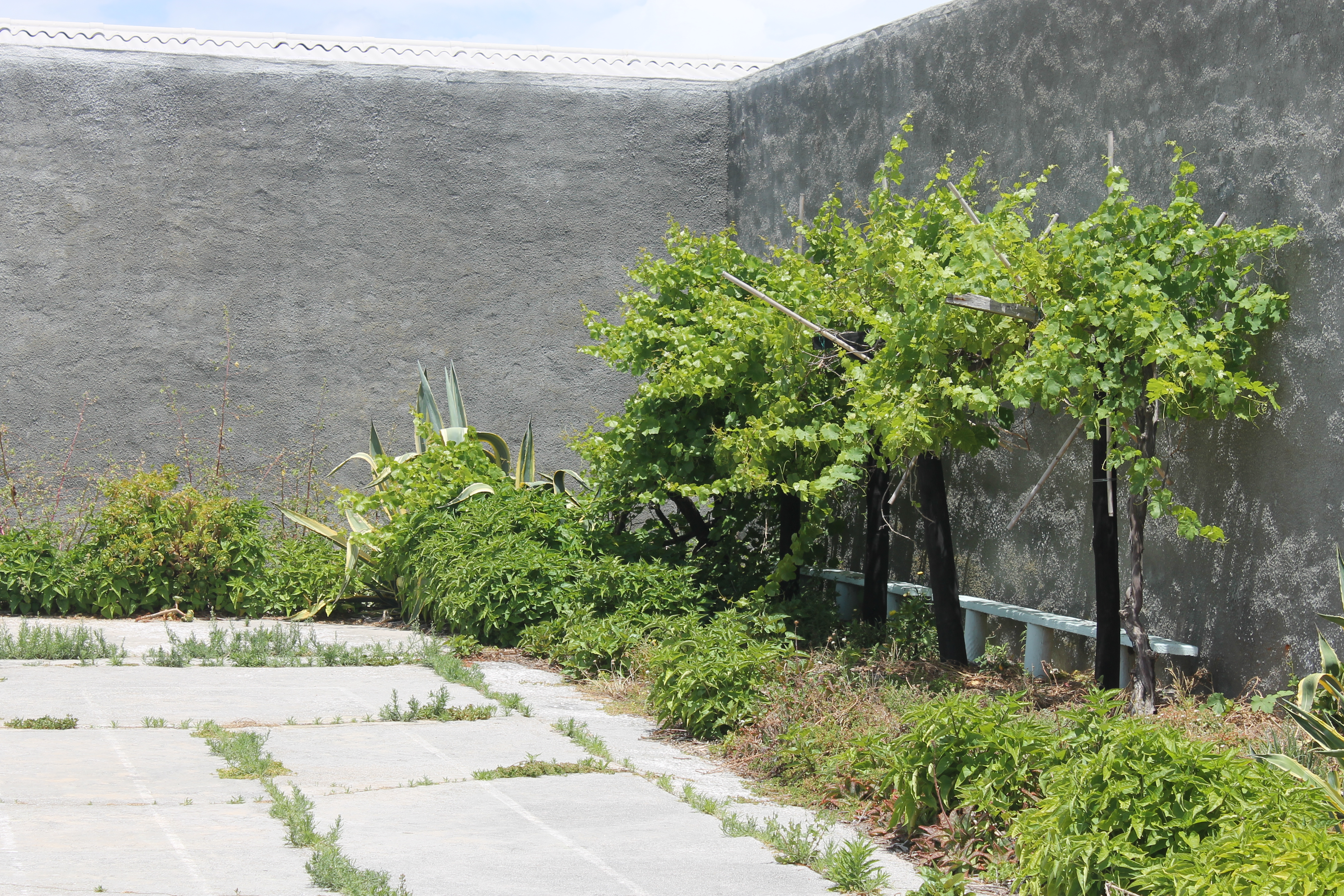
The bush in the corner is where Mandela hid his manuscript of “Long Walk to Freedom”
My Aunt Margaret (who’s one of my inspirations and has taught me a lot about human rights and social justice) took me to my first political meeting when I was a year old, in 1987. It was an anti-Apartheid meeting and I’ve thought of that as technically being the starting point of my passion for social justice. Yesterday was such an amazing day to experience the history of this country that, in a way, lit a fire in me and made me question and try to understand how people can be so cruel to other human beings.

Inside one of the group bunkers
After Robben Island, I wandered a bit more around the Waterfront. It’s so beautiful – and I saw a seal!! I love seals.

Nobel Square, depicting the late Chief Albert Luthuli, Archbishop Desmond Tutu, and former presidents Nelson Mandela and FW de Klerk
Today was a great day, traveling down the Cape. I saw penguins, seals, ostrich and baboons on the way! More on that tomorrow. G’night!

An awesome local band. I got them to sign their CD for me.
Wandering Around Cape Town
My first full day in Cape Town was very relaxed and fun, but also steeped in the history of Apartheid. I’m here in Cape Town with Caroline Foster, Young Adult and Network Coordinator at KAIROS: Canadian Ecumencial Justice Initiatives. We started off wandering around the V & A Waterfront and perusing some of the craft stalls.

V & A Waterfront
Then we wandered over to Greenmarket Square, which had some amazing artwork. I bought a gorgeous painting of a local village scene in Kwazulu-Natal, but haggling at these markets always seriously stresses me out!!
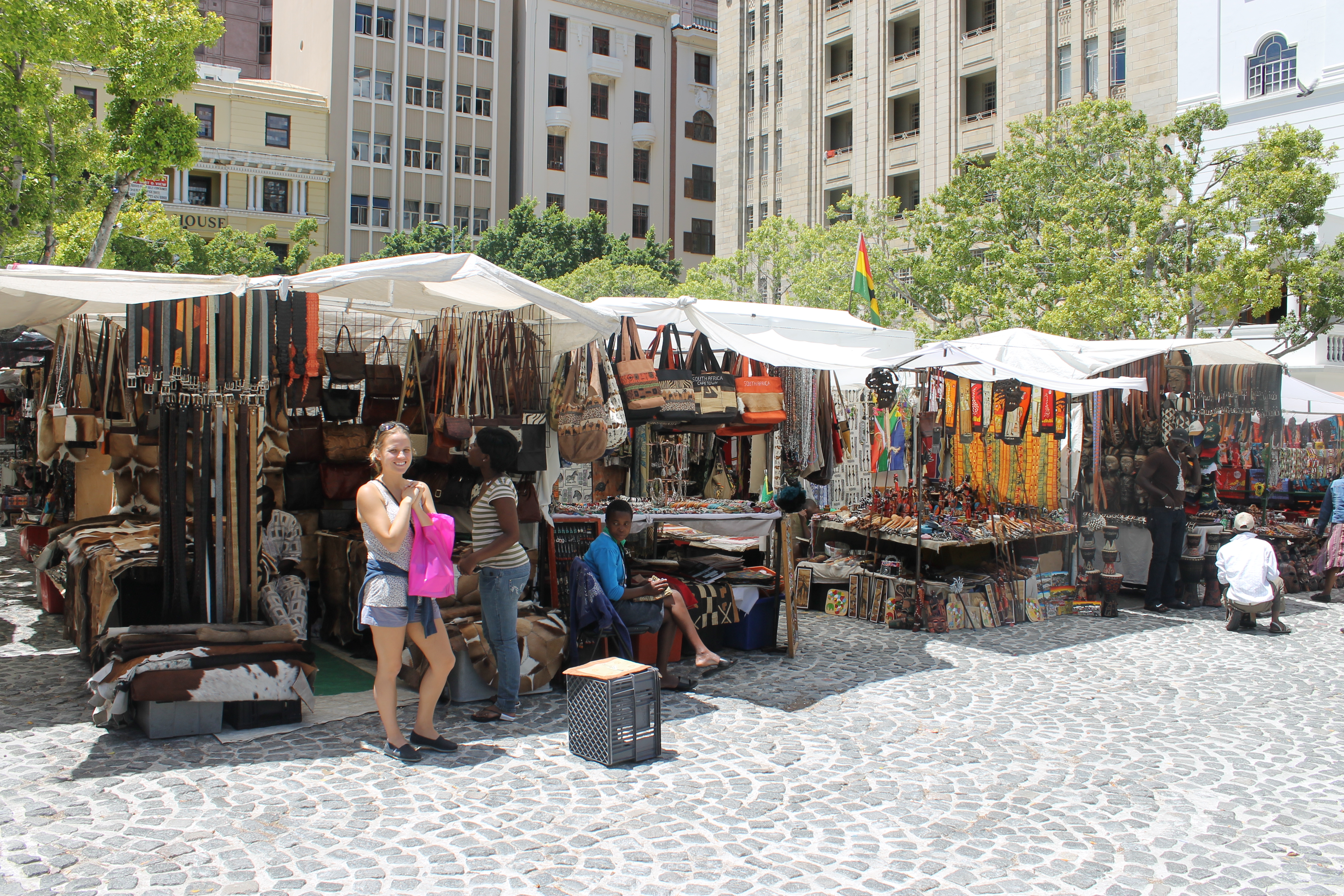
Caroline at Greenmarket Square
A bill was passed in the South African parliament yesterday that is quite controversial and would basically enable corruption by making certain issues “state secrets” and “matters of national security,” preventing investigative journalism. It’s been all over the papers here. The BBC also had an article on it.
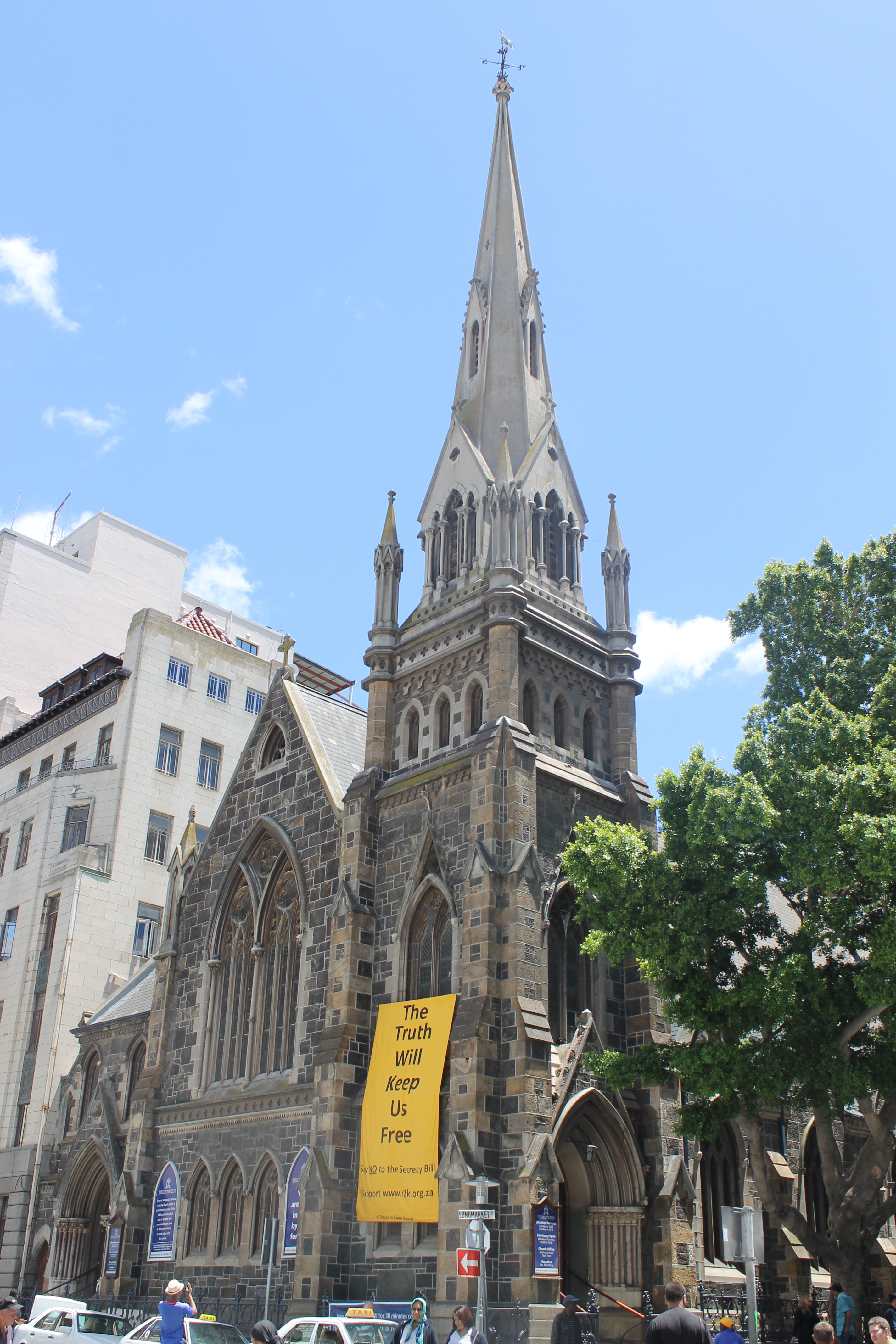
A church near Greenmarket square, stating their opinion on the bill
We then explored St George Cathedral, at the top of Government Avenue.
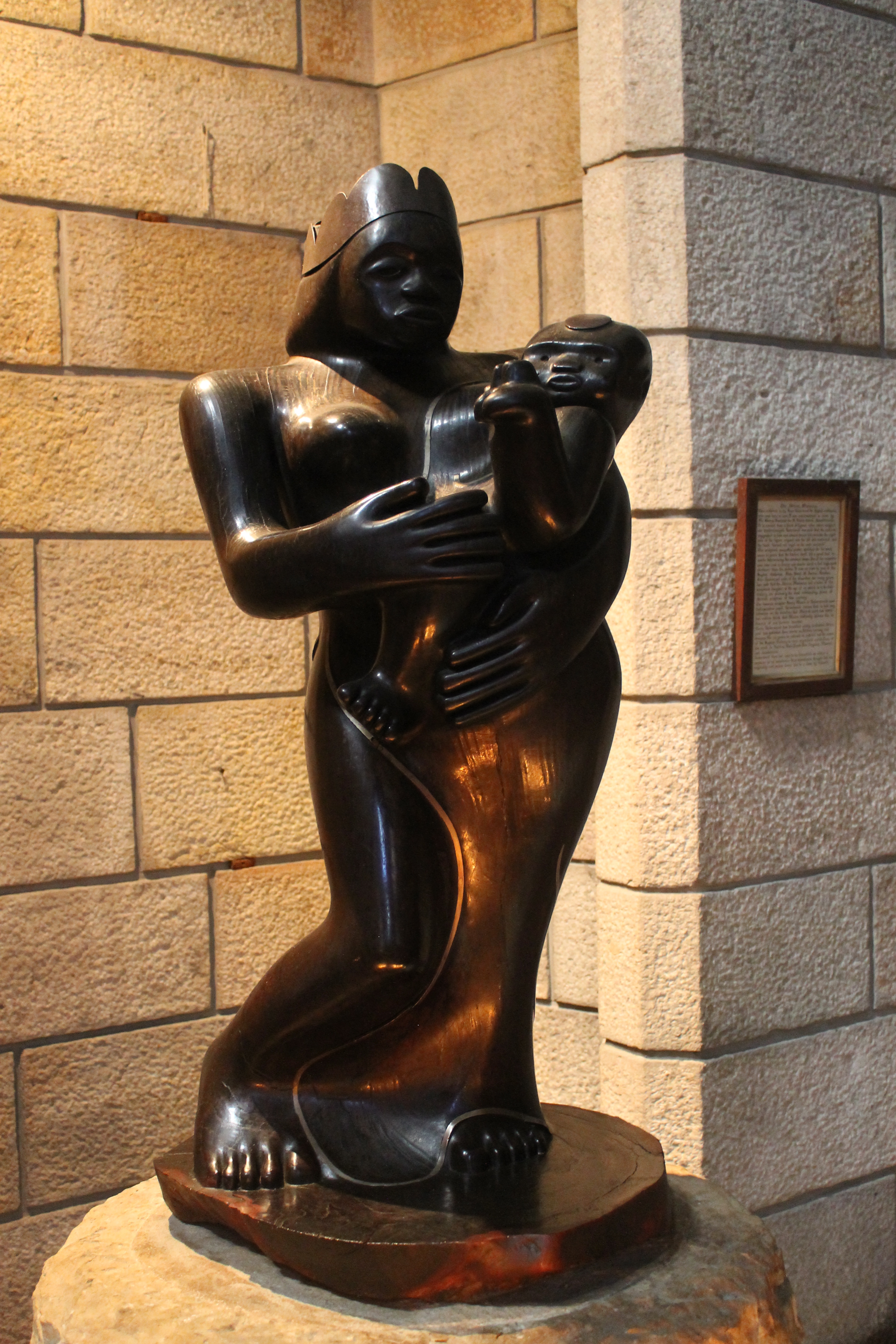
African Madonna and Child statue at St George Cathedral

COP 17 Poster in St George Cathedram
The Cathedral also had an exhibit on Apartheid, which was very interesting. I was surprised to see a member of The United Church of Canada’s Partner Council in one of the photos on display. Farid Esack, the only Muslim member of our Partner Council, was in Toronto in September and delivered a thought-provoking and challenging lecture at Beit Zatoun, partially on the similarities between South African Apartheid and the current situation in Israel/Palestine. And now that I’m here in South Africa, seeing and experiencing the history of Apartheid, I totally understand why individuals and organizations use the term Israeli Apartheid.

Day 1 in Cape Town
Too tired to actually write so will update this tomorrow, but here’s some photos of Langa and Khayelitsha townships in Cape Town.
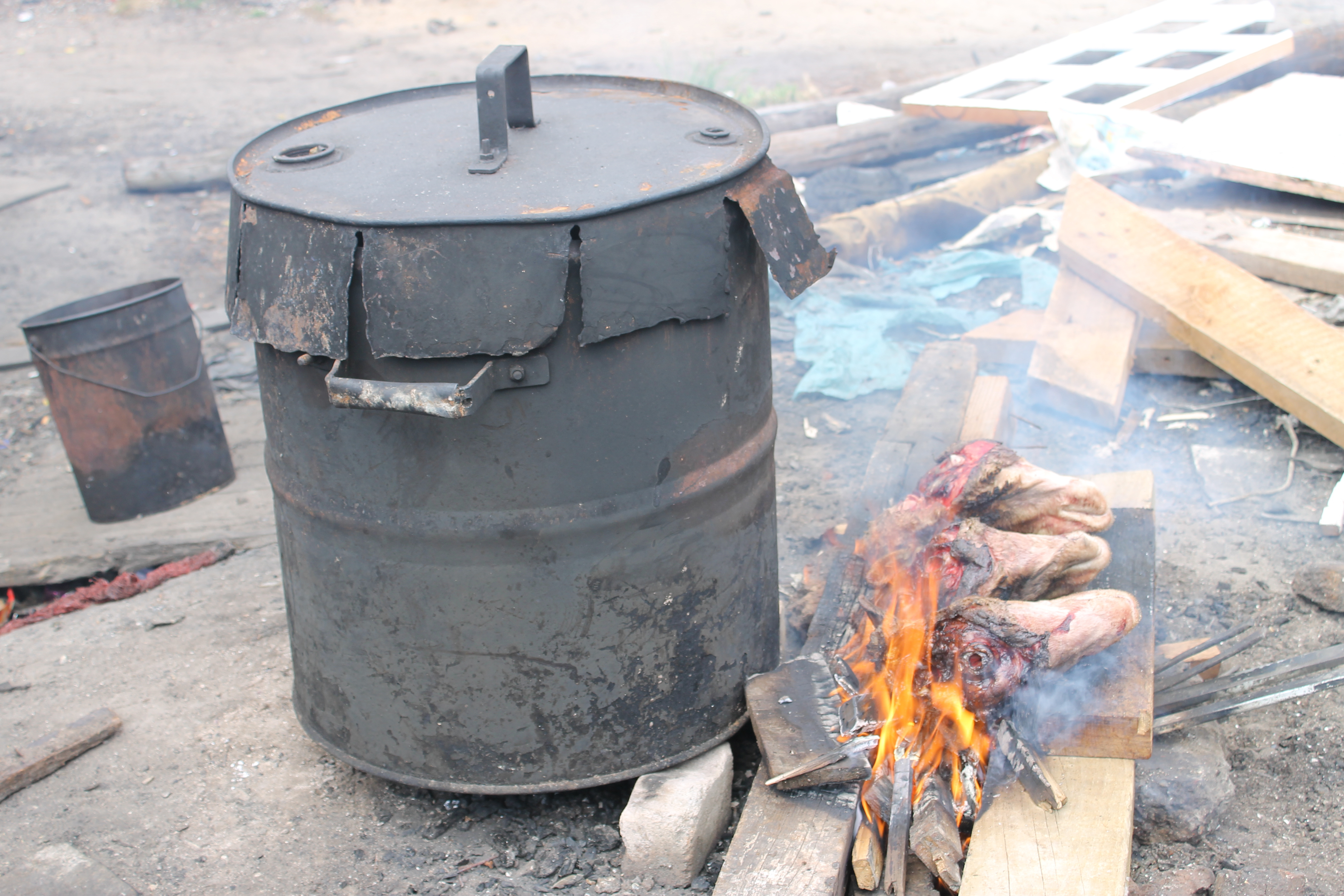
This very nearly made me vegetarian – sheep heads

Boys in Langa playing checkers

I love the girl going to town on the drums for a song and dance at the local kindergarten

A woman walking by solar-powered houses in Langa

A typical shack in Langa

Langa

Girls skipping rope outside “the world’s smallest hotel” in Khayelitsha, Ms. Vicky’s

Ok, so now I’m definitely vegetarian

Leaving Khayelitsha
Update: The township tour was really great, but it was also very weird. When I was on safari in Kenya and Tanzania, we visited a Masai village, and one of the girls said she felt like we were in a human zoo. And that’s kinda how I felt that day. I expected that that might be an issue when I booked it, but at the same time, I didn’t want to go to Cape Town and just see the touristy parts of the city, and not the residual effects of Apartheid.
I asked our tour guide, who was from Langa township, how the residents felt about these tours. And he said that, in the past, there were issues with these tours because people from outside the townships gave them. But now, local residents, like him, gave the tours, so the money goes back into the community and gives local residents jobs. And I get that, and that’s great, but at the same time, I feel like, if I was in their position, I would feel like some of my dignity was taken from me. Maybe that’s not a politically incorrect thing to say, but when Toronto started tour buses and they went through U of T campus, I felt a bit like, “Observe the students in their natural habitats” and that was just when people were on buses, not actually wandering through my community. So yeah, it felt weird, but I felt extremely lucky to see another side of Cape Town.
The tour took us to two townships – Langa, the oldest township in Cape Town, with 100,000 residents, and Khayelitsha, the biggest township with over 1 million inhabitants. We visited local residents in different types of accommodation (hostel living, shacks, and government housing), and visited a local pub where we tried some beer. It was very sweet – but still good, and was apparently based on Irish poutine (essentially moonshine), which was interesting because I’m Irish. I’ve never had poutine, but I think I had some form of moonshine in Rwanda. Anyway….
We also visited a local kindergarten, as you can see from the photos. The kids were SO cute and they danced and sang for us. I brought some pencils, erasers and postcards of Canadian animals for the kids, so I gave them to the teachers to share amongst the kids, which they seemed to like. I was happy with that, because I’m never really sure about giving things like that, from a justice perspective. And then I made the mistake of picking up and hugging a little girl who came up to me with her arms outstretched. 🙂 That then resulted in a mob of kids surrounding me, all wanting to be hugged and picked up, and my tour group had already left the kindergarten, so they had to wait for me. I felt bad not being able to give every single kid a bug hug, because I had to leave, but I managed to at least group hug most of them. And they were so cute – I hope I brought a tiny bit of excitement to their day.
I also got talking to one of the women on the tour who was from South Africa. I told her that I worked for the UCC, on poverty, ecology, and advocacy, and that I’d done a lot of work on human rights issues, particularly in Africa. She told me that she could tell – that she saw that I looked at the township through a different lens, and was less shocked by the things I saw, compared to other people. At first I wasn’t sure if that was a good or bad thing – because I work in this field, I sometimes worry about getting desensitized to the issues I work on. For example, I rarely cry when I watch documentaries or movies based on real-life atrocities (I do sometimes, or at least I tear up), but the end scene of Homeward Bound always does me in. I know, pathetic. But I think she meant that comment a bit differently – that I don’t look at poverty issues with horror, but with a justice lens, and see the individual people and their lives rather than “people living in poverty.” At least I hope that’s what she meant.
And lastly, a BIG shout out to my good friend Sarah and her husband Jon, who had a baby boy, Jacob Michael, on November 21. Can’t wait to see him when I get back!! Love to the three of you! xxx
Occupy London!
From the heavy & political to the light & fluffy, that’s how yesterday went. It began with a trip to Occupy London. After visiting Occupy Calgary last week, I was pretty excited to see what London had to offer. And I was not disappointed. I heard that the day before (I guess that was Friday?), the occupiers had all been served with eviction notices. But everyone seemed in good spirits, and there were lots of people visiting and talking with the protestors and bringing them food.

Occupy London!

Fitting signage

Police chatting with a protestor
My cousin (who lives in Ireland) was with me today, so after Occupy, we spent our time rather frivolously, wandering the streets, shopping, and drinking a glass of mulled wine at the Christmas market in Hyde Park.
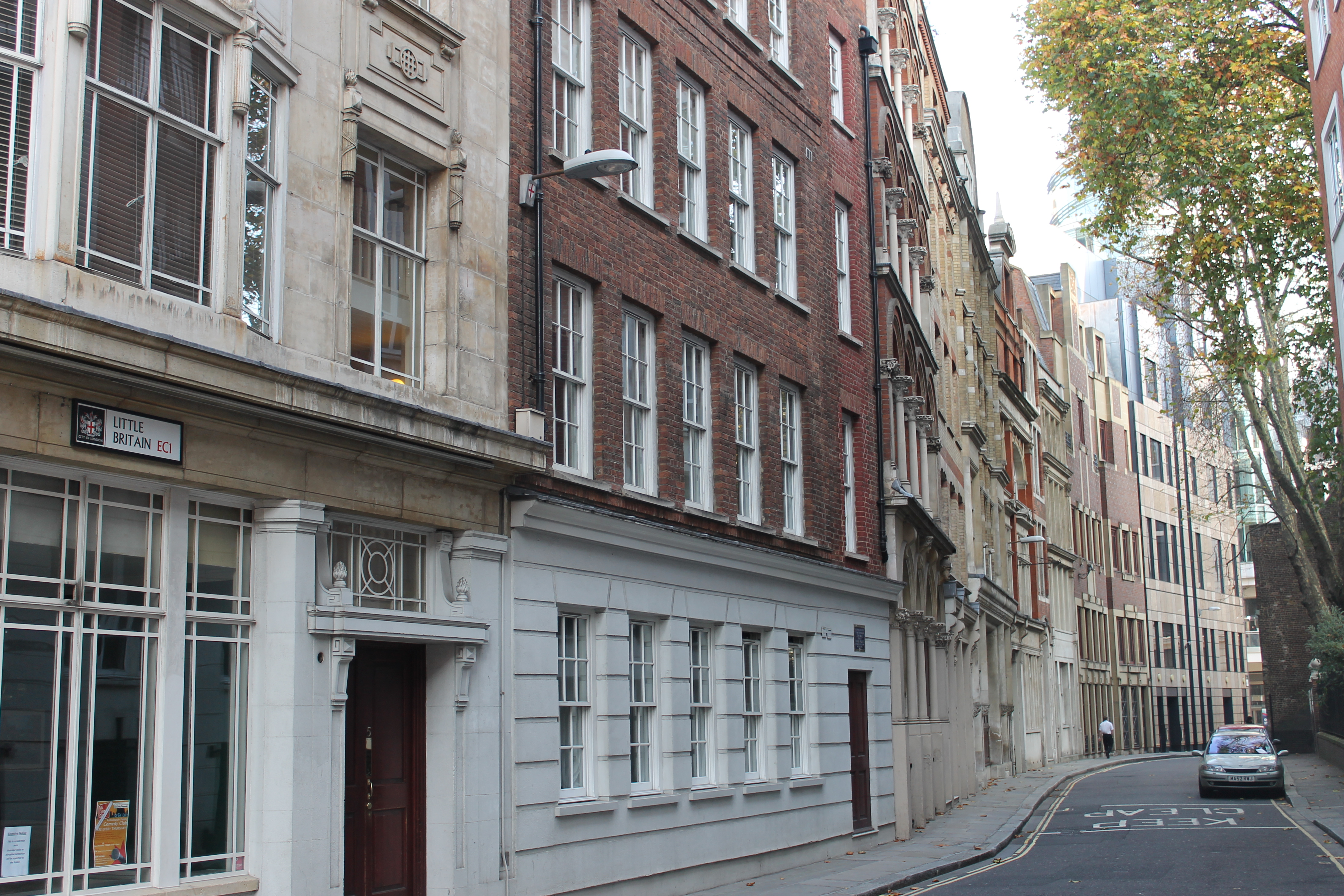
Little Britain??
Last night, the two of us were joined by 8 of my friends for dinner and drinks in Soho. Dancing the night away, it was a great way to say goodbye (again) to London, as I prepare to face some very serious issues in South Africa.
Until then, Cheers!
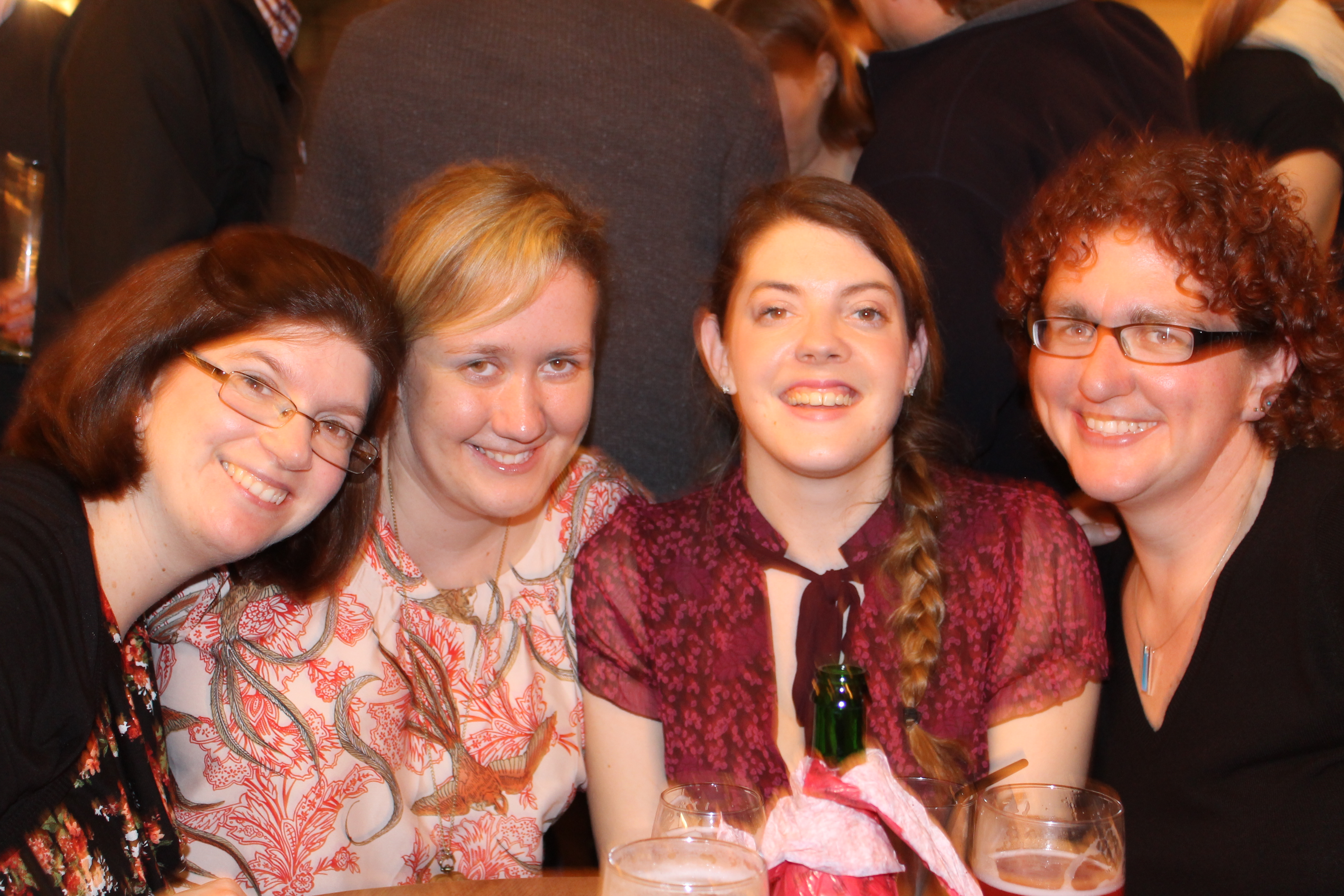
Four of us out at a typical British pub
Day 1: London Calling
And now for my first actual post, though it’ll be more pictures than words b/c I’m way too tired. Arriving back in London, for the first time since I moved back to Toronto in June after 2.5 years of British living, was quite weird. It felt so surreal, like I was in a dream and had just wished to go back to London, so here I was.
The early darkness and Christmas lights everywhere probably didn’t help. But it was gorgeous.
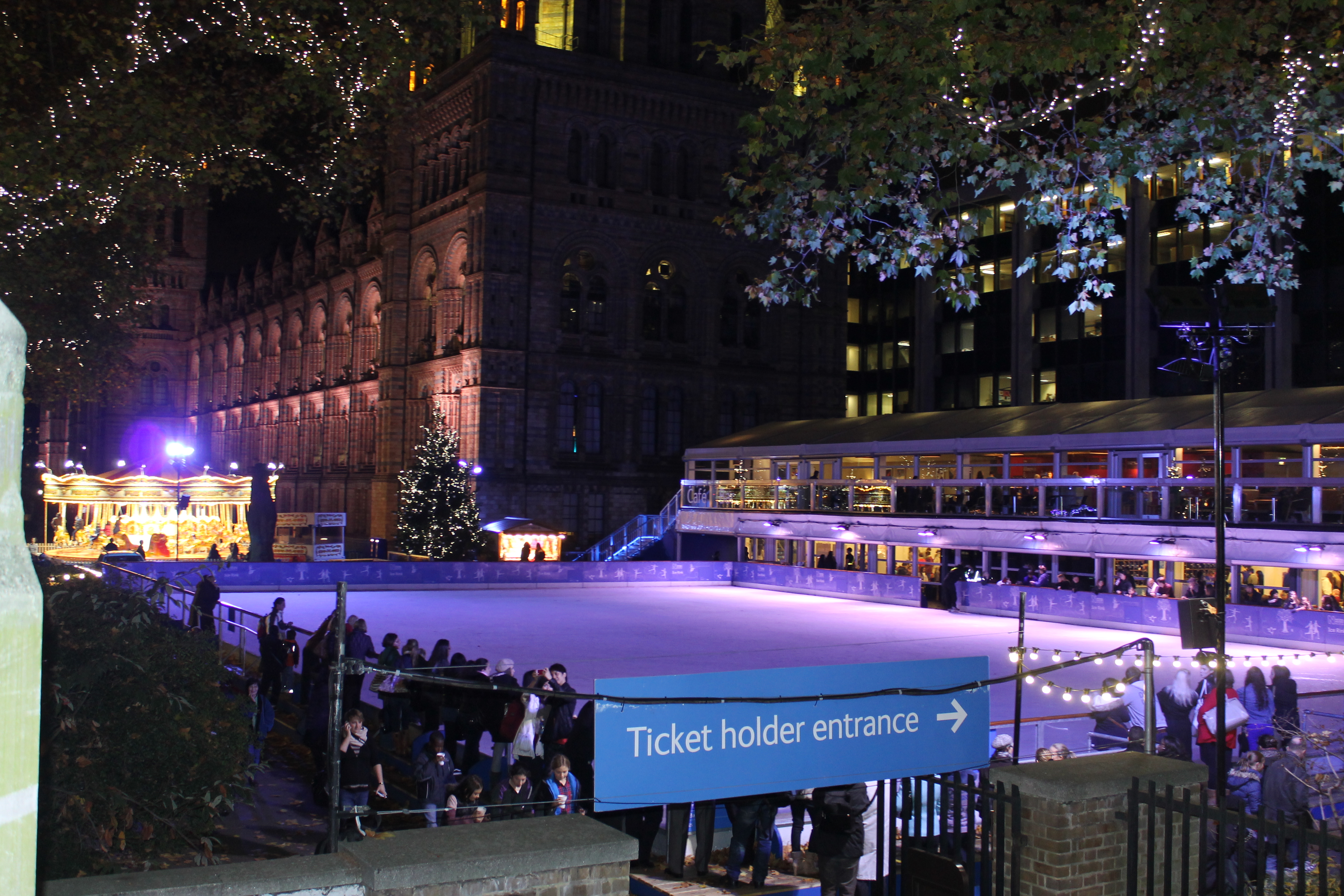
Natural History Museum decked out for Christmas
Two things accomplished today:
(1) Consuming a Hummingbird Bakery black-bottom cheesecake cupcake. De-lish.
(2) Had an amazing dinner at Jamie Oliver’s Italian restaurant in Covent Garden with my two former flatmates.
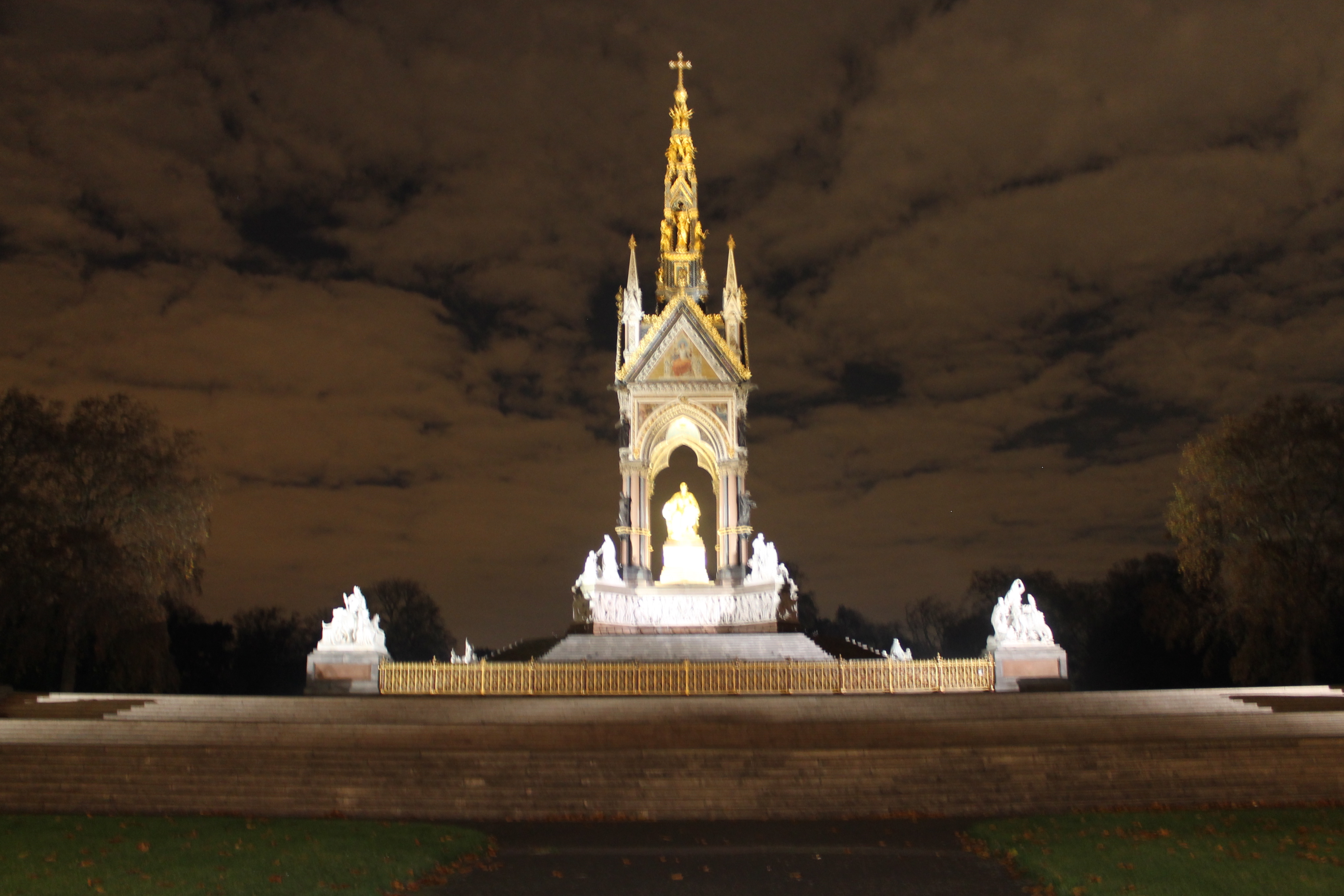
Albert Memorial at Night
I love the Dickensian feeling to this photo (above). Thought I think Dickens died before this memorial was created…we’ll just ignore that fact for now.
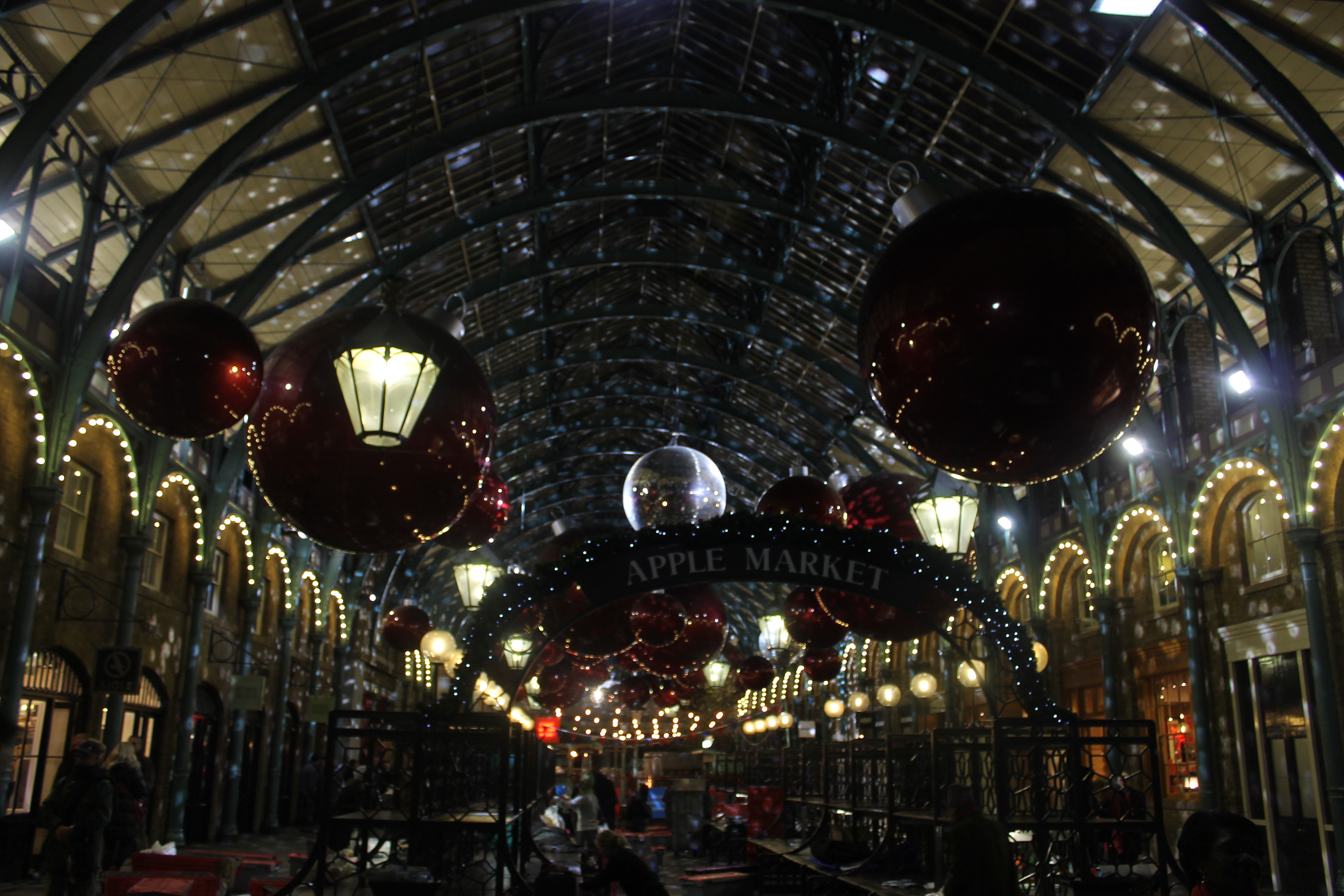
Covent Garden ready for Christmas
Welcome to my blog!
Hello everyone! Welcome to my blog. I decided I should blog about my trip to Durban, where I’ll be participating in the “Youth for Eco-Justice” program. This is a transformational training program for young Christians aged 18-30 years. Addressing the links between environmental and socio-economic justice, it is jointly organized by the World Council of Churches and the Lutheran World Federation in the context of UN climate negotiations in the latter part of 2011.
I’ll be stopping off in London and Cape Town before arriving in Durban on November 26. Stay tuned for more updates!!
The blog is back!
Ok, so it’s been about a year since I last wrote, but this is to officially announce that the blog is back!
Here’s a tidbit to get me started: Went to a club on Saturday night and security took my granola bar from Canada!! It’s those peanut butter nature-something (can’t remember the actual name) ones that they don’t sell here – they have the other flavours, but not the peanut butter one. So I keep one in my purse in case I miss dinner one night, etc. And they took it!! I said, “What if I’m diabetic?” and her response was “Do you have documentation?” Do diabetics usually have documentation? Maybe I should’ve gone with hypoglycemia…seriously, still miffed they took my granola bar!
Stay tuned for more fascinating anecdotes like that…
Reclaim the Night!
On Saturday night, Alex and I went to the Reclaim the Night march and rally. I was there representing the White Ribbon Campaign (and myself, of course).
When we arrived at Whithall Place, I was initially surprised to see so many police officers there. I thought, “what, do they think we’re going to get violent at an anti-violence against women march?”
It didn’t take me very long to realize that they were there to protect US. That was scary.
Alex and I saw many men (usually in groups) laughing at us as we marched through downtown London, bringing traffic to a standstill. One man stood at the edge of the sidewalk, frowning and staunchly thumbs-downing our march. A lad, being a little shit, ran up to us and stuck his butt out at us, saying something like “don’t you want to get some of this?” Another man, more aggressive, started running toward us and yelling “I’ve been on the other side of that!!” until a police officer stopped him. Of course, there are male victims of violence, but how does that fact make protesting violence against women (the VAST majority of domestic violence, rape, honour killings, female genital cutting, forced marriage, etc) any less valid or important?
Still, what we saw was nothing compared to what happened to the blogger Noble Savage, who was sexually assaulted during the march:
Last night, I marched through the streets of central London with 2,000 other women and dozens of police escorts, holding a sign that said “End violence against women.”
Last night, I used my voice to chant and shout about sexual violence, unsafe streets and women’s rights.Last night, when I should have felt at my most powerful, most inspired and safest, I was sexually assaulted.
I had to stop typing there for a minute and make sure I’d written that right and that it wasn’t just a strange dream. But yes, I was sexually assaulted at a march protesting sexual assault. How’s that for irony?
As we came through Leicester Square, a man pushed his way abruptly past the barrier and with one swift movement of his outstretched arm, managed to push me backwards and roughly grab my breasts at the same time. I swung at him with my right hand but he’s already stormed past so I only made contact with the back of his shoulder before he disappeared out the other side and down a side street. My friend Jen and I looked at each other in disbelief and shock. I hadn’t seen him coming until he was centimetres away and before I noticed the arm coming at me, what I undeniably saw was a face riddled with disgust and anger.
He, along with the man who had spit towards us earlier, and the one who had stood on the side shouting “Boo! Boo!” with his thumbs and his mouth turned downwards, and the significant number of men I saw mocking us — laughing, rolling their eyes and grabbing their crotches — were obviously disturbed by our presence. Perhaps we were reminders of violence they had perpetrated themselves, or a catalyst for the potential violence bubbling within them, just beneath the surface, like a nearly-boiled kettle. Maybe they felt threatened by our numbers and our voices and our demands. Maybe they were scared.
But whatever the reasons for their animosity, they will never know what it’s like to be scared of being humiliated and violated, in public, by people who feel they have a right to our bodies, our smiles, our time and our compliance. They will never know what it’s like to trade stories, with friends of the harrassment, abuse, assault and violence nearly each and every one of us has experienced, some of us in many different ways. They will never understand that we call these ‘war stories’ because every day is a battle and we are tired of feeling like soldiers, fighting off an enemy that has the better, more powerful weapons. They will never experience life and humanity the way we experience life and humanity because their view is unobstructed. They stand on the shoulders and backs of so many people, so many women, to survey their kingdom and claim rights to us, its spoils, with indifference and greed.
It’s disgusting. That’s about all I can say. These men are obviously threatened by 2000 women who refuse to back down in the face of gender-based violence. The actions of these particular men only reinforce how important feminism and organisations like the White Ribbon Campaign are.
 Kaitlin Geiger-Bardswich