
This gallery contains 15 photos.
A selection of some of my favourite photos from Pride. For more, see my Flickr album.
Jul 1
This gallery contains 15 photos.
A selection of some of my favourite photos from Pride. For more, see my Flickr album.
It’s currently World Pride in Toronto and it is FABULOUS. I’m celebrating by attending concerts, lectures, drag shows, readings, and parades. But last night I did something to personally celebrate: I came out yet again. This time, it was to one of my former high school teachers.
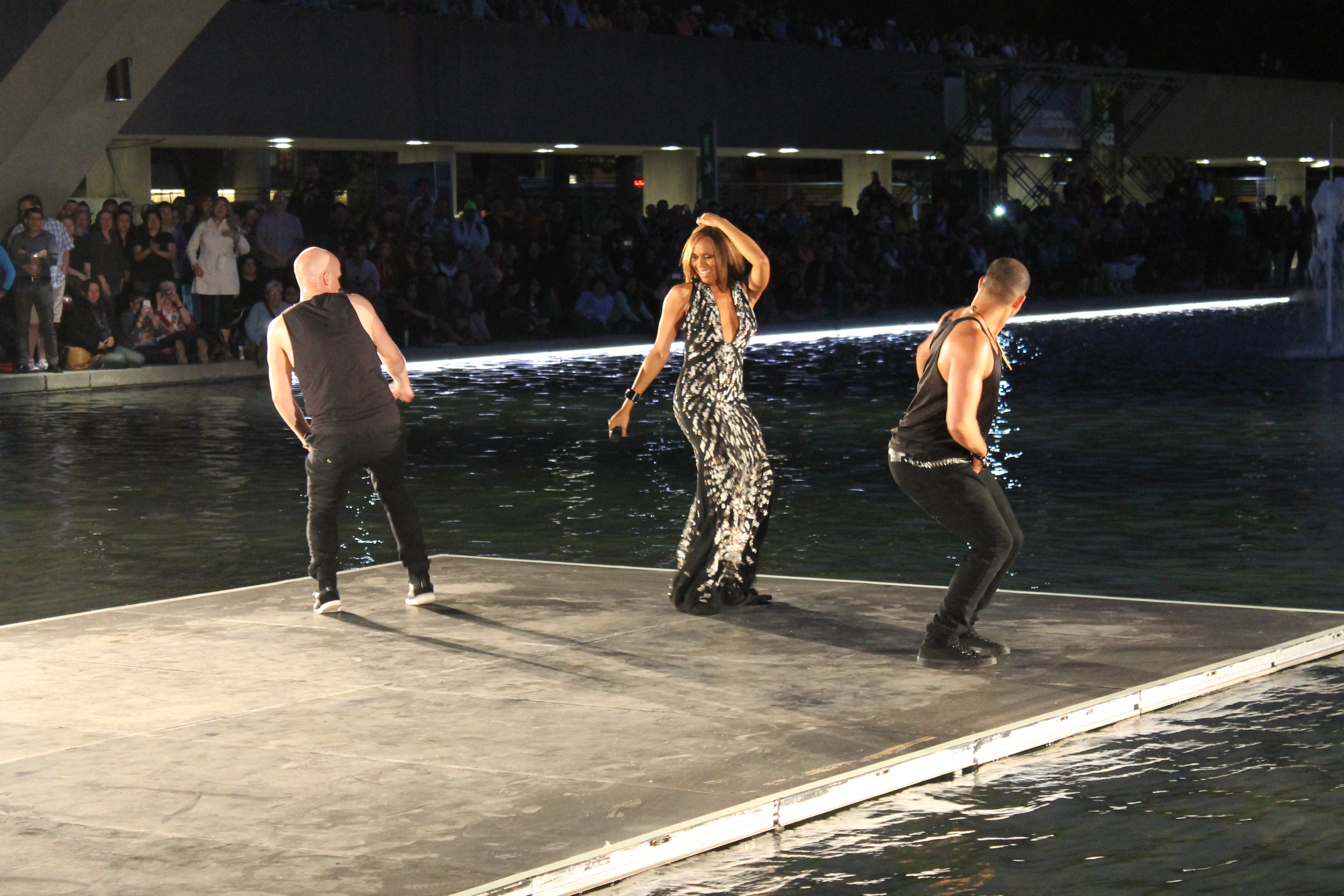
Deborah Cox performing at Nathan Philips Square during the Opening Ceremonies of World Pride
Sometimes I forget that being queer means having to constantly coming out to people. Whether it be my dentist (“no….I don’t have a boyfriend”) or my hairdresser (“yeah, I don’t really have any interest in 50 Shades of Grey”) or my colleague (“well, if I get married it won’t be to a man, so….”), it always starts off the same way. I get that feeling of momentary panic where I think, this person doesn’t know. How will they react? Do I even give a shit if they don’t react well?
Last year, I had my last run in with my past life in high school.
It was like a mini-high school reunion. I’d prepped myself to encounter about a dozen people that I hadn’t seen for nearly 10 years. People whose lives I’d maybe glimpsed as they flashed by on my Facebook newsfeed.
My friend was still good friends with the bride, who we’d both gone to school with. She was invited to the wedding and had a plus one, so asked if I’d like to go and keep her company. I agreed, and was looking forward to seeing some of my former comrades. But I was a bit nervous about one tiny yet extremely significant detail – I went to a Catholic high school; many of the people at this wedding I knew to still be devout Catholics, and here I was no longer Catholic, working for the, you could say, competitor of the Catholic Church in Canada – the largest Protestant church in the country, The United Church of Canada.
And I’d come out just over two years ago.
I’m very open about being queer – all my family and friends know, save for my grandparents for fear of giving them a heart attack. One of my aunts did want me to tell my grandmother, in case she said something homophobic in front of me. (My response? “Well, she’s actually more racist than homophobic, so maybe I’ll consider it if I’m actually dating someone and she’s not white. Otherwise, why deal with it now?”)
So I knew that this might come up, and that some of my former classmates might not have heard the gossip yet. (Because, really, why is this news?). I started talking to one guy, whose girlfriend was there with him, and as we chatted about life and our jobs and how we’d been doing, the inevitable question came up.
“So, what about you? Are you seeing anyone?”
And now the fun began. What would I say? Would I lie? No. Ok then, how would I do it? Would I say, half-apologetically, “weeeeeeell….I’m kinda gay now.” Would I just jump right in with, “Well, yes, actually I’m dating this great girl and…” Or would I have a little fun with it, drag it out until I finally had to use a pronoun or give a name?
I went for somewhere in between. Basically telling him I’m gay, without any half-apology, and that I am dating this great girl right now. End of story. (well – I’m single now, so there is more to that story, but for another time)
His response was very interesting. I think he was kind of shocked, but tried to cover it well. I told him that everyone had been very supportive, and he agreed that that’s how they should be. And then he launched into this slightly-hard-to-follow monologue about people he knew when he was living in Seattle. First, it was about the gay men he knew who chose to be chaste. (Great. So why are you telling me this?) Then I talked about having faced some discrimination (he was shocked by this. “Really? In Canada?” he asked) but that I wasn’t too worried about being attacked in the street for being gay, because it seemed like homophobic men were more likely to beat up other men over that issue. So then he launched into anecdotes about how the men he knew back in Seattle were often more flamboyant and in-your-face than lesbians generally are. (Riiiiiight….?). And then came the kicker:
“Well, y’know, I feel like I’m a sinner, everyone’s a sinner, so why should I judge others? I wouldn’t want other people to be commenting on my sins.”
Seriously?!?
I looked at his eager face, spitting out these overcompensating ramblings that obviously came from a place of discomfort. He was so sure he was being open-minded. Generous, even.
“Well.” I said. “I think the problem there is that I wouldn’t consider it a sin.”
“Oh, right, sure, maybe you wouldn’t…” And the rambling began again in earnest.
I tuned him out, imagining better comebacks in my head but also just wishing that my friend would come save me from this entire situation.
************************************************************************************************
And so here I was again, coming out to someone from my past. This was one of my favourite teachers in high school, who I had kept in touch with since graduating, but who I hadn’t spoken to in a couple of years. I’d wanted to, but honestly I was scared. Scared of rejection or of being treated differently by someone I admired and looked up to while growing up.
This past weekend, I’d had my prototypical stress dream which involves going back to high school, while still being in university or working or whatever (basically I’m told that I haven’t technically graduated and have to go back to complete two courses, and then of course don’t go because I’m working or studying or living on another continent). I’d actually had a similar dream months ago, in which this teacher featured, and I’d started a draft email to her but never actually sent it. This time, spurred on by Pride, I decided to do it.

Melissa Etheridge, at the Opening Ceremonies for World Pride, told us that coming out was the best thing she’d ever done. I agree.
I started by apologizing for not having written for so long, and then jumped right into it:
Honestly I think I’ve been putting off writing to you because I’m scared of rejection. So let’s rip off the bandage – I’m no longer Catholic and I’m gay.
I’m thinking neither of those things will be a huge surprise to you. 🙂 But there’s always a small piece of me that fears a negative response to either of those things, because I have experienced that. But hey, it’s World Pride and it’s all about being proud of who you are, right?
And then I added some more about life and what I’m doing now. And signed off, putting my phone number at the end.
Then this morning, at about 8.20 am – which was ironically when high school used to begin – my phone rang. And it was this teacher! She immediately told me I was being silly and that of course she didn’t care about any of that, but she understood why I might be worried. Because people are ignorant, but that’s their problem and has nothing to do with me.
Of course, I knew all of this already – and was pretty sure this was how she would respond – but hearing it from her in person (or over the phone) was so affirming and wonderful and lovely. I was on a high all day, feeling accepted and supported and loved.
Sure, I should feel like this regardless of what other people think, but it can be hard. World Pride is a wonderful thing, but there are still protests – albeit small ones – that I’ve seen, telling people like me to repent or face going to hell.
So I’m going to take all the good news and happiness and support I can get! Happy World Pride everyone!! 🙂
Calling people out is an important and necessary act, but it’s also really difficult. I’ve been on both sides of the equation – the one being called out and the one doing the calling out.
I think it’s especially difficult in advocacy or justice circles, when you’re dealing with people who are pretty well-versed in anti-oppression work and/or who might feel that they know everything there is to know and are above making racist or sexist or homophobic comments.
But the truth is that none of us are “above” that. We all make mistakes. We all live in a systemically racist, patriarchal and heterosexist society. We have sayings in our everyday vocabulary that we may not even realize are problematic:
“Lowest man on the totem pole.”
“I got gypped.”
“Hysterical woman.”
“That’s so gay.”
There’s a whole discourse around dark/light imagery and how the word “dark” or “black” is almost always used to denote something negative or evil.
“Black sheep in the family”
“The dark side of America”
And those are just some of the ones I hear people in justice work use, or that I’ve used myself flippantly in conversation.
A few weeks ago, I got called out. While I meant to say something along the lines of “don’t want to step on anyone’s toes,” instead I said, “don’t know who’s territory it’s in” because I was thinking along the lines of things being territorial, when it comes to different areas of work. Because sometimes in my workplace things get territorial, as they can in most workplaces.
And I got called out on it. The person I said it to phoned me afterwards and called me out. And I got that sinking punched-in-your-gut feeling. Because I was wrong. I’d made a mistake. But even worse than that – I hadn’t even realized it.
We all make mistakes, and I’ve made my fair share of them, but I’ve started to at least recognize when I say something with racist undertones, especially in an Aboriginal context as I try to move towards Right Relations. I don’t say “let’s have a pow-wow” or “the lowest man on the totem pole” anymore because I know better. I used the totem pole expression while I was at the Truth and Reconciliation Commission last month, and as soon as the words left my mouth I realized what I had said. And I apologized profusely; the person I’d said it to was very gracious, saying we all make mistakes and that these problematic sayings are embedded in our culture. That doesn’t make it right – that doesn’t make it ok – but it also doesn’t mean that we’re inherently racist – or homophobic or sexist – for using these expressions. It just means we have something to learn.
Ironically, I had this link opened in one of my tabs on my work computer. I saw it again a couple of hours after my communications blunder, as I was going through my ever-increasing open tabs, closing those I no longer needed (yes, I’m one of those people who opens a new tab when I see something interesting, and then often forget to go back to it). It’s an article about calling people out and how to do it well; it links to a video that talks about the difference – and importance – of talking about what a person did rather than what a person is. “What you said was racist” versus “you’re racist.”
And I know all of that. So why, when I get called out on something, do I automatically jump to the “I’m a horrible person!” response? I’m not a horrible person. Few people are horrible people. I can be thoughtless – which I was today. I can be moody or tired or a whole range of things. But they don’t make me a bad person.
And the person who called me out is definitely not a bad person. Nor am I when I call other people out. Sure, I felt badly today when this happened. I felt hurt, and it was not because the person calling me out hurt me. No, I hurt myself. My thoughtlessness hurt this person – made them feel uncomfortable – and knowing that hurt me. I hurt me, and I have to take responsibility for that. And a little hurt is a small price to pay for a great learning, a learning about being more sensitive to the language I use.
I’m grateful to my colleague, my friend, for being brave enough and secure enough in our friendship and our professional relationship to call me out. I’m sorry for my thoughtless comment in this instance, but even moreso for the thoughtless comments I’ve likely made in the past – for the times my language has hurt other people and I haven’t even known it. Language is a powerful tool. And like all powerful things, it’s something we need to take care with.
It’s never a good sign when the Q&A is exponentially more interesting than the actual movie. On Friday, the first movie I saw was Bintou, a film about a young seamstress in Burkina Faso who works mainly for white ex-pats.

The poster for the movie
I was interested in this movie because I, as a white Westerner, have gone to Africa and had clothing made for pretty cheap prices. I recognized myself in parts of the movie.White people don’t haggle over prices, for example, Bintou explains. No, we don’t, because they’re so much cheaper than what we’re used to.
But the movie itself fell fairly flat. The director, Simone Catharina Gaul, said they’d shot about 80 hours of footage and edited it down to this one hour. It was basically about Bintou’s life, the unusual living situation with her daughter, and the “secret” around her daughter’s birth, which is never fully revealed. What I would’ve wanted – and this is what I saw in most of the excellent movies at Hot Docs I saw this year – was the social commentary.
When I was in Zambia, I bought a bunch of fabric in the local market (my host, my former boss who has retired back to her homeland of Zambia, actually told me to stop buying fabric at one point, half-jokingly. But it was all just so beautiful). Then we went to a seamstress that my host and her family used quite often, and who they bring tourists to, and I had a few outfits made. And they’re beautiful. But I don’t know anything about this woman except for, really, her name. Margaret.

My suitcase of clothes made by Margaret
During the Q&A, Gaul spoke about the white ex-pats who go to seamstresses like Bintou and don’t seem to be interested in the people who make these clothes. The Westerners are just going to get a dress for $6, as she puts it. They wanted to give Bintou a voice – which is why they gave her her own video camera to shoot her own footage, which also appears in the film.
Gaul also spoke about some of the difficulties of filming in the country. In West Africa, she explained, people are suspicious of WHite people taking photos or videos because of previous bad experiences. They’ve experienced people taking photos and then suddenly when they go back to their home countries and need something to illustrate “HIV in Africa” or “starvation in Africa,” any photo with Black people in it will do.
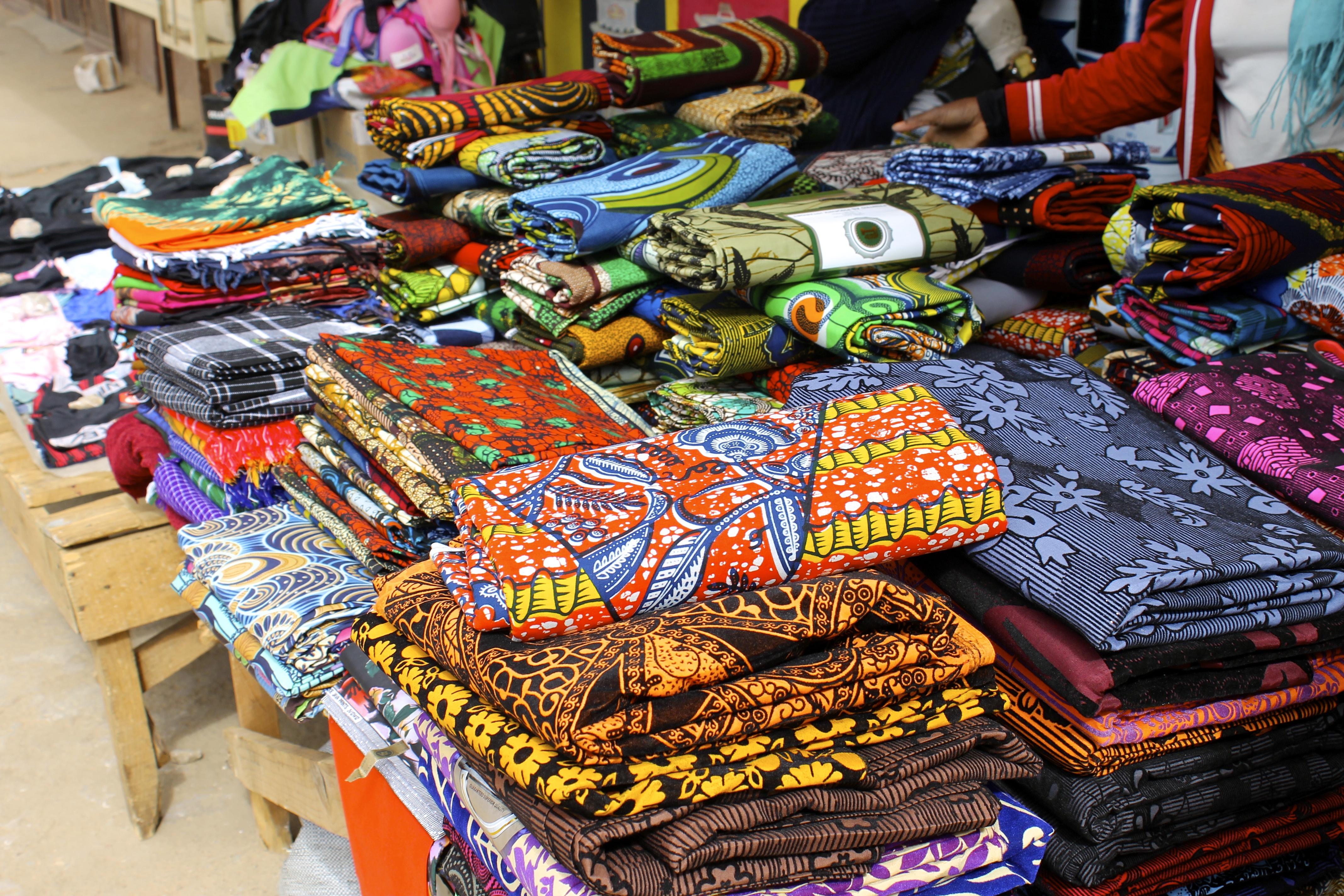
Fabric in a Lusaka market
But none of these very important issues came through in the film. It was a nice little story about a young woman in Burkina Faso, but there was no “oomph”; it wasn’t compelling. And from what I heard on my way out of the theatre, others agreed with me.
Oh well. They can’t all be gems.
Verdict: 3/5
On Tuesday night, I saw an amazing documentary called Watchers of the Sky. It was about the history of genocide and pays particular attention to Raphael Lemkin, the “unsung hero” who coined the term “genocide” and pushed for it to be recognized as a global crime by the United Nations.

The director, Edet Belzbeg, approached the film from the perspective of four main characters – Samantha Power, US ambassador to the United Nations; Luis Moreno Ocampo, former Chief Prosecutor with the International Criminal Court; Benjamin Ferencz, a prosecutor at Nuremberg; and Emmanuel Uwurukundo, a Rwandan UN refugee officer working in Chad. The fifth character, who has inspired them all and knits the narrative together, is Raphael Lemkin.
It was a movie that had a lot of resonance for me. I’d been to Butare in Rwanda, where some of the scenes with Emmanuel Uwurukundo were filmed. While working for Aegis Trust in London, UK, one of the alleged war criminals we “tracked” was Ratko Mladić, who was largely responsible for the massacre at Srebrenica and who features in this film in archival footage. And of course, I’ve loved Samantha Power’s book, A Problem from Hell, which was the inspiration for this film.
Technically, there was one thing that distracted me in the film – the use of subtitles for people speaking English (who had accents), but not consistently. Sometimes the subtitles would only be used for parts of the sentence, for example. It was a bit weird.
But another technical element that did impress me was the use of original archival footage, including a lot of footage that I’d never seen before, especially from the former Yugoslavia in the early 1990s.
This film raised a lot of questions for me in a mind that hasn’t had a lot of opportunity lately to delve into this kind of content and intellectual activity. One thing that struck me while watching the film is when Ocampo speaks about the disappearances in Argentina and how “the numbers weren’t there for genocide.”
But do the numbers really matter?
This reminded me of the time I met Stephen Lewis after an event honouring his wife, the incredible journalist Michele Landsberg. We got to talking about Rwanda, and I told him about the research I did for my Masters dissertation, on the rights of children conceived through rape during the Rwandan genocide. At one point we started talking numbers – number of children, etc – and I said something like, “Well, some NGOs estimate that if about 250,000 women were raped during the genocide…”
He interrupted me to ask, “Do you really believe that number?”
I was taken aback by this question. I hadn’t really thought about it before; I’d just taken it for granted. Yes, of course we should question numbers and try to get truthful statistics. But at the same time, does it matter what the numbers were? Is 25,000 women raped not enough? What about 5,000? What about 1? In terms of defining something as a genocide, the numbers don’t matter. It is about the intent to destroy, “in whole or in part,” a particular group of people.
Numbers don’t mean anything to the individual human beings on the ground, living through these situations.
In the same vein, it doesn’t necessarily matter to the victims if what they are experiencing is termed a genocide, or ethnic cleansing, or war crimes, or crimes against humanity. Or all of the above. Or none of the above.
Still, Raphael Lemkin worked so hard to have the concept of the crime of genocide codified in international law. And that is not insignificant. Sadly, he died alone, waiting for a bus, from a heart attack. Less than a dozen people attended his funeral. Nowadays, everyone knows the term “genocide,” yet we are often bogged down in semantics, arguing what is or is not a genocide. Often so that we – or our country – doesn’t have any obligation to intervene.

My worn copy of “A Problem from Hell”
There were shortcomings in this film. I would’ve liked to see a more nuanced perspective regarding the International Criminal Court. Following the Lubanga trial, for example, a few years ago, I saw what I interpreted to be blatant incompetence on the part of Ocampo and his colleagues on two separate occasions (perhaps that’s a story for another post). But a film can’t show everything – it needs to have a narrative, and it’s purpose is to make an argument.
This film was about connecting the dots. About making connections and seeing patterns, so that we can perhaps stop similar atrocities from taking place in the future. Lemkin knew how to recognize these patterns – the film speaks about his obsession with learning about historical acts of genocide, starting with the Armenian genocide. When things started getting bad in Europe, Lemkin went to warn his parents, begging them to leave with him for the United States (he arrived in 1941). But they refused to leave – not seeing that a government or army would want anything to do with them, this elderly couple in the Polish countryside. In the end, Lemkin lost 49 relatives in the Holocaust.
There was a beautiful narrative arch in this film – from Raphael Lemkin and his persistent attempts to have the UN recognize the crime of genocide to that of a modern day Lemkin, Benjamin Ferencz (the former prosecutor at Nuremberg) who is now similarly lobbying countries at the UN to recognize the crime of aggression in terms of war.
The film ends with Ferencz tearing up as he tells the story of an astronomer years ago who “watched the sky.” He spent 25 years observing the stars, trying to find the secret of the universe, and he didn’t. Someone asks him why he keeps doing it – when he will stop. After all, he already has 90 logbooks full of his observations. “I’ll stop when I hit 100,” he replies. “Why? What for? What are you achieving?” the inquirer asks. “We build on top of each others’ work. Maybe,” he explains, “I’m saving someone down the line 25 years of work.”
That, my friends, is the stuff of legends.
Verdict: 4.5/5.0
The EAPPI programme is a wonderful thing – an observer programme in the OPT run by the World Council of Churches and supported by The United Church of Canada. Check it out!
Today, the Presbyterian Church of Canada, one of our coalition of churches in Canada, shares why they participate in EAPPI.
 A group of EAs from Canada join Palm Sunday celebrations in Jerusalem. Photo EAPPI.
How did you get involved with EAPPI?
The Presbyterian Church in Canada (PCC) sent its first Ecumenical Accompanier (EA) to volunteer with the Ecumenical Accompaniment Programme in Palestine and Israel (EAPPI) in 2007, in response to the call from Heads of Churches in Jerusalem to stand in solidarity with the churches and people in Palestine. To date, 6 volunteers from the PCC have served as EAs.
What’s…
View original post 657 more words
I feel I am human.
– Justin/Pasha on living in Toronto for the past 6 months

Children 404 Logo; source: Wikimedia Commons
The second movie I saw yesterday was Children 404. Another heavy movie, but one well worth the watch. A film by Pavel Loparev and Askold Kurov, and co-presented by Cinema Politica, Children 404 tells the story of LGBTQ youth in Russia, a population made even more invisible by the country’s recent “gay propaganda” law. The film focuses on the stories told through the Children 404 project – an online community started by Elena Klimova, a Russian journalist who wrote a series of articles on LGBTQ youth in Russia last March. It is called Children 404 after the “Error 404 – Page Not Found” on the Internet, the idea being that these children are invisible in Russia, that some people don’t believe they even exist. So they are reclaiming their identity – bolding proclaiming “We’re here and we’re queer” (though maybe not in so many words).
In these months after the Sochi Olympics, the situation of LGBTQ rights in Russia has fallen somewhat off the radar. Even when it was on the international agenda, rarely did LGBTQ-identified youth have a voice in the mainstream media. And so it was incredibly interesting and important to hear from these youth themselves. We heard from a boy who lives in Sochi and describes it as a very homophobic city, who is humiliated every day and had to move from his mother’s house to another district where no one knew him. According to the directors, he doesn’t think anything has changed since the Olympics.
There were stories of youth being thrown out of their homes, of mothers telling their children that they wished they’d miscarried rather than give birth to a sick monster like them. There were stories of social workers and therapists blaming the LGBTQ youth for their own harassment – telling them, for example, that it is because they hate the homophobes that the homophobes hate them back. And that if they loved them, they would receive love in return <insert collective groan from the audience>. Elena and her partner share a bit of their story as well, and about how they were both fired from their job when their relationship became known.
The film also follows Pasha, a 19-year-old young man who is planning to move to Toronto to learn English, become a journalist, and realize his dream of having a family with a male partner. The scene where he sings the Canadian national anthem in his broken English (“We stand on guard for free!!” he sings joyously) inside Lenin’s Mausoleum is one of my favourites.
Pasha’s family is one of the only supportive ones we see in the film. His mother is incredibly loving and protective, and even his somewhat racist (they talk about him having “black children” with a “black woman” in Toronto, who they will then take fishing, etc) grandparents know about his sexuality and actively love him just the same. It made me tear up. A lot made me tear up.
But what really got me was when the Q&A reached its second or third question and it was revealed that Pasha was in the audience, as many of us suspected and hoped. As he came up to the stage, he received a long standing ovation. It was powerful.
He now somewhat jokingly goes by “Justin” as well, an homage to Justin Bieber (who Pasha mournfully refers to as “straight” in the film).

The Directors with Justin/Pasha (second from the left) during the Q&A
The words “fag” and “faggot” are used quite liberally throughout the film, as we witness the harassment taking place firsthand. It’s a jarring word, and one that I don’t usually encounter in everyday life. One of the most incredible things Pasha does during the film is create a poster regarding a social living index (I’m unsure which one he uses) that reads something along the lines of “Russia is 66th and you can’t be gay here. Canada is 2nd and gays can get married. Maybe we should start focusing on the important things?” He then stands in what I believe is the Red Square in Moscow, enduring the ensuing taunts. One man spits on him and calls him that horrible F word; both are brought to the police station and both are eventually released, Pasha believes, because the police did not want to deal with the other guy.
Many of the questions during the Q&A involved what we could do, here in Toronto, for LGBTQ youth in Russia. All three men – the directors and Justin/Pasha – said that talking about this issue is the most important thing we can do. “You can help us by talking about it,” Justin/Pasha explains. “The problem of children 404 is that society wants to pretend they don’t exist, so we need to bring them out into the open.”
Justin/Pasha will be at World Pride this summer. He is one of the lucky ones, able to get out of Russia. As he repeatedly tells the audience, it’s impossible for 99% of these teenagers to move to a country like Canada. They need money, they need a visa. He hopes that the Canadian government will learn about the issues facing Children 101 and will begin to support them in immigrating.
Last night was the international premier; it was an honour to be one of the first audiences to see this impressive documentary. It did have a small showing in Moscow earlier, the directors told us. It must’ve been only days ago, as they also said they finished the film only the week before. As the screening in Moscow was about to start, Orthodox activists broke into the room with weapons and police, trying to find minors and accuse the non-minors there of gay propaganda. The police checked everyone’s documents; there were no minors there, and the audience chanted “We want to see the film” while the search went on. The directors don’t know what the repercussions will be for having produced this film; they don’t know if it will become banned in Russia. Children 404 became available online last night in Russia, after the screening took place in Toronto. Hopefully many Russians will see it; hopefully it will have an impact.
As Elena said in the film, changes in society’s viewpoints are inevitable. 60 years ago, things were much different in the USA, she says, referring to racial segregation in the South. “And what is 60 years? Only 2 generations!” she exclaims. Elena sees a future as an elderly woman, when children will wonder in amazement at the idea that gay people were discriminated against in her country. Her hope is inspiring – I too believe it is inevitable, but for the sake of the Russian youth struggling today, I pray it comes sooner rather than later.
Verdict: 5.0/5.0
Check it out – there’s three more screenings!
Nelson Mandela. Synonymous with reconciliation. Forgiveness. A grandfatherly figure, laughing and smiling (though perhaps not as much as Desmond Tutu).
Freeing South Africa. Creating the Rainbow Nation.
A comforting narrative. Not a controversial figure. Not someone who used violence to reach his goals, who was labelled a terrorist by the American, and many other, governments. Not someone who said that our freedom is bound up in the freedom of the Palestinians.
The second film I saw at the Hot Docs festival 2014 was titled Nelson Mandela: The Myth & Me, also known as A Letter to Nelson Mandela. This was not a love letter to Mandela. It was a critical look at the myth that rose up once he was released from jail and went on to become South Africa’s first Black president. As one of the interviewees put it, he wasn’t that genteel, benign grandfatherly figure. “He was cold.”
Because the reality is that Mandela was the epitome of the phrase “one man’s terrorist is another man’s freedom fighter.” He’s been called both during his lifetime, and he’s made the epic arc from being widely viewed as a terrorist to now being overwhelmingly considered a saint; in fact, few people would argue otherwise, at least in polite company.

Mandela’s cell on Robben Island, November 2011
This film, however, argues a more nuanced perspective of the man behind the myth. As write and director Khalo Matabane said during the Q&A after the screening, quoting the incredible Chimamanda Adichie, “It’s dangerous to have a single narrative. Mandela suffers from that, from the Western media as well as the media in South Africa.” For Matabane, this film was meant to provide multiple alternative narratives to the story of a man who is often only portrayed through a single lens.
And so he interviewed many diverse subjects – ranging from leftist activists to right-wing Conservative politicians (side note: when Henry Kissinger appeared on the screen, I wanted to boo and hiss. Same when Colin Powell described himself as essentially a peace activist who knew when to use hard power to get back to the bigger goal of peace. I did restrain myself). He interviewed people who believed that forgiveness was the ultimate goal – that the Truth and Reconciliation Commission in South Africa went about things the right way, and that Madiba succeeded in transitioning from an armed idealist to a politician who could birth and cultivate a healthy, thriving democracy.
But there were other interview subjects who saw things differently. Who saw things similarly to the way I saw them when I visited South Africa two and a half years ago. They spoke of the myth of Mandela as a hero and a god (which was telling, as only gods can forgive, as one interviewee put it). And that he’d bought into that myth and even encouraged it. One woman, who’s caption simply read “Feminist” below her name (and apologies but I don’t remember the name and there’s no list of interview subjects online that I can find), spoke of how the reality on the ground was much different from the myth. The myth says that South Africans are free, that they are so much better off than they were under Apartheid, when they were dying in the streets. “But depending on who you are,” she said, “people still are dying in the streets.”
South Africa is a country of extreme contrasts. It’s the most advanced African country when it comes to LGBTQ rights, and yet Black lesbians know the fear of corrective rape all too well. It has one of the most progressive constitutions in the world, yet it is also one of the most unequal societies in the world. This was starkly illustrated when I was flying into Cape Town from London at the end of 2011. Flying into the airport, when we got low enough that I could really see the houses, I saw grandiose homes, nearly every single one with a swimming pool. Then the homes became more structured, more box-like, and there were no more bursts of blue in their backyards. Finally, closest to the airport, was the township.
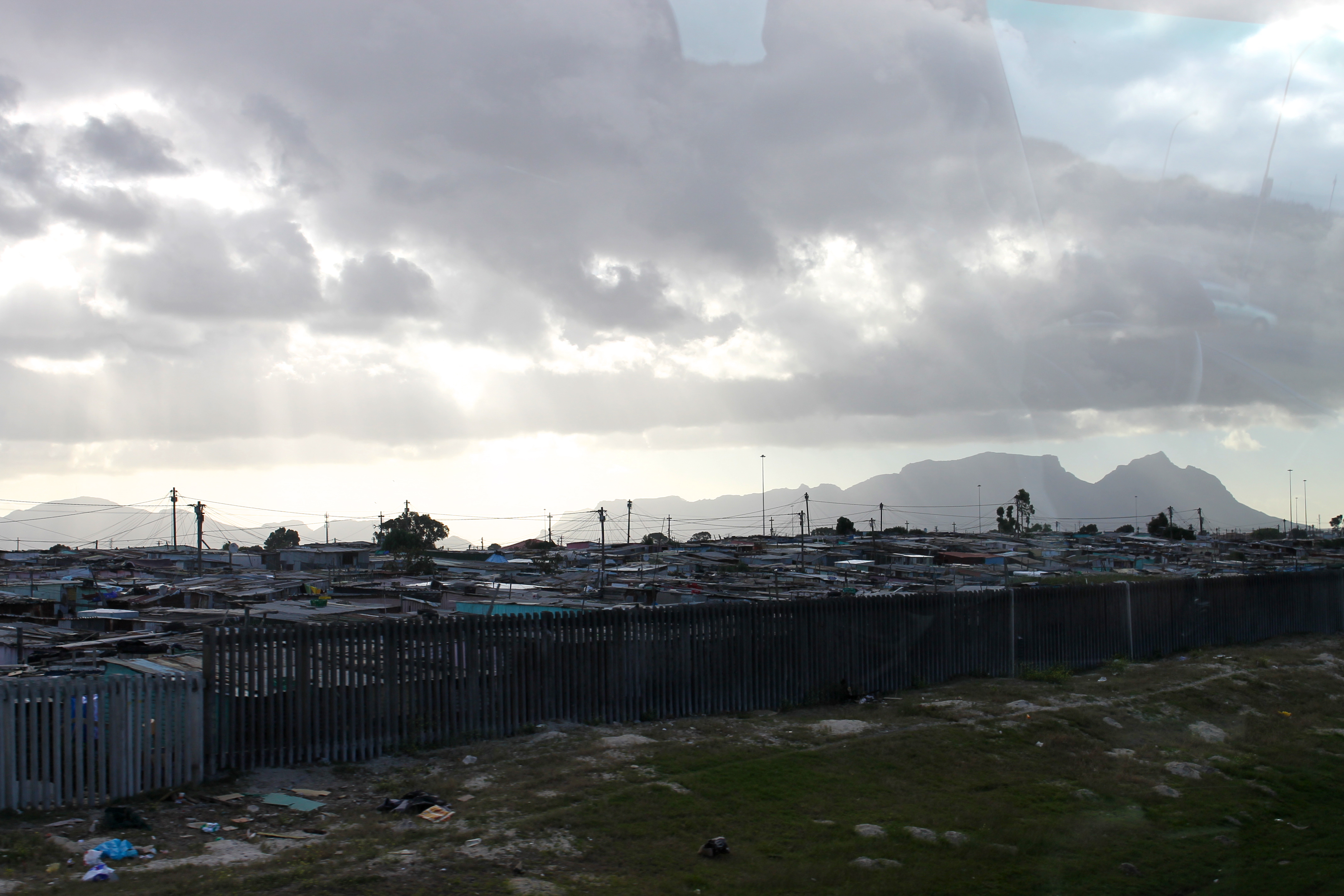
Khayelitsha township, the largest one in South Africa, with over 1 million inhabitants, Nov 2011
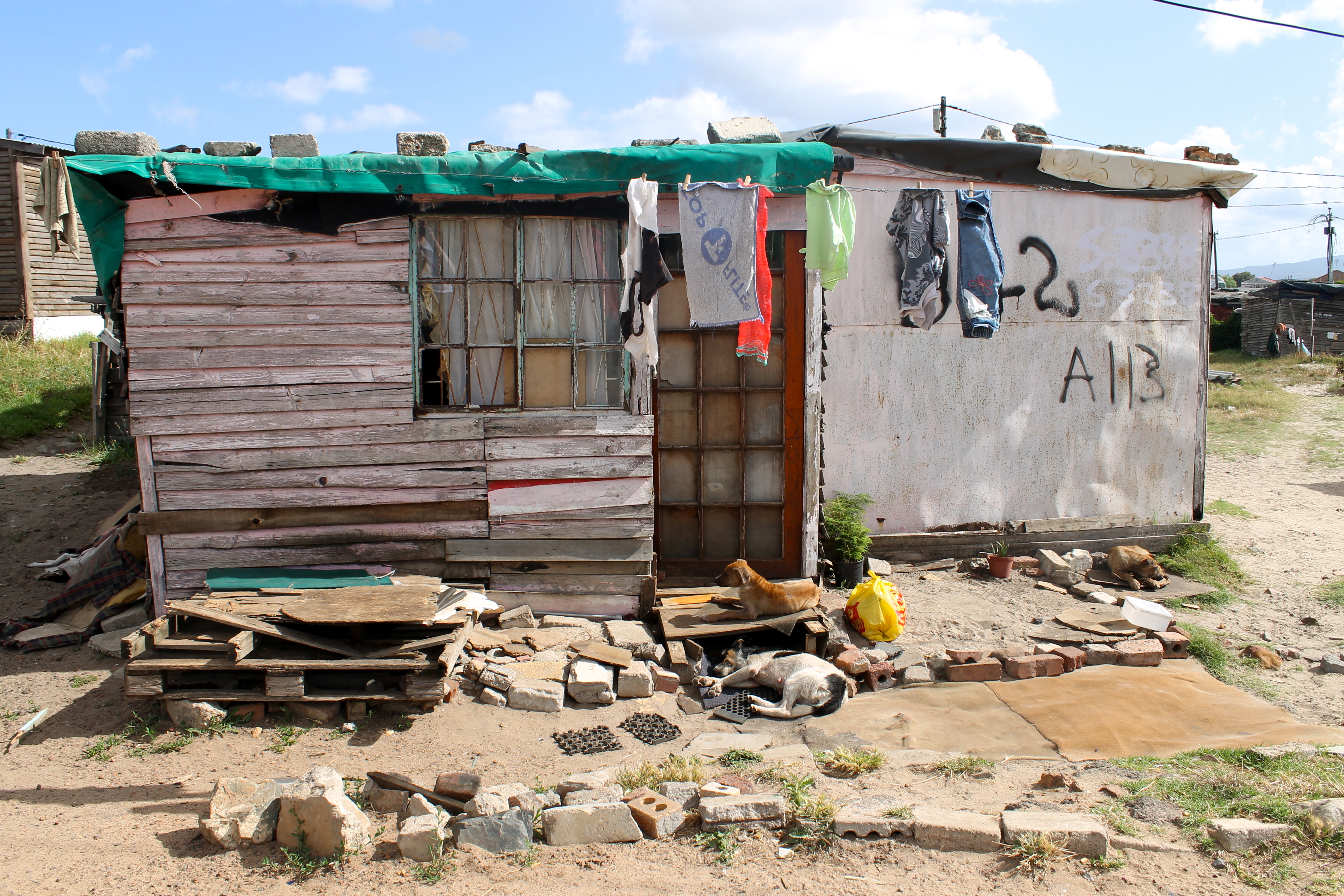
A typical home in Langa township, November 2011
It’s been twenty years – almost to the day (April 27, 1994) – since South Africa had its first democratic elections (here’s a good article about the changes, good and bad, and what hasn’t changed, since the end of Apartheid). Yet the country is still widely divided along racial lines. The poorest of the poor are overwhelmingly Black, with the richest of the rich still being overwhelmingly White. This is seen in terms of land. From when Apartheid ended until the end of 2011, when I visited the country, less than 7% of the land had been transferred. Rich White landowners own the big farms, and poorer, Black small scale farmers are landless and continue to suffer under a similar unequal system as they did under Apartheid. (Side note: there are organizations like Surplus People Project working for land reform. See my blog post from November 2011)

Willem, a small-scale farmer without access to water on the land he farms (but does not own) near Citrusdal, Western Cape, November 2011
As some young people interviewed in the film commented (and this was filmed when he was still alive), Mandela never goes to bed hungry. Mandela is fed because of them, they argue. Another interviewee says its easy to forgive when you’re the president. But what about the woman in the hut whose son went missing and who is inconsolable every time she realizes that the footsteps she hears outside her home are not that of her long lost son returning? We are being presumptuous, insulting even, if we think we can comfort her.
This brings up the issue of forced reconciliation, which is somewhat addressed in the film. As one interviewee analogizes, “If someone steals your watch and asks for forgiveness but is still wearing your watch, what good is that?” It creates a culture of impunity, not one of reconciliation, he argues.
What good is forgiveness if it is coerced? I am very uncomfortable with forgiveness narratives, especially around genocide or ethnic cleansing or system human rights abuses. The 20th anniversary of the start of the Rwandan genocide was earlier this month, and there were countless media portrayals of perpetrators standing with their victims in solidarity and forgiveness. I remember when I was completing my Masters degree and seeing a short video of a Rwandan woman serving food to the man who had killed her entire family, in a move that the narrator clearly viewed to be inspirational. But for me, there’s a problem with that. Not least because, when I visited Rwanda in 2009, I heard time and time again, “We have no choice but to forgive.”
In the TRC in South Africa, there were times during the hearings when forgiveness was definitely coerced, or at least strongly encouraged. I heard one story, during my Political Reconciliation class at LSE (taught by Dr. Claire Moon who’s written extensively on South Africa) of a victim who came to tell her story even though her perpetrators refused to appear. Yet still she was asked, repeatedly, by the Commissioners, “But you forgive them, right?”
That’s why it was so interesting that Matabane included the story of Charity Kondile, who refuses to forgive the man who killed her son, Sizwe. “I was looking for an alternative narrative to the Black woman who cries at the TRC and forgives,” Matabane explained during the Q&A. “I was trying to be as honest as possible in a world where everything, even documentaries, is a performance.”
I couldn’t help but think back to the time last month I spent at the TRC in Edmonton. In this Canadian context, I didn’t encounter that kind of “cult of forgiveness” that has appeared in other reconciliation processes. While we may still argue whether justice is being done in this care, or any of the cases discussed in this blog post, the Canadian TRC process is much more victim/survivor focused. It is about survivors telling their stories, and having institutional perpetrators apologize to them. Very rarely did individual perpetrators appear before the Commission, although it did happen. Of course, concepts of forgiveness and reconciliation were discussed and promoted at the TRC. But I never felt a coercive element; survivors were allowed to be angry and to remain angry. To tell their story as they saw it. Reconciliation is a process. As Elder Lorna Standingready said to me one day in Edmonton, the residential school system operated for over 100 years. We can’t expect it all be fixed in the few years of the TRC’s mandate.
But back to Matabane’s movie. Watch the trailer below. And then make sure you see the full feature film as soon as you can.
Verdict: 4.5/5.0
“No one should be punished for the sin of the father.”
– Verodiane Nyirasinamenye
Amahoro Orphanage
Musanze, Rwanda
Twenty years ago today, the Rwandan genocide began. The night before, a plane carrying then-President Juvenal Habyarimana – a Hutu – was shot down, killing everyone on board, including the president of neighbouring Burundi. Hutu extremists blamed the Tutsi rebel group, the Rwandan Patriotic Front (RPF), based in Uganda, and began a well-organised campaign of slaughter in retaliation. The RPF said the plane had been shot down by Hutus as an excuse for the genocide.
Many articles today will write a variation of the following: “Over 100 days, 800,000 to 1 million Tutsis and moderate Hutus were massacred.”

Skulls in the Nyamata Church Genocide Memorial
But there are two groups of people deeply affected by the genocide that are rarely mentioned in the news, or the academic literature: the Batwa and children conceived through rape during the genocide.
Five years ago, I travelled to Rwanda to conduct research for my Masters dissertation (I was attending the London School of Economics, completing an MSc Human Rights) on the rights of those children. I had also recently completed a 3-month placement as a Gender Intern with Minority Rights Group International (MRG), working on violence against Dalit and Batwa women and girls, among other issues.
I felt that I was fairly well-versed on the Rwandan genocide before starting my research. After all, I’d been immersed in learning about egregious human rights violations since I was 1 year old, when my aunt took me to my first political advocacy meeting, on the anti-Apartheid movement in South Africa.
But even I had never heard of the Batwa. The pygmy people of Rwanda, Uganda, Burundi, and the Democratic Republic of Congo. They were maybe 1-2% of the Rwandan population in April 1994, but more than 30% of their population was killed during the genocide (in comparison to about 14-20% of the entire Rwandan population and 70% of the Tutsi population). They were often caught in the middle of the violence, and accused of taking one side or the other.
I’ve watched a lot of movies on the Rwandan genocide – Hotel Rwanda, Shooting Dogs, Sometimes in April, The Day God Walked Away – but in only one have I noticed a Twa* character, and that was in Kinyarwanda. For more on the Batwa, see MRG’s publications.
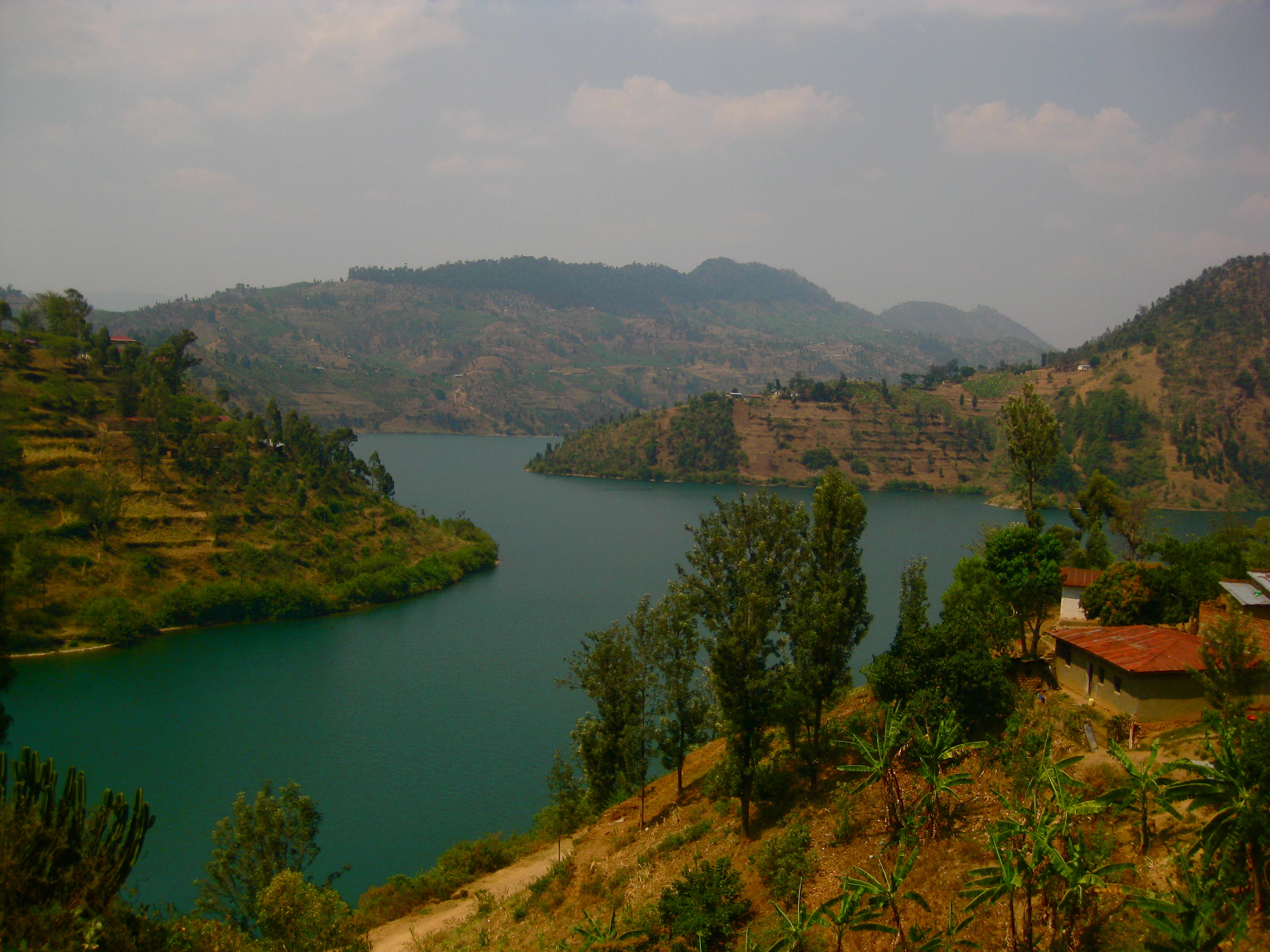
Kibuye, on Lake Kivu
With children born of rape, they’re only just beginning to receive some attention in the popular media. An article in The Guardian this week profiled some of those children, for example.
NGOs estimate that at least 250,000 women were raped during the genocide, and possibly as many as 500,000. Rwanda’s National Population Office estimated that, as a result of this violence, between 2,000 and 5,000 children were born. Many victims’ groups state that there are 10,000 such children, while some NGOs, such as Foundation Rwanda, quote a much higher number – 20,000 children.
But when I was conducting my research, there really was very little out there. For example, in 2003 Human Rights Watch had a report on children in post-genocide Rwanda, called Lasting Wounds: Consequences of Genocide and War on Rwanda’s Children, and children born of rape were conspicuously absent.
Why is this the case? For one, sex is a very taboo topic in Rwanda, as it is in many countries, let alone sex outside of marriage. There isn’t even a kinyarwanda (the local language) word for “rape.” Rather, rape victims would use phrases such as “married until I couldn’t breathe” and “I had no choice but to be a wife to him.”
Secondly, and this may seem like a technicality but it is quite important, these children are not considered survivors because they were not alive during the genocide. They were born afterwards, and consequently are not viewed as survivors by NGOs such as Fond d’Assistance aux Rescapes du Genocide (FARG). While I was in Rwanda, one situation was related to me of a child whose siblings had their education paid for by FARG, but not her own, as she was not considered a survivor. Her mother was left to explain the situation of her birth.
Thirdly, and this is only relevant for some children born of rape, only Tutsis are considered survivors. Official state policy is that there are no longer any tribes or ethnicities in Rwanda. In fact, it is illegal to use the words “Twa,” “Tutsi,” and “Hutu” in public political discourse. Hutu, Tutsi, and Batwa no longer exist; everyone is “Rwandan.” However, in practice, this is certainly not the case. In order to be viewed as a survivor in Rwanda today, a person must be Tutsi. According to the RPF-dominated government, no Hutu are survivors, even if their own Tutsi relatives, such as a spouse or child, were killed.Those Hutu women who were raped during the genocide are therefore also not considered survivors. In fact, even those Hutu who have relatives who participated in the genocide, but did not participate themselves, can be labelled “génocidaires.”
The Batwa continue to live in extreme poverty, most are landless, and Tutsi and Hutu continue to discriminate against them. They are also invisible. In a February 2009 response to the Committee on the Elimination of Discrimination against Women, when asked about Pygmy (Twa) children, the government of Rwanda’s response was, “The country of Rwanda does not have Pygmy children.” When dealing with a government that refuses to acknowledge a victimized minority group, it is extremely difficult to achieve change. How does one advocate for a group that does not exist? This makes life especially difficult for children born of war to Twa mothers.
This sentiment, that only Tutsi are survivors, is also found in state laws, such as Law No 69/2008 of December 30, 2008, regarding the establishment of the fund to assist survivors of the genocide (FARG). Throughout the law, and in its title, survivors are called “survivors of genocide against the Tutsi.” There is a disconnect between the state’s attempt to eradicate ethnicity from the public discourse, and a discriminatory policy that only helps Tutsi survivors, but not Hutu or Twa. The children born to Hutu or Batwa mothers are doubly affected; not only are they not survivors because of when they were born, but their mothers are not considered survivors either.
And lastly, these children are usually considered to be their rapist fathers’ children, both by their families and by wider society. They are called such things as “children of hate” and “little interahamwe.” There are fears that the children will “rise up and join their fathers.” Many newborns were abandoned on the steps of government buildings, their mothers saying they were “the state’s problem.” According to the Family and Promotion of Women Ministry of Rwanda in 1995, more than 80 percent of mothers were abandoning their babies. In other cases of genocide and ethnic cleansing, such as Bosnia, there were reports of women killing their babies shortly after birth. I have not read about any such case in Rwanda, but that doesn’t mean it didn’t happen. Others were kept by their mothers, with both mother and baby driven out by the mother’s family because the child was a “child of the enemy.” There are cases, as well, of children being kept by their mothers and raised in loving extended families.
I won’t get into the details that consist of my Masters dissertation, but suffice it to say that children born of war in Rwanda faced stigma and discrimination due to the circumstances of their birth, which often lead to violations of their rights to life, security of the person, education, health care, an identity, and birth registration. But there are some great organizations like Foundation Rwanda working to rectify that situation (in Foundation Rwanda’s case, its focus is on education).
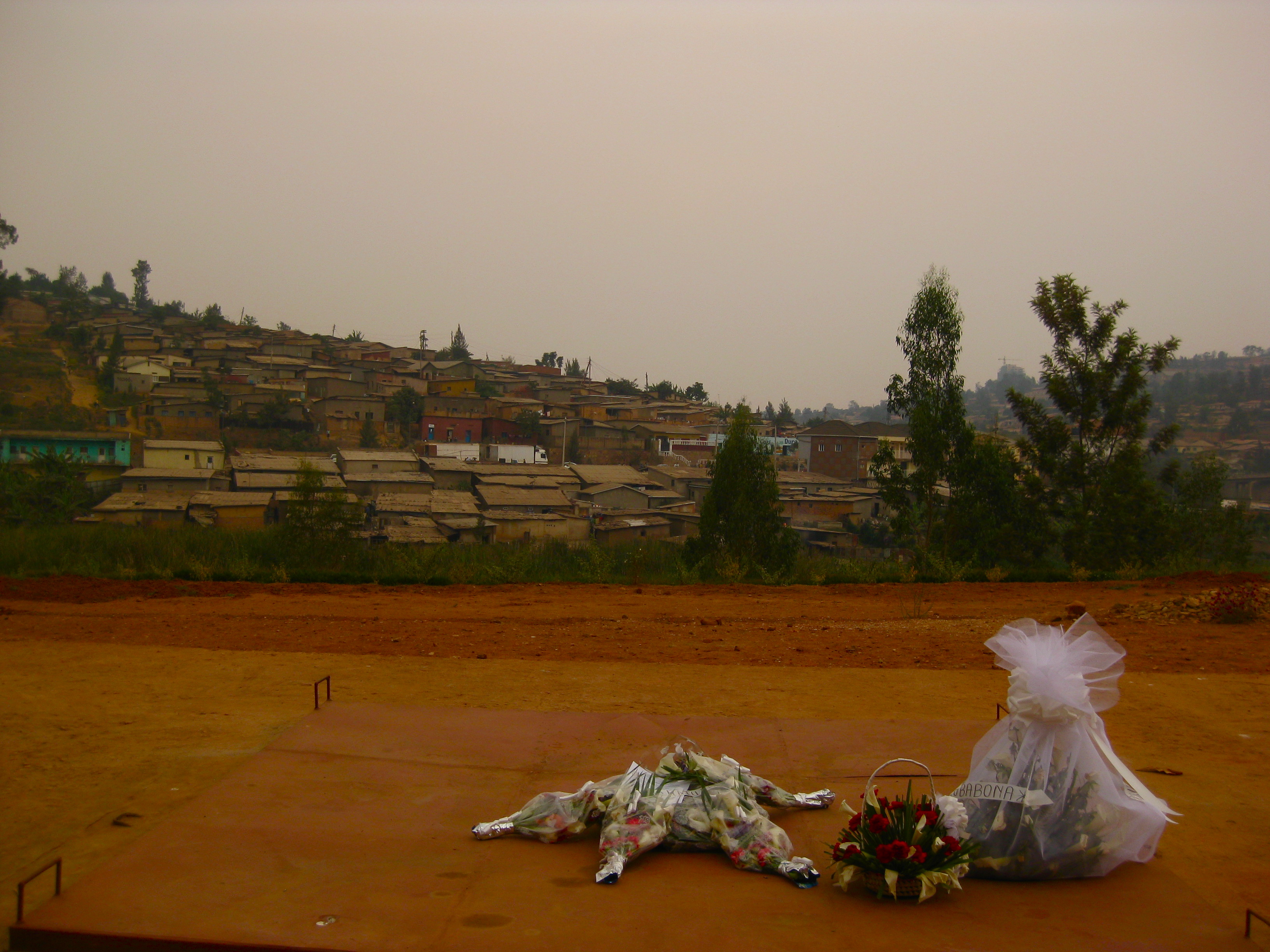
Kigali Genocide Museum Memorial
Some people talk about Rwanda as the “great bastion of democracy in the heart of Africa.” This is false, in my opinion. There are countless stories of political dissidents, opposition leaders, and journalists being killed or “disappeared.” Does anyone wonder how or why Paul Kagame is still in power, twenty years later?
And as stated above, people cannot speak openly about ethnicity in the country. For a persecuted minority like the Batwa, this is extremely problematic. How can organizations work to further Batwa rights (e.g. land, poverty, the belief that sleeping with a Twa woman cures backache) when they can’t look at the Batwa as a separate group?**
Yes, Rwanda has come a long way, but it’s not all the way there yet. There’s still a lot of work to be done.
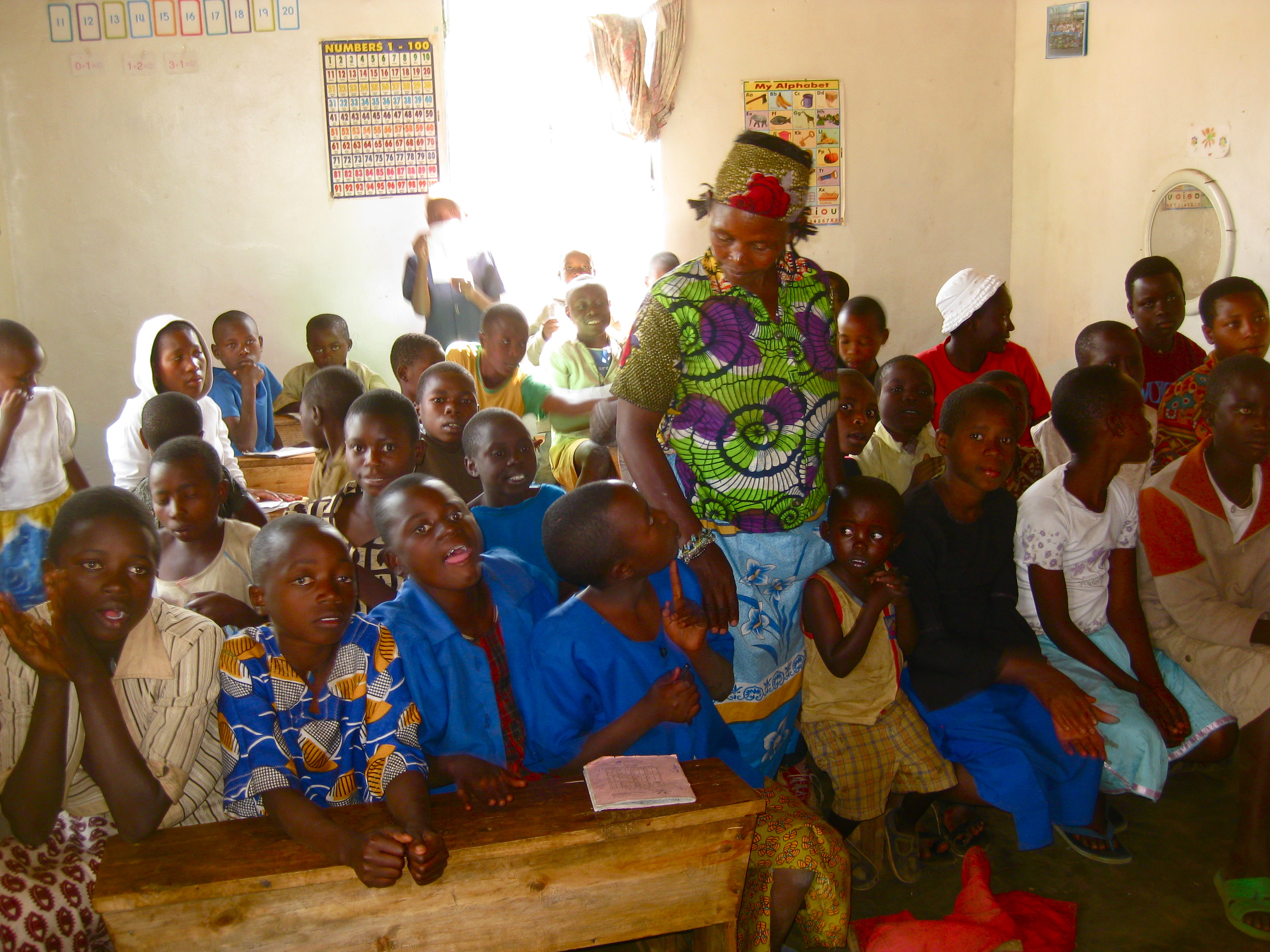
Verodiane Nyirasinamenye, the Mama of Amahoro Orphanage in Musanze, Rwanda, with some of the children in her care. She takes care of a few abandoned children born of rape; I interviewed her for my dissertation
* Twa is for a single person; Batwa is plural. Technically, Hutu should be Bahutu and Tutsi should be Batutsi when speaking about groups. I decided to use the more common Hutu and Tutsi instead.
** I met with a representative of a Batwa organization in Rwanda while conducting research there; we had to be very careful, and he ended up meeting me at my hotel as a tall, blonde, white woman like me would have caused too much unwanted attention by showing up at their office.
*** For more photos of my time in Rwanda, see my Facebook album
My time at the Truth & Reconciliation Commission (TRC) was one filled with strong Aboriginal women. I loved every minute I got to spend with them, especially one woman in particular – Leading Elder of the All Native Circle Conference of The United Church of Canada, Lorna Standingready.

Me with Leading Elder Lorna Standingready
Lorna is a residential school survivor. She spent 10 years in three separate residential schools – Anglican, United, and Presbyterian. On the first day of the TRC, Thursday, Executive Minister of the Aboriginal Ministries Circle, Maggie McLeod, interviewed her after the opening ceremony:
Lorna spent a lot of time at the archives section of the Shaw Centre. The four main churches who ran residential schools – Catholic, Anglican, United, and Presbyterian – had archival photos of their schools on display and in binders for survivors, and others, to look through.

Lorna found several photos of herself, and her sister, in those files
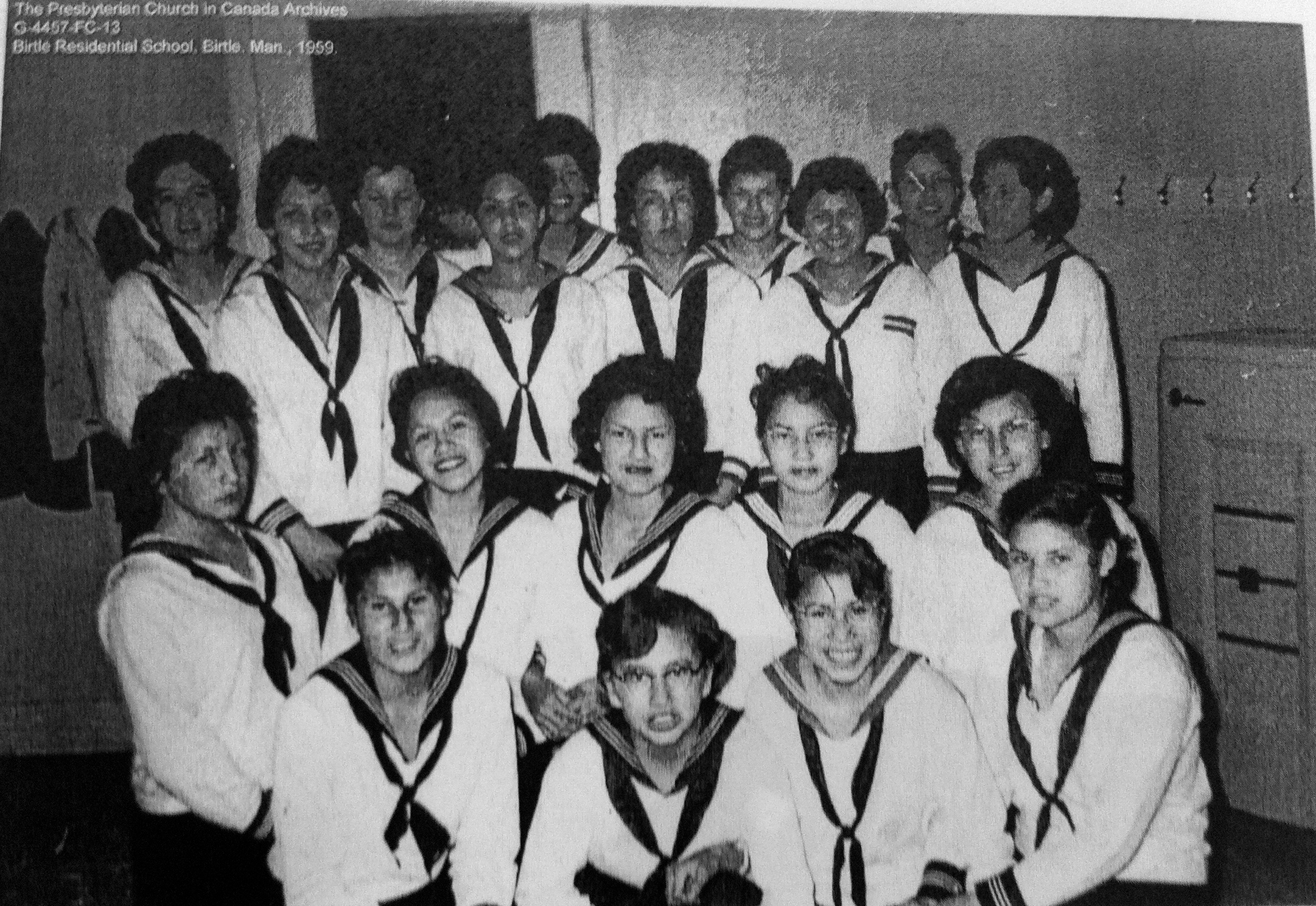
Here’s the photo that Lorna is referring to. She’s the one second from the right, in the front row. This is at Birtle Residential School, run by the Presbyterian Church of Canada.
On the Friday, March 28, a United Church delegation consisting of former Moderator Bill Phipps, current Moderator Gary Paterson, and Maggie McLeod, supported by elder Ray Jones (Chair, Aboriginal Ministries Council) and Lorna herself, made a statement to the TRC. After the statement, Lorna shared her views on it:
Later that day, she and General Secretary Nora Sanders had a conversation about it:
Lorna was asked to share her story during the Churches Listening Circle. This circle happened each day of the TRC, and was a space for survivors and church officials to sit together, with survivors telling their stories directly to church officials, and the officials responding at the end. There was also an opportunity for survivors to privately speak with a church official of their choice, and to receive a personal apology.
Here is her story, in her own words

Cheryl Jourdain, speaker of ANCC, supports Lorna as she tells her story
It was difficult to hear. But I can only imagine how difficult it was to share, and for that I am so grateful to the incredibly brave and strong woman that is Lorna Standingready. Not only did she relive the emotional trauma she endured, but she also had the strength to stand behind the next survivor who was having a difficult time getting the words out, holding her and telling her that “Kokum’s (grandmother) here.”
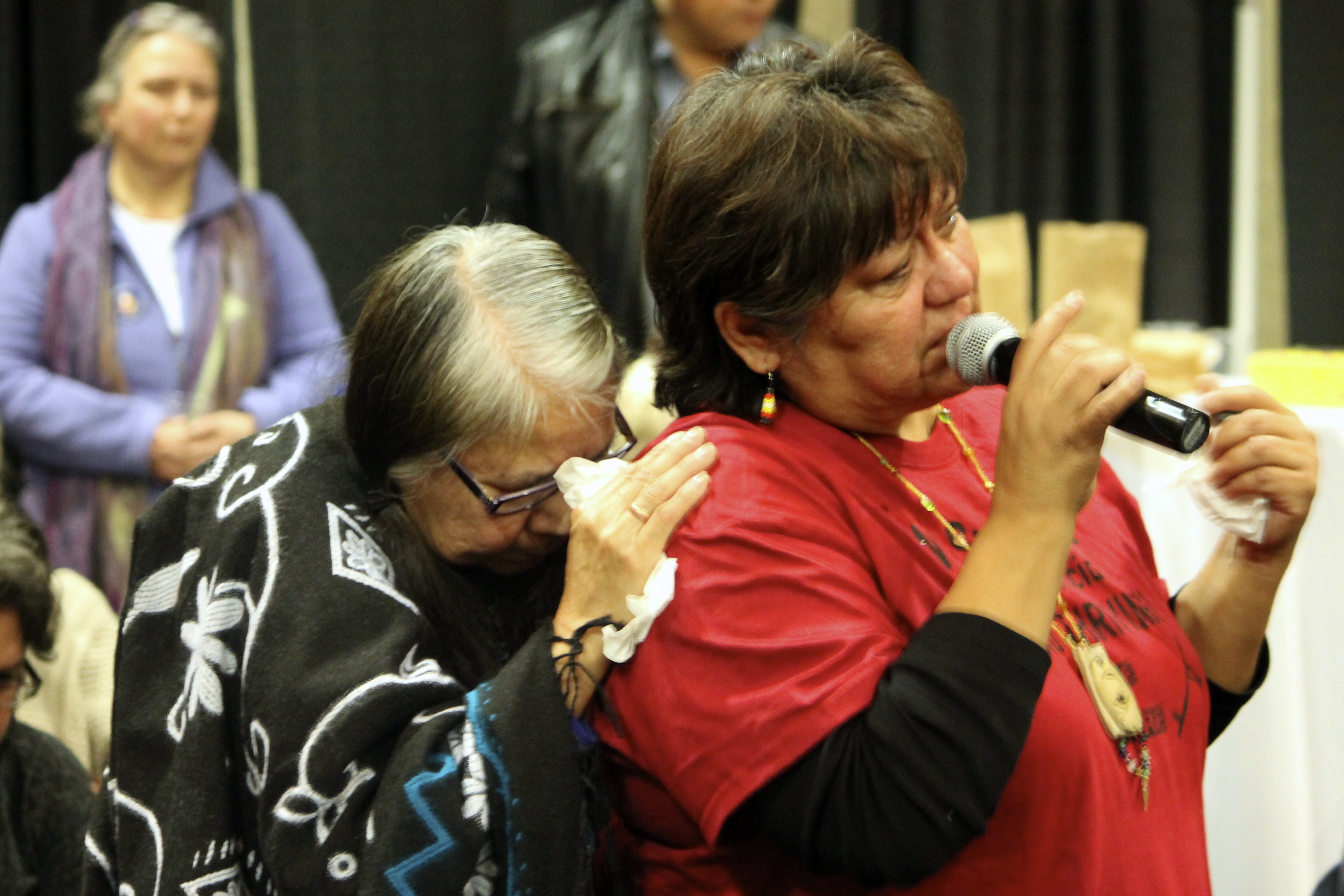
Lorna speaks about her experience sharing her story here:
Lorna also wanted to do a short recap of her experience at the TRC in Edmonton:
This is the photo she refers to in the video – that’s Lorna playing the piano.

The interesting thing is, earlier I was supposed to interview Lorna. I’d asked her previously if she wanted to tell her story and have me record it. She said she did, so long as she wasn’t rushed.
This was a common sentiment during the TRC, survivors feeling rushed and comparing the TRC process with the residential school system, where they were constricted in rigid timelines (I’m still thinking about this, and hope to devote an entire blog post to it). I told Lorna we could take as long as she wanted, and so we planned to meet in the Survivors Lounge to film an interview, giving ourselves at least an hour.
But then she was asked to share in the Churches Learning Circle, so we didn’t get to do our in-depth interview. In the end, it worked out better. Lorna was able to give witness in public, to a large group of people. I was able to record it and, with her permission, share it on Youtube, where even more people could hear it.
There were other things that struck me as I was working throughout the event, that I set aside or jotted down as a note to myself to come back to and reflect on later.
One was the statement given on behalf of the United Church. It was a good, strong statement, but not one that I wholly agreed with. For starters, the two white men on the 3-person delegation spoke longer than they perhaps should have, leading Commissioner Marie Wilson to interrupt Maggie, the only woman and only Aboriginal person on the delegation, at the beginning of her statement, telling her to hurry up as time was running out.
The optics were not good.
Also, part of the statement said that the United Church would include Aboriginal peoples “in all decisions that affect them.” When I heard that, my ears perked up and I wrote the statement down on my iPhone. It just seemed really patriarchal and colonial, not to mention that it wreaked of the whole “women should only be concerned with women’s issues” idea.
I mean, if Aboriginal peoples are truly completely part of the United Church of Canada, why should they only be involved in decisions that affect them? Shouldn’t they be involved in all decisions? If they are truly integral parts of the church just like any other group of people? And don’t all decisions affect them, like they affect the rest of us?
Yes, I’m critical of my church. Perhaps overly critical. The United Church was the first church to apologize to Aboriginal peoples, in 1986 (see this timeline regarding residential schools). It is trying to make amends. It apologized for its role in the residential schools in 1998, and pushed the Canadian government to apologize as well, which it finally did in 2008. I heard from other people at the TRC who said they wished their churches could deliver a statement as strong and powerful as the one the United Church gave. But while the United Church is trying to live out those apologies, it isn’t there yet.
1986 was the year I was born; the United Church has been working towards right relations for as long as I’ve been alive, yet those apologies have still not been accepted by the Aboriginal population of the United Church, though they have been acknowledged. (This too continues to stay with me, and I’m thinking about a separate blog post to expand on it.)
Lorna is a very grandmothery, maternal figure. She reminds me of my grandmother, though Lorna’s about 30 years younger. My grandmother died nearly 10 years ago, in 2004, the week before I turned 18. She would’ve been 100 years old this past November. I was with her when she died, along with most of my immediate family. I remember it vividly. Holding her clammy hand, thinking I felt her squeeze my own even though she had gone into a coma a few hours earlier. The death rattle.
My grandmother, Nanny as I called her, was like Lorna in stature and strength. She was a small woman, much smaller than the 5 foot 10.5 inches I would grow to be, but I always felt like a child when I was with her, safe and secure. And she was feisty! She’d tell it like it is, just like Lorna does. She’d talk about the Black & Tans in Ireland and the things that they did. I knew that she and her family, and others in rural Co. Cork and elsewhere, were often not allowed to speak their language, Irish Gaelic, in school or outside the house. But she tried to teach me a bit of the language, and I savoured those teaching moments, even as a young child. Today, I can still say things like “Thank you,” “How are you?” etc, but I’m nowhere near reclaiming the language the way many of my relatives who still live in the Gaeltacht regions of Ireland are.
I’m not trying to equate the experience of Aboriginal people with that of the Celtic population, but stories close to my heart help me to better understand the truth-telling of other peoples. I know that some have called the Celts the indigenous peoples of Europe. Even though my ancestors were not forcibly taken from their families and sent to schools where they were abused and beaten for speaking their language, language was still lost in Ireland; names were anglicized. This isn’t just the case with the Irish, but with many different groups both here in immigrant communities in Canada and around the world. It’s something in common that could build a bridge towards solidarity, especially among those people who don’t know much about the residential schools or see this whole thing as an “Indian problem.” Finding personal connections is the first step in recognizing the more systematic and severe experience of Aboriginal peoples here in North America. We shouldn’t only care because something similar happened to our own peoples; we should care because this horrible, horrible Canadian legacy happened to other human beings.
UPDATE: 10 days after the TRC ended in Edmonton, Lorna was in Toronto and we were able to film her speaking with Rev. Maggie McLeod about the importance of Aboriginal Women’s leadership:

 Kaitlin Geiger-Bardswich