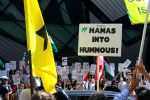
This gallery contains 31 photos.
Yesterday was the first time I went to a rally since the assault on Gaza began over a month ago. Here’s a summary via the signs from both sides:
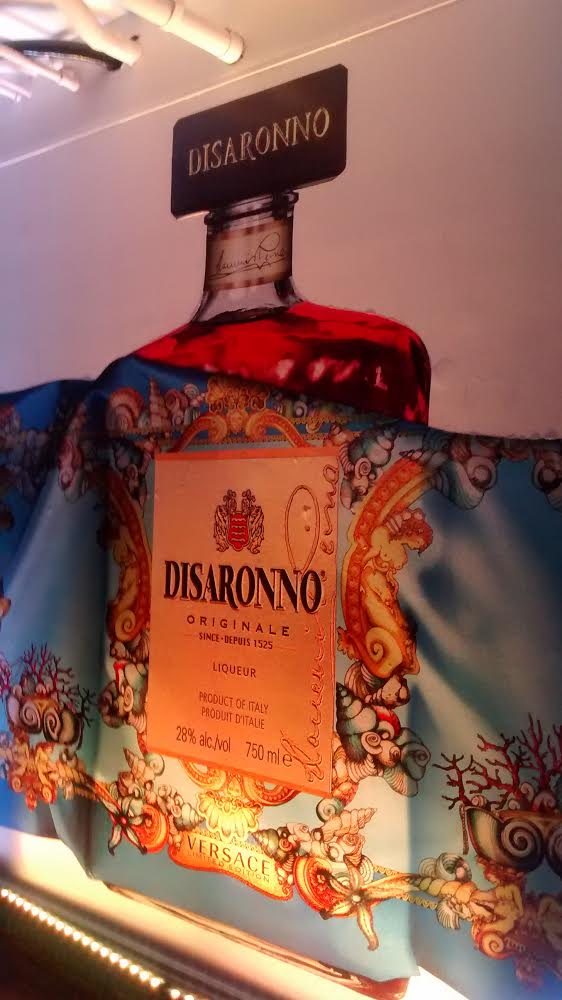
Last week, a colleague and I went to a posh DISARONNO event at the Spoke Club on King West. It was my first time at that venue – I’d heard good things, and was expecting some posh-ness.
I was not disappointed.
All the pretty people – I felt a bit out of place, but man those cocktails were good!
Read the article I wrote for Style Empire
On Thursday night, I went to a lecture with my aunt about homosexuality and the Holocaust. I began to write a blog post about it yesterday and then thought, “This is super interesting. More people need to see it.” So I wrote to my editor at Xtra and the result was this article.
It was edited down to make it much more newsworthy, but I wanted to share my original opening, as I think that the quote from the survivor should be shared.
Gay men were not only persecuted by the Nazis, but were re-victimized when liberating armies put those rescued from concentration camps back into prison, Dr. James Waller explains
“In order not to mutually incriminate ourselves, we decided to no longer recognize each other.”
These words, recorded as the testimony of a gay survivor of the Third Reich, struck Dr. James Waller, the Cohen Chair of Holocaust and Genocide Studies at Keene State College in Keene, New Hampshire, as particularly heart wrenching.
It was as though they also could no longer recognize themselves, Waller explained. He likened this to what many LGBT people continue to experience today, particularly in countries where homosexual acts are illegal and the LGBT community is forced to “not recognize” who they truly are, at least publicly.
On November 6, Waller gave a public lecture during Holocaust Education Week in Toronto, co-sponsored by Facing History and Ourselves, Kulanu Toronto, and The Equity Studies Program at New College, University of Toronto. Entitled “Do No Harm? Nazi Doctors and the Persecution of Gay Men,” the lecture looked at the psychological, social, and cultural factors that influenced Nazi policy against homosexuality.
For more on how ordinary people, such as German doctors, can commit extraordinary acts of evil, see Waller’s book “Becoming Evil: How Ordinary People Commit Genocide and Mass Killing.”
Yeah, so I’m going to chime in on this Jian Ghomeshi thing. And look, I don’t know if he’s guilty or innocent, and it’s not my place to determine that. I don’t have the evidence. But what IS bugging me is all the swirling speculation that these women must be lying since they haven’t gone to the police. I understand why they haven’t gone to the police. I was mildly sexually assaulted (I say mildly because it could’ve been a lot worse, it was very quick and over my clothing, but it was still violating and is still an assault) while I was living in London, England, at 9 am on my way to work. I yelled at the guy to “Fuck off!” and whipped myself away from him as he smirked and walked away. I walked in the other direction and promptly burst into tears. And when I called a close female friend, still weeping, what was her comforting response? “It’s no big deal, it’s happened to me. It happens to everyone.”
This is a systemic problem. It’s a political and legal and cultural problem; the conviction rate for sexual assault is abysmally low. Victim-blaming, as we have seen, is rampant. Yet instances of false accusations are statistically quite rare.
Eventually, I was convinced by a lawyer friend to at least report it to the police for statistical purposes. Even though I had no idea what this guy looked like, besides his race and general height – I didn’t get a good look at his face – it could show a pattern in the area. No one answered the phone at the local police station, and that was enough for me to give up and try to forget about it. Because I could envision the response: “What do you want us to do about it? You can’t ID the guy, you’re not physically injured, so why are you calling us? At least you weren’t raped.”
We need to look at the bigger issues – the systemic issues of misogyny and patriarchy and victim-blaming. And yes, while women need to be careful when walking alone at night – or in my case, in the morning – the focus of sexual assault prevention should NOT be on the women who are victims, but on the men who perpetrate.
There are several articles out there that explain the topic better than I can, like this one and this one and this one. But in the end, we all say the same thing: #IBelieveThem

Alanna Mitchell knows good sex.
No, not the Carrie Bradshaw version. But rather the coral-spawning sex orgy that happens in Panama once a year, an event so sexually charged that Mitchell describes the water as being electric, the whole reef vibrating with sexual energy.
This is but one of the encounters with the ocean that Mitchell describes in her one-woman show Sea Sick, based on her award-winning, best-selling book of the same name. The research for that book took three years and consisted of 13 trips to different parts of the world, where Mitchell interviewed the leading scientists studying the ocean and its mechanisms.
In just over two and a half months, I will be embarking on an epic journey. The foundation is already in place – I’ve given my notice to work; I’ll be giving my two months’ notice to my landlord on November 1. I’ve arranged to store the things I want to keep in my parents’ basement.
And I’ve renewed my passport.
In mid-January, I will be leaving the country for what I hope to be a year to a year and a half voyage of not only the cliched self discovery, but also of writing, taking photos, and making short films. Meeting people and discovering new places and interesting stories.
First stop? Pakistan. And then India. Then onto more of Southeast Asia. Eventually some of southern and eastern Africa. Then onto the Middle East, a dash of Europe, and then a giant tour of the Americas – everything south of Mexico.
I cannot wait! And I invite you to follow the journey with me, on this blog as well as on Facebook and Flickr.
While my writing has usually focused either on human rights – my degrees, my blog, recently published articles, etc – or creative writing, I’ve been venturing into new areas this year. And I’m loving it!
The first is memoir writing. Earlier this year, I discovered that there’s an awesome queer memoir reading series at the 519 on Church street in Toronto, called Queer Confessions. I’d never written a personal piece for public consumption. But I decided to give it a go. In June, I’d gone on a few dates with a girl who I really, really liked. She was the first girl I felt any kind of connection with since my ex. And then, suddenly, I got the text. THE text. Y’know, the one that says “I don’t really think we should keep seeing each other because I’m not ready.” And it stung. It hurt, even though I believed her, as she’d recently come out of a serious longterm relationship. Feeling sorry for myself, my colleague emailed me the link to Queer Confessions. The next month’s theme? Crush(ed). And submissions where due the next day.
Perfect, I thought. It’s time to channel some of this angst and heartbreak into art. And so I dug out some of the snippets of writing I did as I was going through the break up with The Ex. And it was really cathartic; I was able to deal with both heartbreaks – one much more significant and deeply felt than the other – in a way that, I thought, turned them into something beautiful.
(Side note: On the night I was reading this piece, I went to dinner near the 519 with a friend beforehand and guess who walks in? The girl from a week or two previously who sent “THE” text. Insert mini freak out while I wondered if she was attending the reading. Luckily, she wasn’t. And it was a good distraction from my nervousness about reading in public.)
An excerpt:
No, what I hate most are the memories that swoop down and slap you in the face as you’re going about your day, minding your own business…You glance up as you walk to the subway and see a girl of similar build, wearing the same coat as your last girlfriend. The girlfriend who broke your heart. In public. The girlfriend you’re still not really over even thought you think you are. And the weight comes crashing down, into the pit of your stomach. The memories slice you. And all for a coat. A stupid, black, faux-fur trimmed winter coat.
Fuck.
Some people who’ve seen me perform these pieces or have read them on their own say I’m brave. That it takes a lot of courage to write something so personal, and even more to stand up and read it aloud. Perhaps that’s true, but for me, it’s more freeing than courageous. It’s standing up in front of people and saying “This is my story. Like it or hate it, it’s how I view the world. This is me.”
Then last month the theme was “Coming Out” and I decided to submit something again. This piece was lighter than the last one, but still cut to the core:
And then came the kicker.
“Well, y’know, I feel like I’m a sinner, everyone’s a sinner, so why should I judge
others? I wouldn’t want other people to be commenting on my sins.”Seriously?
You can read these two pieces here.
Also during this past summer, I started dabbling in lifestyle writing in my free time, thanks to my super cool friend and roommate Nicole Edwards, the Lifestyle Editor at Style Empire, an online magazine. I’ve done two articles for them so far, and they were a lot of fun:
Classy without being pretentious, the cocktail is light and fruity, perfect for the summer heat. And versatile too; at first, I thought there were two versions being made, one that was more generous in its sourness than the other. When I asked the bartender, he said it must just be the different way the two bartenders were making them. But either way – a lovely sour experience or a more fruity-tasting version – the drinks were a hit. “I’m more sour, and she’s sweet,” the male bartender explained to me. “We get that a lot,” his female counterpart chipped in with a laugh
Read the first article: Disaronno Sour is the Drink of the Summer

“Disaronno.” Just saying it makes me feel Italian.
Decorated with florals and bright colours at the moment, the space will evolve with the seasons. It’s classic, elegant, and a friendly space. “I don’t ever want to hear the word uptight,” Salm says, in terms of the feel of the space. I doubt he will.
Read the second article: Colette Brings a Touch of France to the Thompson Hotel
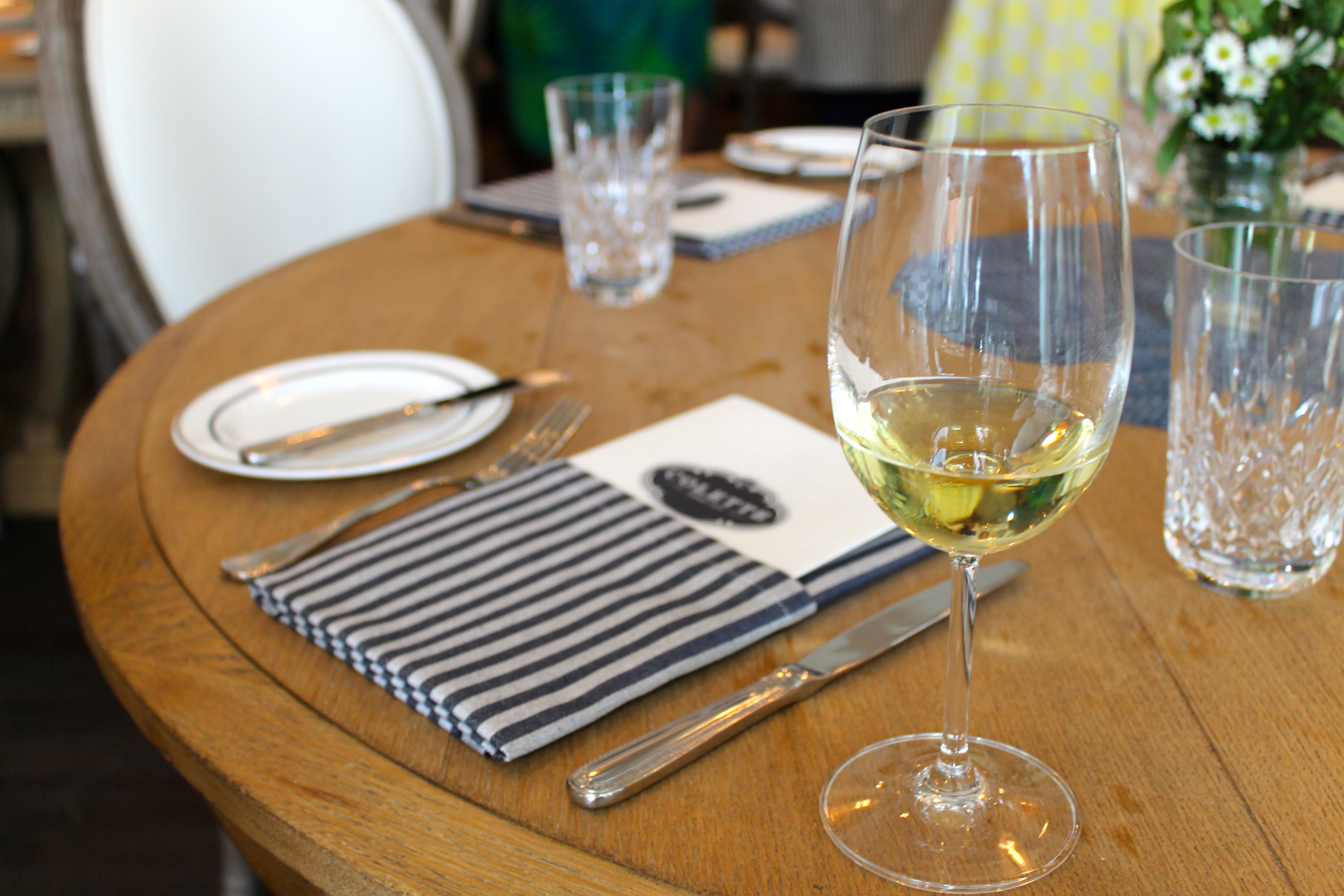
Some white wine to go with your hors d’oeuvres? Don’t mind if I do.
And as a bonus, here’s a recent article by Nicole featuring photos I took of her around our neighbourhood last month.

One of my favourite photos from the shoot, though it doesn’t show off the clothes quite as well as some of the other shots
And the latest writing venture? Travel writing. As you can see from this blog over the years, I love to travel. So why not dabble in some travel writing as I go about my more human rights-focused journalism? More on this soon – something big and exciting this way comes!
I got published!! It’s been such a crazy adventure trying to get this piece out, but it finally happened in late July. And I just realized I never wrote a blog piece about it. So here we go!
Last Fall, I took a writing course at Ryerson University with the amazing Carla Lucchetta (check out her writing) where I wrote a pitch letter for this piece, as well as a first draft. Just before Christmas, I pitched a story on LGBTQ rights in Zambia to Daily Xtra, and just after the new year, they accepted it! But then there were delays with editing, then my editor left for another publication, etc, etc. But now I’m finally published!!
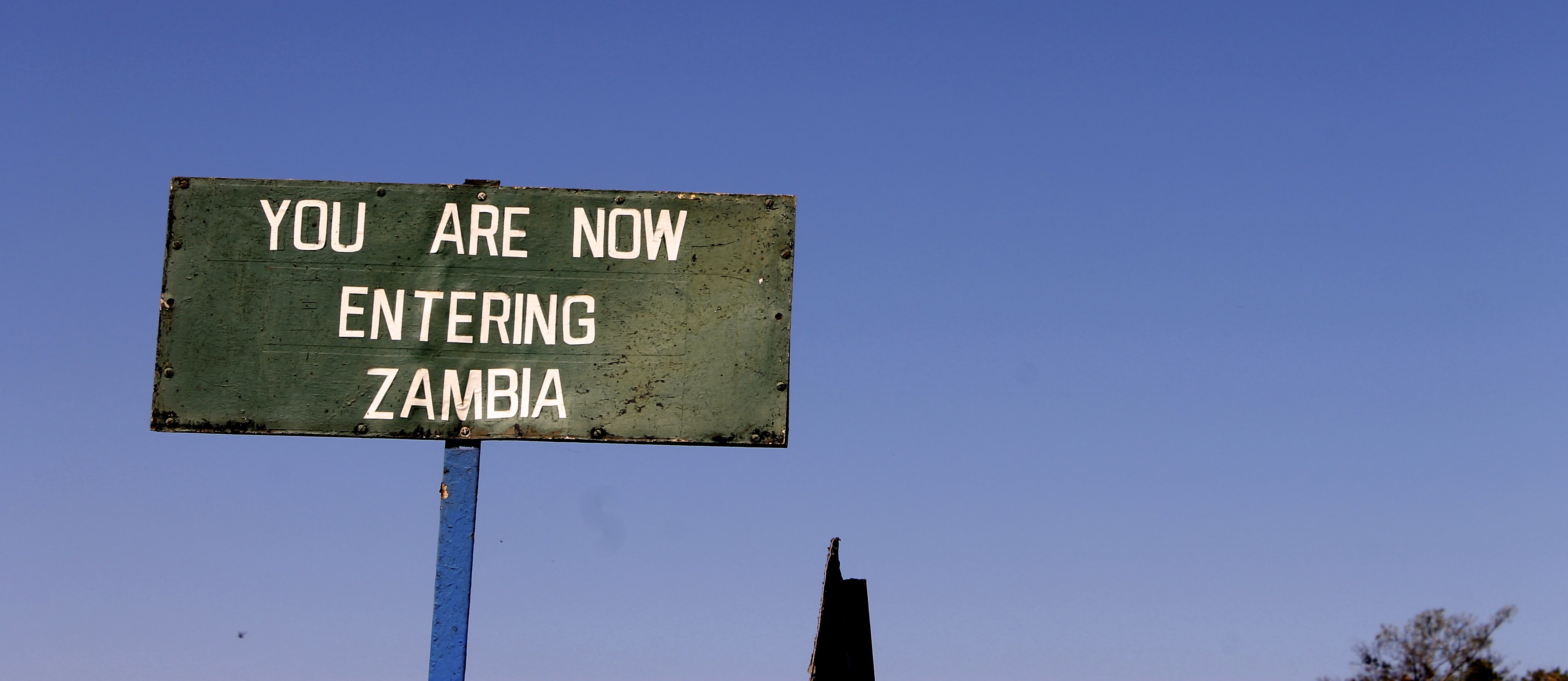
Welcome to Zambia!
I’d visited Zambia the previous summer, and also travelled through Namibia, Botswana, and Zimbabwe. While in Zambia – a country, like many in sub-Saharan Africa, where homosexuality is illegal – I interviewed Juliet Mphande, the Executive Director of LGBTQ organization Friends of Rainka. These were my original opening two paragraphs, for the writing class:
In Zambia, a landlocked country in southern Africa, Juliet Mphande leads an LGBTQ organization, Friends of Rainka, which aims to advance, promote, and protect the human rights of sexual minorities. It’s a difficult place to be doing that kind of advocacy. A 2010 study showed that 98% of Zambians find homosexuality intolerable compared with 11% of Ugandans who do find it tolerable. It is within this context that I arrange to meet Juliet at a Lusaka location that won’t bring too much unwanted attention to either of us. As I search for someone who could be her on the open-air patio of the restaurant we’ve chosen, a recent front page headline in Zambia’s daily national newspaper swirls in the back of my mind: “Cage Filthy Homos….they are worse than dogs.” This is not a place to be openly gay, even for a white, blonde Canadian like me. Finally, I spot a solitary woman at a booth just inside the restaurant. I join her, and we begin to discuss the reason I am there – to learn more about the situation of LGBTQ people in the country. “Enough is enough,” Juliet begins.
It’s summer 2013, and this is the first time I’ve considered myself an “unwanted tourist.” I am travelling through a country, as an openly gay person, where homosexuality is illegal. I’d been to other countries, also on the African continent, with jail sentences for the “crime” of homosexuality, but I wasn’t yet out – to myself, or to anyone else. Back then, I had an acceptable level of contempt for the laws of the countries where I travelled, but that was it. I didn’t have to think about my own personal safety. While I was incensed by other people viewing my friends as being “sinners” or less deserving of human rights, I now felt a new level of hurt, when that hatred and prejudice were directed at me.

A painting in the Lusaka national museum. I don’t know about you….but it appears to be depicting lesbian activity (which would technically be illegal). I think it’s beautiful.
It was a very surreal experience travelling through four countries where I knew I wouldn’t be allowed to live and truly be myself. Where I knew that people like me were struggling to live their lives in fear and hiding. There were glimpses of these lives as I wandered along my trip. I brought a Canadian LGBTQ flag with me, and took a photo of it in every country I was in – my own little act of rebellion. Then there were the other gay and lesbian travellers I’d subtly suss out and warm up to, like the woman who worked for MSF who spoke to me about being gay and working for an international organization in countries where homosexual acts are illegal. There was the book I stumbled across in the national museum in Lusaka about sexuality in Zambia, with its three paragraphs on homosexuality. It described how women in America “chose” to be lesbians because of fear of contracting HIV/AIDS.
Interesting.
And finally, I met with Juliet Mphande.

The incredible Juliet Mphande
And the final result of all this travel and exploration? My very first commissioned – and paid – piece published in Xtra on July 26, 2014, entitled Zambia’s Pervasive Homophobia. Hope you like it! The ending is one of my favourite parts:
I ask if she’s afraid and mention David Kato, a well-known gay rights activist in Uganda who was murdered in 2011. Mphande appears unfazed. “It’s not a job; it’s who I am,” she says. “The worst thing that could happen is to not be an activist.”
Shortly after I got back from my trip through southern Africa, I was killing time at the Indigo at Yonge and Eglinton before meeting a friend for dinner. There, just before I left the store, there was a table lined with books for Gay Pride. “Wow,” I thought. “I’m home.”
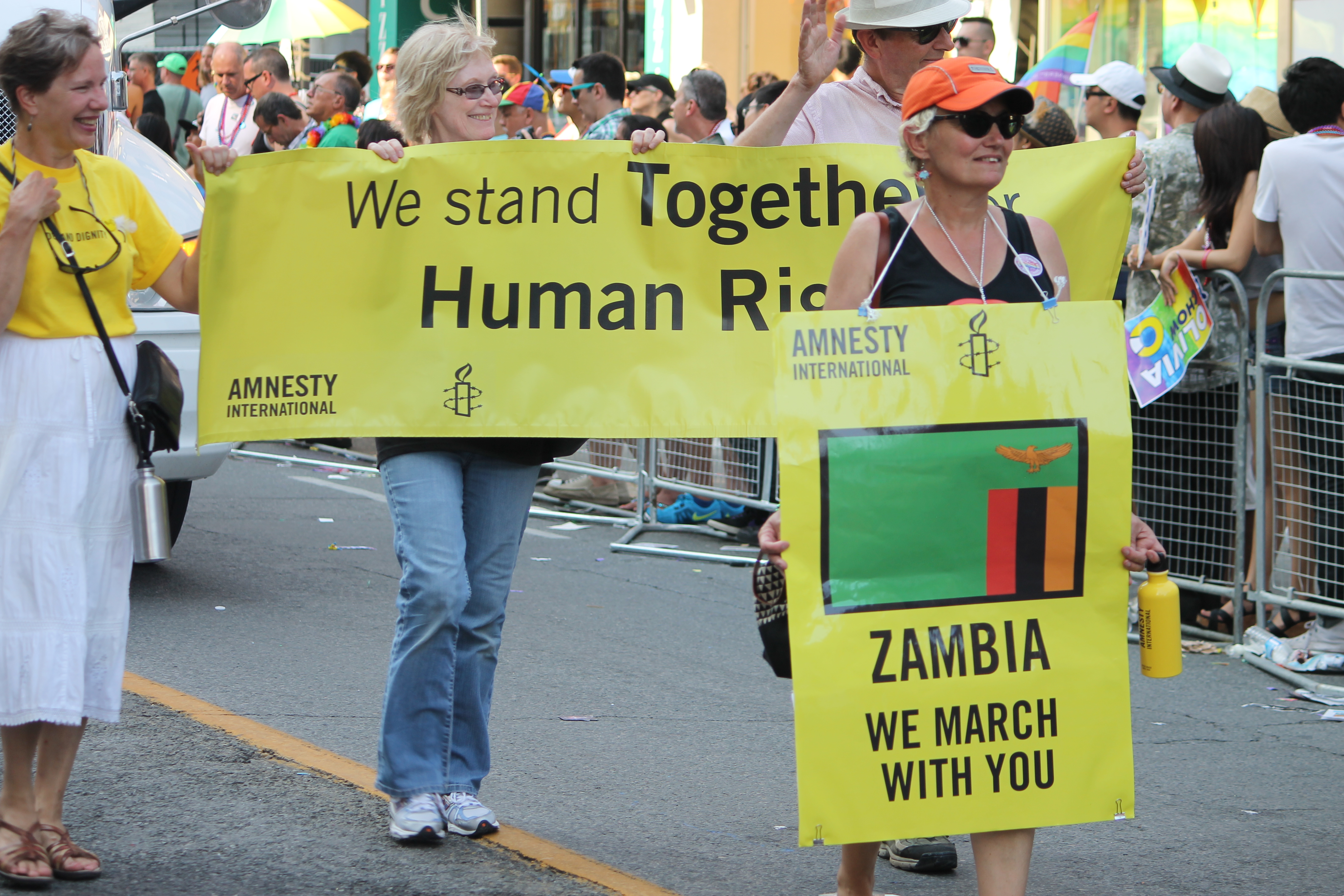
Amnesty International marching in the World Pride Parade, Toronto 2014
So I have this friend. Let’s call her Laura. And she has cerebral palsy. She’s probably my first close friend with a physical disability, and she uses a motorized wheelchair to get around.
We met a few years ago, and I’m still stunned by the types of interactions I witness between her and other people. There was the time a woman with a dog stopped us in the street – Laura has a helper dog, a gorgeous black lab – and started speaking to her and petting her dog. Laura had to explain that the labrador was working, which you think would be fairly self evident with the harness and everything (though I admit, it is hard for me not to pet him when he’s wearing his harness as he’s the sweetest thing ever). When she left, I turned to Laura and asked, “Do you know her?” Laura’s sarcastic response? “No. But we all look alike.”
Then there are the comments about her being heroic or an inspiration. They happen often. This TED talk by Stella Young can tell you a lot more about inspiration porn and the objectification of disability than I ever could.
And of course there’s often – I can’t even count the number of times – a patronizing “You can do anything you set your mind to!” from well meaning people. I often want to respond with “Yes, thank you, she knows that.” But then I’d be speaking for her, and that’s not something I want to do.
Which brings me to this past summer’s World Pride parade in Toronto, when the patronizing and infantilization was the greatest I’d ever witnessed while being out in public with her. We went to one of the accessible sections along the parade route to watch the floats go by, and I was treated like the all-knowing (probably paid) helper, and Laura like the young child who couldn’t speak for herself. There was one woman in particular, who was there with her elderly mother who couldn’t stand through the whole parade, who would only speak to me. Asking me what happened to Laura, for example – was she born that way or did she have a stroke? Because she looked just like this person she knows who had a stroke. (Ugh)
I remember one point when she turned to me and said, “Oh I’m so glad they gave her some beads” referring to one of the people in the parade who walk along the floats handing out stickers or buttons or cheap glittery beaded necklaces.
I wanted to snap back with, “She’s not a child!! She’s twenty-fucking-six. She’s getting her Masters degree!! FUCK.”
But I didn’t. I was polite. I just smiled and gritted my teeth.
The most recent situation was earlier this month during the Toronto International Film Festival, Laura and I saw Margarita with a Straw, a movie from India about a young girl with cerebral palsy who moves to the United States for school and falls in love with another girl.
The movie had its faults, and many of us were surprised when the main actress walked onto the stage with no signs of any disability. As the Q&A progressed, we realized that she didn’t even have a mild form of CP. She was an able-bodied actress portraying someone with CP. Even Laura was convinced she had CP while she was watching the film. And that brought up a whole litany of issues like – why aren’t disabled actors used to portray their own stories? Is it ok that an able-bodied actress played the role flawlessly, with realism and depth? Is it ok to view the movie differently just because the main actress is able-bodied in real life?
I don’t know the answers to these questions; they’re great discussion questions, and Laura and I did discuss them as we walked out of the theatre, along with a couple of other friends. That’s when we passed a TIFF volunteer, an older lady, who stepped in to filter the traffic around us, with these incredible words:
“Please step aside for this poor lady.”
I wanted to respond with, “Ok, see that movie we just came out of? You need to go see that and then get some sensitivity training.”
For fuck’s sake.
It’s only when I’m with Laura that I truly see how much of an ableist society we live in. And how much privilege I have being able-bodied. The examples above are only the examples I’ve experienced of real, blatant ignorance when it comes to disability . And I’ll admit, before I met Laura and before I started to read about disability and ableism, I fell into some of those categories discussed above.
But I haven’t even mentioned things like accessibility. That would be a whole other blogpost – or 10. I try to notice how many times I use stairs to get into a building or an event. But really, it doesn’t usually cross my mind unless I’m with Laura. Because I don’t have to think about it in my everyday life, when I’m going about my business alone. Take the TTC for example. This map was recently posted of what the TTC looks like if you’re using a wheelchair.
And this is just my experience, as an able-bodied person with a friend who happens to have cerebral palsy. I can’t even imagine the frustration that my friend deals with on a daily basis. If you’re intrigued by what I have to say, please check out some of the disability activists who blog like Glenda Watson Hyatt, Dave Hingsburger, and Stephen Kuusisto.
Do you have some favourite writers in the blogosphere? Let me know in the comments!
Aug 11
This gallery contains 31 photos.
Yesterday was the first time I went to a rally since the assault on Gaza began over a month ago. Here’s a summary via the signs from both sides:
The following is a reflection I wrote for an ecumenical organization based on the lectionary readings for this past weekend. The prayers are from The Revised Common Lectionary. For a variety of reasons, the organization decided not to publish it. I asked if I could post it to my personal blog, and was given permission. So here it is, my views on the situation in Gaza as of July 11:
O God of Jacob,
you speak in the light of day
and in the dark of night
when our sleeping is filled with dreams of heaven and earth.
May Jacob’s vision
remind us to be open and watchful,
ready to discover your presence in our midst. Amen.
The lectionary readings this week are quite challenging. There’s a lot about enemies, heirs of God, of people being thrown “into the furnace of fire, where there will be weeping and gnashing of teeth.” As a non-theologian, with a background in international relations and human rights, these passages are difficult for me to process. But they did make me think of the current situation in Israel and Palestine.
A few weeks ago, three Israeli teenagers were found murdered in the West Bank and a Palestinian teenager was burned alive in East Jerusalem in suspected retaliation. As I write this, hundreds of rockets are being fired from Gaza into Israel. Israel has launched its largest offensive on Gaza targets since November 2012 and is lining up troops for a possible ground invasion. The death toll mounts. Defence for Children International Palestine, a United Church partner, documented 14 children killed by Israeli air strikes on July 8 and 9 alone. Who knows what the situation will look like a week from now, when this reflection is published?
“And he dreamed that there was a ladder set up on the earth, the top of it reaching to heaven; and the angels of God were ascending and descending on it. And the LORD stood beside him and said, ‘I am the LORD, the God of Abraham your father and the God of Isaac; the land on which you lie I will give to you and to your offspring’…So Jacob rose early in the morning, and he took the stone that he had put under his head and set it up for a pillar and poured oil on the top of it. He called that place Bethel.” (Genesis 28:12-19a)

United Church Ecumenical Accompanier Sherry Ann Chapman and Renate Wolfson, from Women in Black. For Sherry Ann’s post about Renate, see her blog post
For some, the place where Jacob had his dream – the place he’s named Bethel – is Beitin, a Palestinian town in the West Bank. Nearby, the illegal Israeli settlement of Beit El bears the same name as the one Jacob proffers.
The root of this violence is in the ongoing illegal Occupation of the West Bank and Gaza; organization such as Jewish Voice for Peace and the World Council of Churches affirm this. One way towards peace is to promote nonviolent resistance aimed at ending the illegal Occupation, the systematic injustice that affects all Palestinians regardless of whether or not they have taken part in violent resistance. This collective punishment of Palestinians – starkly evidenced in the aftermath of the kidnapping of those three Israeli teenagers when over 400 Palestinians were arrested, 200 of whom still remain imprisoned without charges as I write this – is illegal under international law. It is also not part of Jacob’s dream, a dream where angels are able to move freely up and down the ladder between Heaven and Earth.
The Palestinian people do not have this type of freedom of movement. In June 2012, there were 542 checkpoints and roadblocks in the West Bank compared to 376 in August 2005. Palestinians have to apply for permits that are not always granted in order to leave the West Bank and enter Israel; in Gaza, it’s practically impossible to leave, even for medical reasons.
Is this really Jacob’s vision? Jacob is a revered figure – a patriarch – in all three of the major monotheistic religions. Surely his vision is better realized by the peaceful, equal, and self-determining coexistence of all peoples in and around the city of Jerusalem, deemed holy by all three traditions.
It’s difficult in times like these to know what action you can take personally. One way is through the United Church’s Unsettling Goods campaign, which uses nonviolent economic action against three products made in the settlements to promote peace through an end to the Occupation. May the dream of Jacob come true in this world… sooner rather than later.
To fulfill the ancient promise of salvation, O God,
you made a covenant with our ancestors
and pledged them descendants more numerous than the stars.
Grant that all people may share in the blessings of your covenant,
accomplished through the death and resurrection of your Son
and sealed by the gift of your Spirit. Amen.
 Kaitlin Geiger-Bardswich