I Didn’t Cry at the TRC
I didn’t cry at the Truth & Reconciliation Commission in Edmonton this week.
Don’t get me wrong – I was moved. I welled up, from the tips of my toes to the top of my head. I wanted to cry. But I didn’t; the tears wouldn’t come.
I wish I’d shed them while I was part of this historic event. That I could’ve added my tears, and the tissues they were dried on, to the Sacred Fire like so many other participants did. That I could be part of such a beautiful and sacred ritual.
But the tears wouldn’t come.
I think it was partly from working throughout the event – from constantly taking photos and videos, sending tweets, writing Facebook posts, and recording notes so that I could write further, thoughtful reflections after the fact. Reflections like this.
When I’m in “work mode,” I put up a wall around me. I don’t let the emotions get to me, because I feel I need to be objective and rational and record the stories, and to get emotional would be to do a disservice to the people who’s stories I’m recording. I know this is likely flawed thinking, but it’s what I did when I was researching both my undergraduate and graduate dissertations – on the use of rape as a tool of war, and the rights of children conceived through rape during the Rwandan genocide, respectively.
I think, overall, it’s for self-protection. I numb myself to the stories. I take them in, I preserve them and protect them inside of me, and then I set them aside for another time. For when I feel that I can truly feel them.
And I know this is probably a very “White” way of dealing with emotion.
But the stories never leave – even while I continued working, they remained with me. Just below the surface.
And I don’t want them to ever leave.
I want to constantly be reminded of what my country, my church (both the one I was born into and the one I now consider home), and my people did to an entire civilization of numerous, diverse, and amazingly rich cultures.
I want to always remember the Métis woman who told the story about a relative who could only whisper “It wasn’t very good” when asked about the residential schools.
I want to remember the woman whose grandmother left school with a Grade 4 education, had a mental breakdown, and spent the rest of her life in psychiatric hospitals.
I want to remember the countless survivors, men and women alike, who told of returning to their communities, where 95% of the population had become alcoholics to deal with the trauma of having their children literally ripped out of their arms.
I want to remember the countless stories I heard of abuse – physical, mental, sexual and spiritual. Of the many rapes. The forced sterilizations. The neglect. The humiliation. The loss of language. The forced feeding. The shame.
It’s that shame that really hit me hardest. The shame that survivors said they felt, about everything that happened to them. The survivors who said they were dirty, unworthy, after being raped. It’s that shame – that second dose of victimization that perpetrators impart – that adds to my anger.
I know the tears will come. Maybe not today, but soon. Most likely when I find time to sit alone, to really look at the photos I took and truly watch – and listen to – the videos I shot. To listen to the testimonies I didn’t get to hear.
As I heard numerous times throughout the TRC, tears are nothing to be ashamed of. They are meant for healing, a way towards healing.
I don’t know if I’m ready for healing yet. I think I need to feel some of the pain first, to hold some of the shame and guilt and atrocities that my people perpetrated, if only so that I feel a need to constantly tell other people about it.
To convey what we did, so that it will never happen again.
Maybe then the tears will flow more freely.
My first experience with the Truth & Reconciliation Commission
Well, I’m back and I’m blogging about Indigenous Justice and Residential Schools. As you saw last year, I’ve been called “offensive as a Canadian” for speaking about the situation of Aboriginal peoples in this country today. And in the past.
This weekend, I’m attending Canada’s Truth & Reconciliation Commission. It’s the last national gathering, taking place in Edmonton, Alberta. I’m learning more and more about Canada’s shameful history of residential schools, when we tried “to kill the Indian in the child.”
But Aboriginal peoples are resilient. They are survivors. They are still here. The designers of the residential school system have failed.
I feel so privileged to be spending time with this amazing woman – Leading Elder Lorna Standingready – this weekend. Tomorrow I’m sitting down with her for an hour interview as she tells me her story of spending 10 years in residential schools.
More writings and reflections to come. In the meantime, follow my work tweets and Facebook posts, and check out more of the videos I’m filming on the official United Church of Canada youtube channel.
Will write more tomorrow – there’s so much to say and so much still to learn. I am a non-Aboriginal witness, and that is a role I take very seriously. It’s the least I can do as I grapple with my own responsibility, and that of my ancestors, in the treatment of the First Nations people of Canada.
Chipembi – A School Without Books
This post is adapted from an article I recently wrote for my church (Trinity St. Paul’s United Church in Toronto) newsletter, the TSP Times. I’ve added some more photos and descriptions.

The mural painted on the side of Chipembi basic school
This summer, I spent three weeks travelling through southern Africa – Namibia, Botswana, Zimbabwe, and Zambia. While the first three countries were vacation, I was in Zambia for another reason. Namely, to visit TSP-er and recently retired Executive Minister of the Partners in Mission Unit at the General Council Office, Omega Bula – and to take her up on her offer to “come and see” Chipembi, in central Zambia.
Chipembi is a beautiful place with beautiful people, but it’s also a place of poverty. The focus of this piece is on Chipembi Basic School – the primary school in the area; I visited one of the Grade 4 and Grade 9 classes there. The Grade 9 class was full of young teenagers eager to get out into the world, to become doctors, teachers, lawyers, and nurses. But looking at the history and current state of the school, it was heartbreakingly difficult to imagine those dreams coming true. In the history of the school, I was told, only 2 students have gone on to university; some others have gone to college. And, most disturbing, and likely the reason for this low number, many if not most of the children do not know how to read.

Helen attempting to read simple sentences
The problem is not a lack of qualified teachers, or committed parents. Though the reasons for this lack of literacy are many and multi-faceted, the main problem, teachers explained to me, is the lack of textbooks. Each class has one book – for the teacher to use as s/he then transposes words on the chalkboard to instruct her/his students. And many of these limited textbooks are old and falling apart. What the classes need are Zambian curriculum textbooks, one for each student in a class. Students need books in order to learn, especially to learn to read.
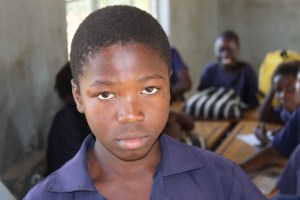
Bonaventure
This is Bonaventure. He walks 10 km each way to school, which takes almost 2 hours. He lives with his parents. As they have a low income, he has not yet paid the 20 kwacha ($4) in this semester’s fees. When I showed him his photo on my camera, he broke into one of the biggest smiles I’ve ever seen.
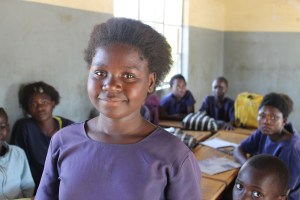
Helen
Helen is 13 years old. She walks 45 minutes each way to school. She moved to Chipembi a few years ago after her mother died, to live with her father. Her grandmother pays her school fees. She cannot read.

Phinious
Phinious is 10 years old. He walks almost 2 hours each day, to and from school. He lives with his grandmother; they have money issues and he has not yet paid for this semester. He cannot read.

Manasse
This is Manasse. She is 12 years old, and repeated a grade. She stays with her aunt and uncle at the Farm College in Chipembi, so has a short walk to school. She can read very basic sentences.

The fourth grade class
Benjamin Whitney, from Ottawa, recently visited Omega with his parents. When he returned to Canada, inspired by the people he met and the community he witnessed, he and two others – Jennifer Van De Vooren and Sebastien Wardell – federally incorporated the non-profit Literacy for Africa. You can find them on Facebook. They will start with ensuring there are adequate textbooks in Chipembi, but not stop there; Chipembi will be the pilot project of a hopefully successful relational program that moves beyond that community.
Trinity St. Paul’s United Church is well-known for its social justice advocacy. The goal of this initiative is to support systemic change through education, namely through literacy. By supporting Literacy for Africa, TSP would be working in partnership with the Zambian education system to ensure students in Chipembi have regular access to Zambian textbooks. If we focus on getting the Grade 1s textbooks, and then the Grade 2s, and so on, we are helping to equip an entire generationof Chipembi children for a solid future.
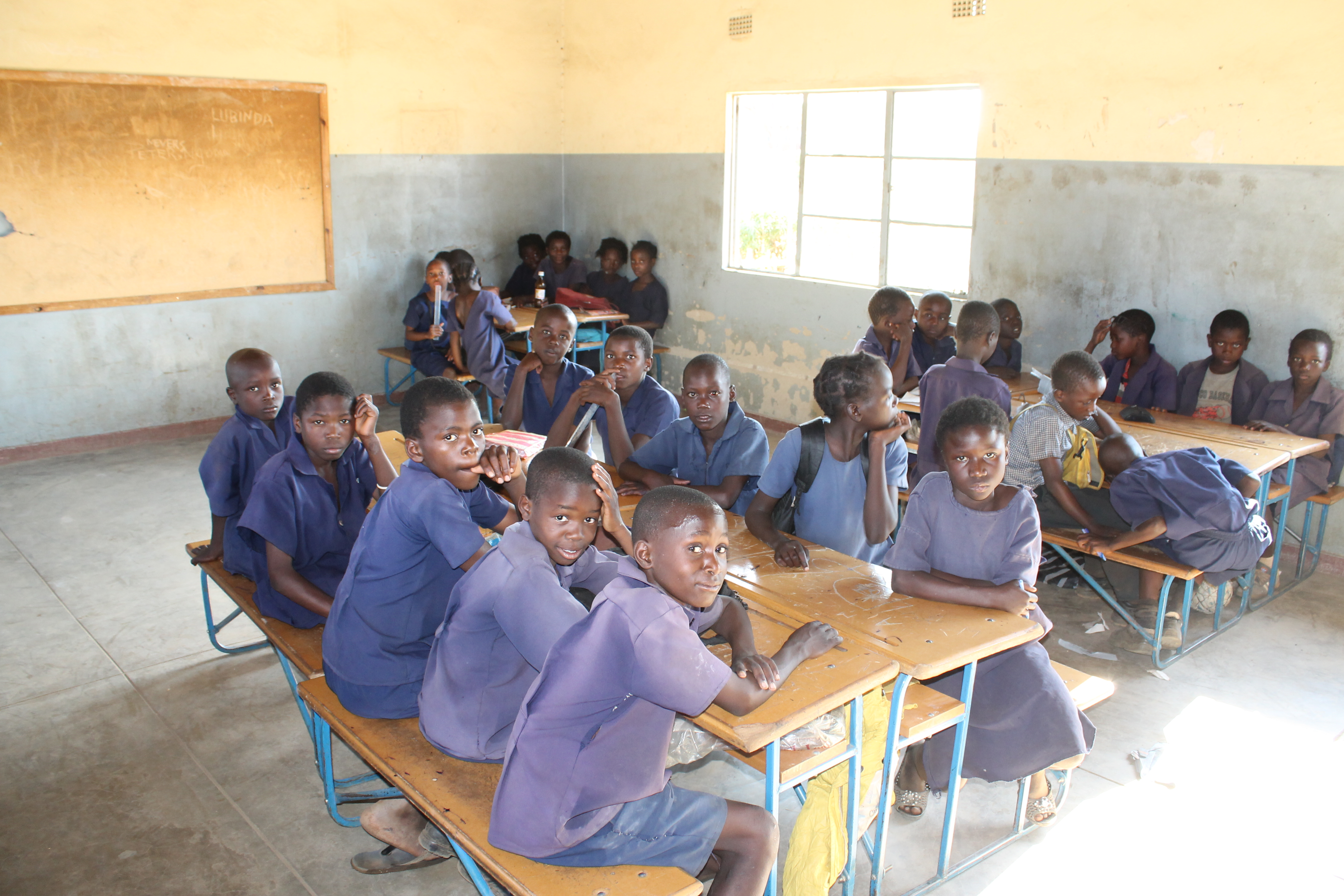
Fourth grade class
Many of you who have visited communities like Chipembi know how important literacy and education is, as it is for Canadian children. All children deserve a solid education, so I encourage those of you who are interested to consider donating to or volunteering with this very worthy cause. The fundraising has begun and is going strong, but more is needed to support all the grades. You will behelping to affect positive change, in one individual and one community at a time.
I love this photo. I love the defiance on her face, the strong stare. I hope this kid goes far.
* Note: All of the children were asked for their permission before taking their photo, and copies of the photos have been sent back to them and their families.
Focusing on the Positive
I’ve let myself down to a certain extent. There have been some more quite negative situations occurring at the conference, and I’ve let them tarnish my experience here. I have let certain people, who are in the minority, control my experience of the conference and distract me from all the wonderful people and ideas that are floating around me. I will list them, purge the negative, and then move on.
First, we had one speaker a few days ago come to speak to us about the use of social media to start a movement. In his case, it was a movement against FARC in Colombia. One of our young leaders, also from Latin America, began to ask him a question, and obviously had a slightly differing approach to the situation. The speaker immediately cut him off, attempting to shut him down. He said, “I’m not answering your question! I’m not answering your question! Next question!” And basically called him a Communist. The rest of us young leaders intervened, saying he had the right to be heard. Our moderator stepped in, calmed the speaker, and the young leader was allowed to finish his statement. The speaker did apologize towards the end of the session, but then told the young leader that he shouldn’t bring up things like that because he’ll start fights.
Right.
Then we have had some sexual harassment issues among the young leaders. One male young leader in particular, the same one who told me that gay people are spreading disease throughout society and it’s the greatest sin of all sins etc, has been sexually harassing many of the girls here. Even the girls who haven’t been directly affected say that they feel uncomfortable around him. His attacks have ranged from unwanted attention, telling girls he wants to take another wife, calling girls sinners for drinking, etc, and then on the extreme end, telling a girl that her “problem” is that she’s not a virgin. When she told him to f*** off, he got very aggressive, telling her to “watch her tongue” and that “if she wasn’t a girl, she would do something to her.” Later that evening, he told his roommate that he “wanted to f***” this particular girl. And he said this three times.
As would be understandable, many of us are outraged by this behaviour. I will speak for myself right now, but I feel that this behaviour is not the behaviour of a young leader. I feel that he should not be able to call himself an Echenberg Fellow nor should he be part of the network we will be creating afterwards. Of course, I will experience people who disagree with me everywhere I go, but there is a difference between disagreement and outright offensive and aggressive speech and behaviour. Those types of things, while we may encounter them, should not be tolerated.
A third thing that is getting on my nerves is the founder’s constant use of the words “facts and context.” You have to have “the facts and context” before you make any statements, they constantly say. And this is obviously a code for Palestine/Israel. It was even said at the opening of the “adult” conference that the worst offender of political correctness, double standards, selective facts, etc was the UN Human Rights Council. Man! Can we even have a conversation about Israel and Palestine? Like an actual conversation?!?
Phew! Ok, I’m done. Will write again tonight, post some photos, and concentrate on trying to get the most out of this amazing opportunity, even though it’s not perfect.
But don’t worry, I will continue to speak Truth to Power.
I Wonder: Am I at a Human Rights Conference?
I warn you: this is the blog post in which I vent. The blog post that is controversial, is quite critical, and I admit is biased. It’s how I feel about all that has happened, and what my emotions are.
First, yesterday, we had a conversation about the blogs we wrote before coming here and the Facebook discussions we had about them. The facilitator asked me if he could use a conversation I had with another young leader, since it garnered the greatest number of comments. It started out as a blog post about the voices of homosexuals in Uganda being silenced. It elicited a very positive response re this human rights issue, with both me and another young leader “coming out” to the group. In fact, I said I was a bit worried about attending this conference because I’d been to a similar “young leaders” conference where I experience some homophobia, and now I felt silly about that because the response was so positive.
Then someone else jumped in. Someone who said LGBTQ people are spreading disease throughout society. And quoted those infamous Bible passages. Ignorant, yes. And I was surprised and saddened that I had to deal with this at a human rights conference based in Canada! Once I arrived here, I learned that said individual is not in fact Christian, but is Muslim. Which angers me to no end, that someone is using my holy book, when he is not of the same religion, to say that I am a sinner of one of the gravest of all sins!! And the Qur’an doesn’t even say anything about homosexuality!!
Then, today I did a presentation on Idle No More. In a very short amount of time, about 10 minutes (this was part of a larger workshop), I tried to give some context as to why Idle No More was founded and grew. I stated the fact of colonization, of genocidal policies that saw the deaths of the majority of the Aboriginal population in Canada. I began by asking if anyone knew who’s land we were currently on. Of course, no one did. I didn’t know until I looked it up myself, that this land is Kahnawake Mohawk Territory. I spoke of the residential schools, of cultural genocide, and tried to give a balanced approach by speaking about how my church, which happens to be the organization I work for, was complicit in these schools. How both the UCC and the Canadian government apologized for these schools, but that an apology is not enough in either case. What happens after the apology, to restore right relations, is what counts.
I tried as best I could to not speak on behalf of Aboriginal people. I showed videos of young people speaking about the movement, including an awesome rap video. I spoke about how I, as a white settler, enjoyed more funding for my education and my health care. I spoke about the amazing Cindy Blackstock and the government’s efforts to spy on her and derail her case against them, rather than actually look at the issues she raised. And I talked about Bill C-45, the women who started Idle No More, and stated INM’s vision as stated on their website.
I’m the only Canadian young leader at this conference. I carry this as a badge of honour and as a serious responsibility. It is not my job to put on a good show for the visiting young leaders, to pretend that Canada is this perfect example of democracy and respect for human rights when that is not the case. So I chose to do a case study on Idle No More, and to explain the situation as best I could, from what Aboriginal people have told me. Not to come up with solutions, not even to critique the movement at all. My part of the presentation was simply context-setting.
So I began my part of the presentation with a caveat. I said that Canada is a great country, that it does, by and large, a good job when it comes to human rights. But it is not perfect. And I hold it to a higher standard because (1) I am Canadian, so who else should do it? and (2) Canada is a democracy. It is not Syria or the DRC. It is a First World democracy and if it purports to be that, it should be that for all citizens.
Afterwards, one of the funders of this conference, a Canadian, who had been sitting in on this workshop told me that my presentation was “offensive as a Canadian.”
Like, whoa.
I was obviously upset when I heard this, as I was expecting some disagreement but not that my presentation was “offensive” to my country or as a Canadian. It smacked of the nationalistic sentiment that one should not criticize one’s country, out of loyalty or patriotism or whatever. I wish I’d said, “Y’know what I find offensive as a Canadian? The average standard of living for Aboriginal people.”
This person did apologize to me afterwards, twice. I understand that this person may get their back up when they hear criticism of Canada, but it still makes me wonder – this is a human rights conference, correct? It’s not a conference about how the rest of the world is violating human rights and Canada is so awesome. It’s a conference about the human rights of all citizens of all countries and, I thought, to acknowledge how minority groups in those countries are the most vulnerable to human rights abuses.
The other young leaders generally supported me. One of them even sent me this article after. I’m glad they were listening; I’m glad they got to hear a snippet of the truth and not only the “official party line.”
Finally, I recently discovered that the Centre for Israel & Jewish Affairs is one of the sponsors of this conference. Basically, they do not like the United Church of Canada, and have told Canadian Jews to have nothing to do with “The” United Church or United churches because of the recent decision to take economic action against Israeli settlement products. And I work for the UCC. So this could be interesting.
It hasn’t come up yet, but I sense there is a fear to bring it up. I’ve spoken to others who work/study at McGill and those attending the conference, and there’s a general feeling that speaking about the conflict in Palestine and Israel would be uncomfortably controversial, based on the opinions of some of the conference’s funders and sponsors. I hope Palestine comes up soon. I won’t be bringing it up, as I feel I need to fly under the radar a bit for my own sanity and emotional health. But if it is raised, I will not back down from what I feel is right – that Israel has a legitimate fear for its safety but that that does not justify collective punishment against the Palestinian people. Maybe throw in the fact that it is Canadian foreign policy that the settlements are illegal. And I hope that when it is raised, there will be calm discussion, rather than personal attacks or accusations of anti-Semitism.
So, this brings me to my final questions: Is this a human rights conference? Or is it a human rights conference for everyone except maybe LGBTQ people, Aboriginal people, and the Palestinians?
Jazz with Leon the Llama
This weekend has been a bit like the calm before the storm. It’s been very relaxing, but I know that the rest of the week is going to be intense, when we really jump into the young leaders’ forum and what I refer to as “the big whigs” or “adult” conference.
I arrived yesterday and had dinner with several of the other young leaders here. They’re all pretty amazing, and from all over the world – India, Kenya, UK, USA, Australia, Burma, Jordan, Oman, Nepal, Turkey, Sierra Leone, Zimbabwe, Egypt and the list goes on.
Then my lovely friend Sarah Shepherd (I promised she’d get a shout out!) came over to meet us and we went to this lovely little jazz club off of Rue St Denis.

Drinking a Manhattan at a Jazz Club in Montreal
This morning, the organizers took us for a quintessential Canadian experience – the (maple) sugar shack. I was excited – I haven’t been to a sugar shack since I was in high school! And it had a petting zoo!! Albeit it was fairly anti-climatic. But at least we did get a big “Bienvenue!” from Leon the Llama.
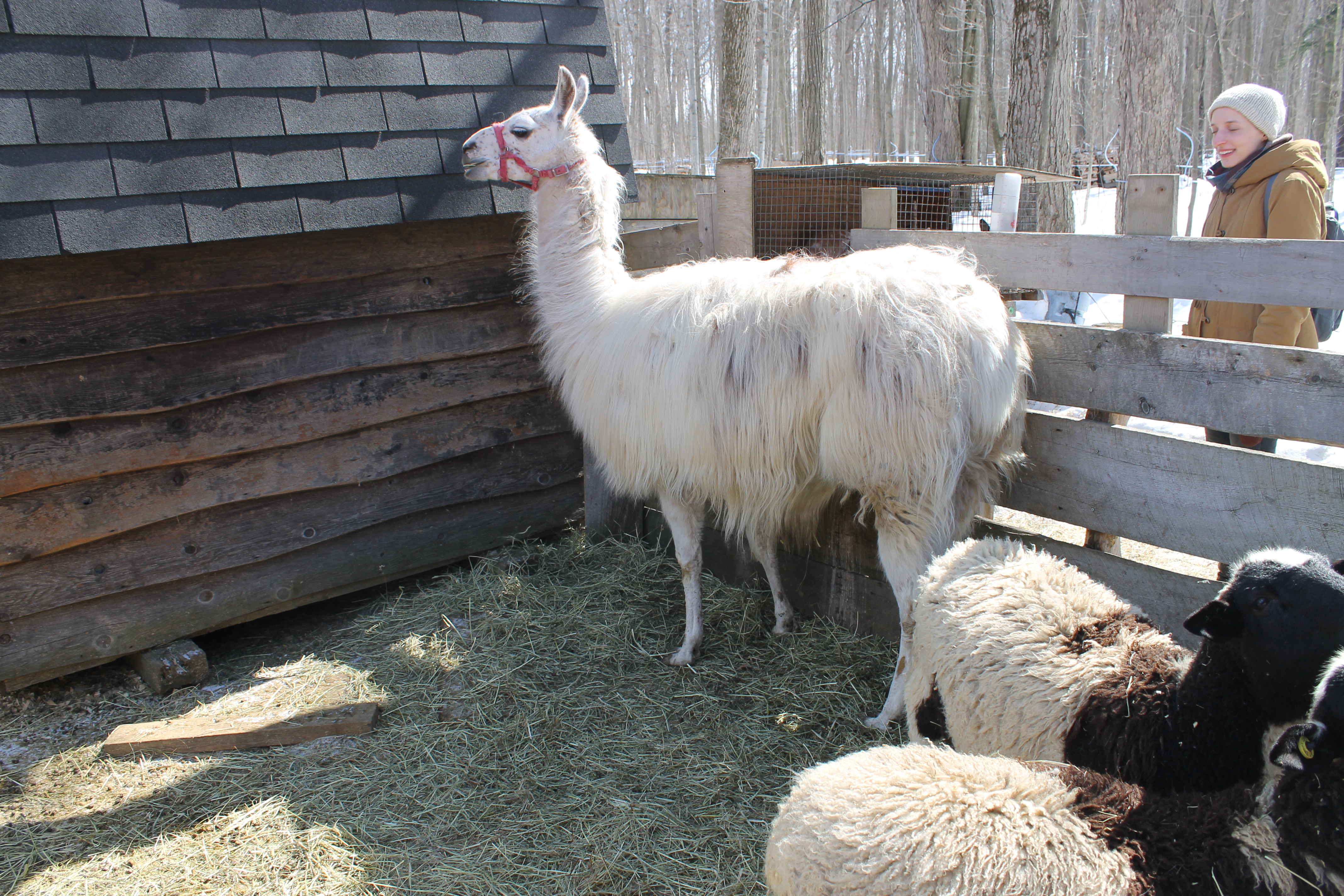
Leon the Llama
There was some explanation re how llamas are not indigenous to Canada.
Anyway, we had a taste of Quebecois cuisine at the sugar shack, which ended up not being so accommodating for those who were vegetarian or couldn’t eat pork due to religious reasons. An interesting clash of cultures, I thought.
A relaxing evening, but of course I had to have a beer for St. Paddy’s Day! I think they take away your Irish citizenship if you don’t.
Happy St. Paddy’s Day to all!
Beginning Again
I’m starting up this blog again, just in time for my journey to Montreal, where I am participating in McGill University’s Global Conference on Democracy, Human Rights and the Fragility of Freedom, the third Echenberg Family Conference on Human Rights. I’m attending as a “Young Leader,” along with 24 others from around the world.
I’m currently on the train, on my way to Montreal, a city I’ve never visited before. And yes, I realize the ridiculous fact that I’ve been to Rwanda but somehow haven’t made it to Montreal, even though I’ve lived in the GTA for most of my life!
Anyway.
I’m excited for this conference! It’s an amazing opportunity, a chance to network with prestigious people from around the world. I hope to blog regularly, to share my musings while I engage in sometimes difficult debates around human rights. I’m sure it will be an adventure!
Actual Last Post
Well, my last post was supposed to be my last post, but since the UCC has created a 4.5 min “Report from Durban,” I figured I should post that too. Just to bring everything to a close.
Enjoy!!
Holy sh*t, it’s had 364 views so far! That’s a lot of people!
Looking to the Future
Well, after only 33 hours of travel, I’m safely back in Toronto. It was a long journey, and I kinda feel like I don’t know what day it is (it feels like I missed Monday – how is that possible?). I’m back at work at Church House tomorrow, but first, this morning, I went to see my friends Sarah and Jon’s new baby Jacob, who was born while I was away, on November 21.
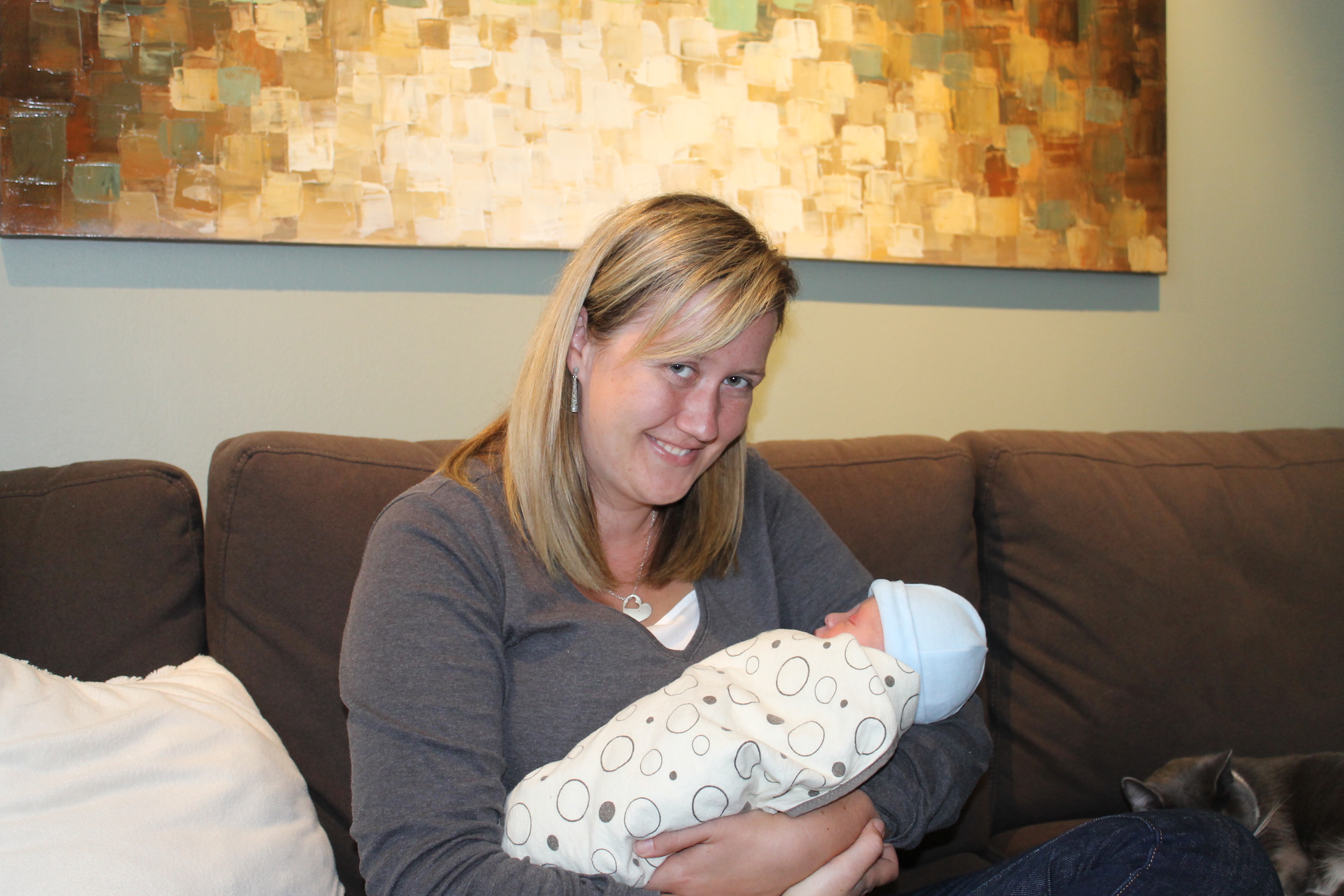
Me with Jacob and Bobby (the cat)
I was so excited to meet Jacob, as I’d thought about him a lot while I was in Durban. Sometimes, Durban felt very doom and gloom – a bit like “We’re all going to die!” Things are getting desperate; things are getting serious, and we really need to start taking concrete action, well before 2020. I heard several people talk about saving Earth for our children and grandchildren. Some even broke down, saying that they wanted their grandchildren to live in a world where they “wouldn’t be burned.” It got pretty heavy at points, and sometimes I even felt helpless. What kind of world are we bringing our children into?
I remember one day in Durban, after the briefing with Ambassador Guy Saint-Jacques, I was talking to Moderator Mardi Tindal about having kids. I’d like to have kids, maybe in 5 years or so, but I sometimes wonder if I even should, with the state the world is in. The Moderator told me that many people also felt this way in the 1970s, when nuclear war felt like a very real threat. But, she said, “We still need to have hope.” Despite feeling hopeless at times, we need to hold on to our hope and our faith that we can change the course the world is on, and preserve Earth for many generations to come.
The Moderator told me about Madeleine L’Engle, and her words about bringing children into a non-perfect world:
This is no time for a child to be born,
With the Earth betrayed by war and hate
And a comet slashing the sky to warn
That time runs out and the sun burns late.That was no time for a child to be born
In a land in the crushing grip of Rome
Honor and truth were trampled by scorn —
Yet here did the Saviour make his home.When is the time of love to be born?
The inn is full on planet earth,
Any by a comet the sky is torn —
Yet Love still takes the risk of birth.– Madeleine L’Engle
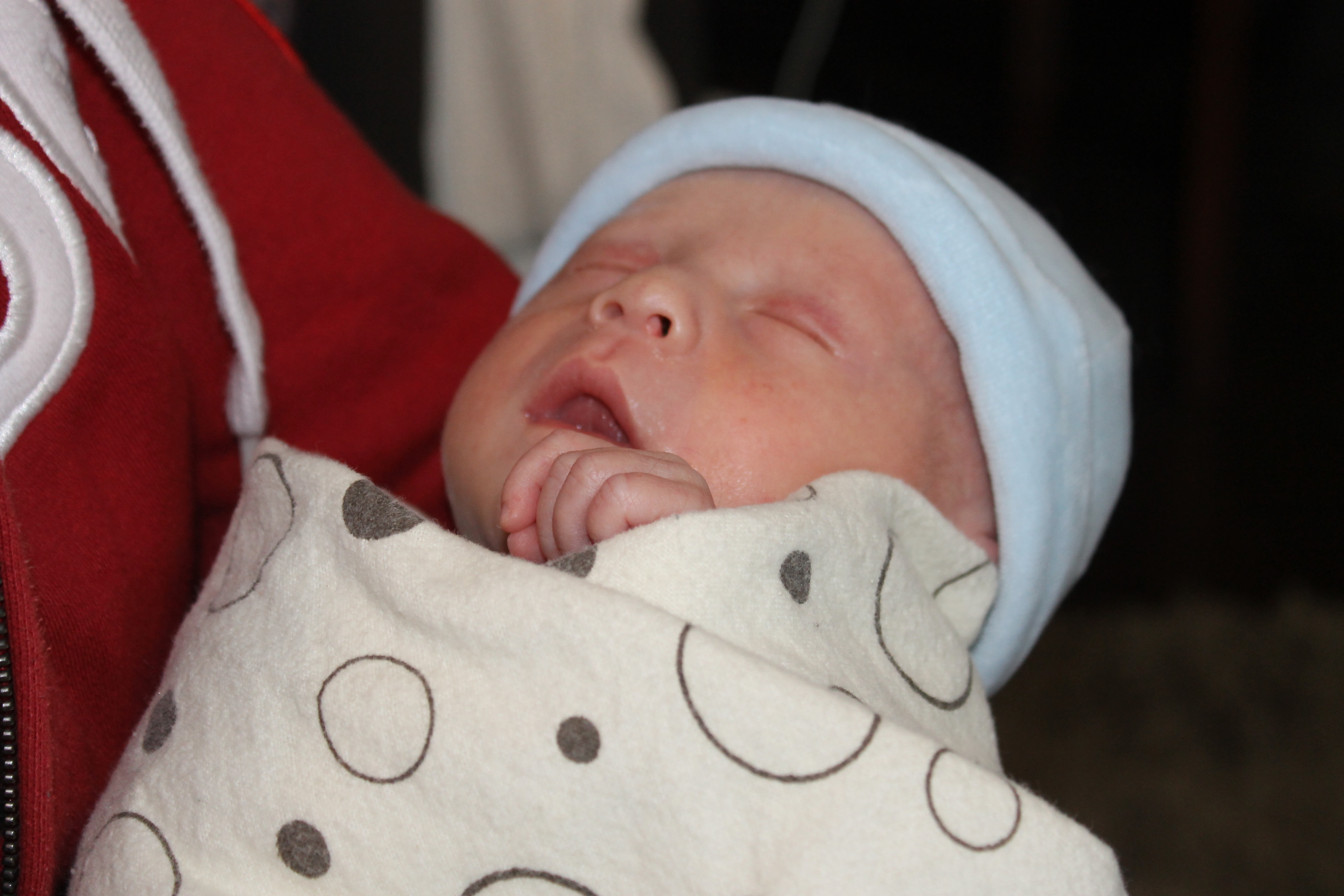
Because, really, isn’t this what it’s all about??
Merry Christmas, everyone.
Resolution??
My last few days in Durban were pretty eclectic. At the Centre, we spent most of the last 3 days working on our individual projects. These are projects related to eco-justice, and centred on youth, that we will be implementing back in our home countries. We presented them to each other in small groups, giving each other (hopefully) constructive feedback.

Project Group A
Friday afternoon was free, so naturally a few of us went down to the ICC (where the COP is being held). Our first stop was at the Occupy COP site, where we affixed our sign from the previous weekend’s rally to the fence surround the site, facing the ICC.

Our sign at Occupy COP
Next, Claire (UK) and I went into the ICC to see what was happening. The sessions were closed to us, even though we were accredited, at this point because only certain key people were allowed into the negotiations. Claire and I took a photo of our accreditation badges, just in case they got taken away at a protest. Mine was not; Claire’s was, when she, and a group of others, sat down in the ICC in silent protest. Again, how is this a security threat?? And how is Canada’s position at these negotiations not a security threat?

Look Ma, I’m accredited!!
Inside the ICC, there was a big protest near the Plenary. Interested, we went to investigate, and met some of our fellow Youth for Eco-Justice participants.
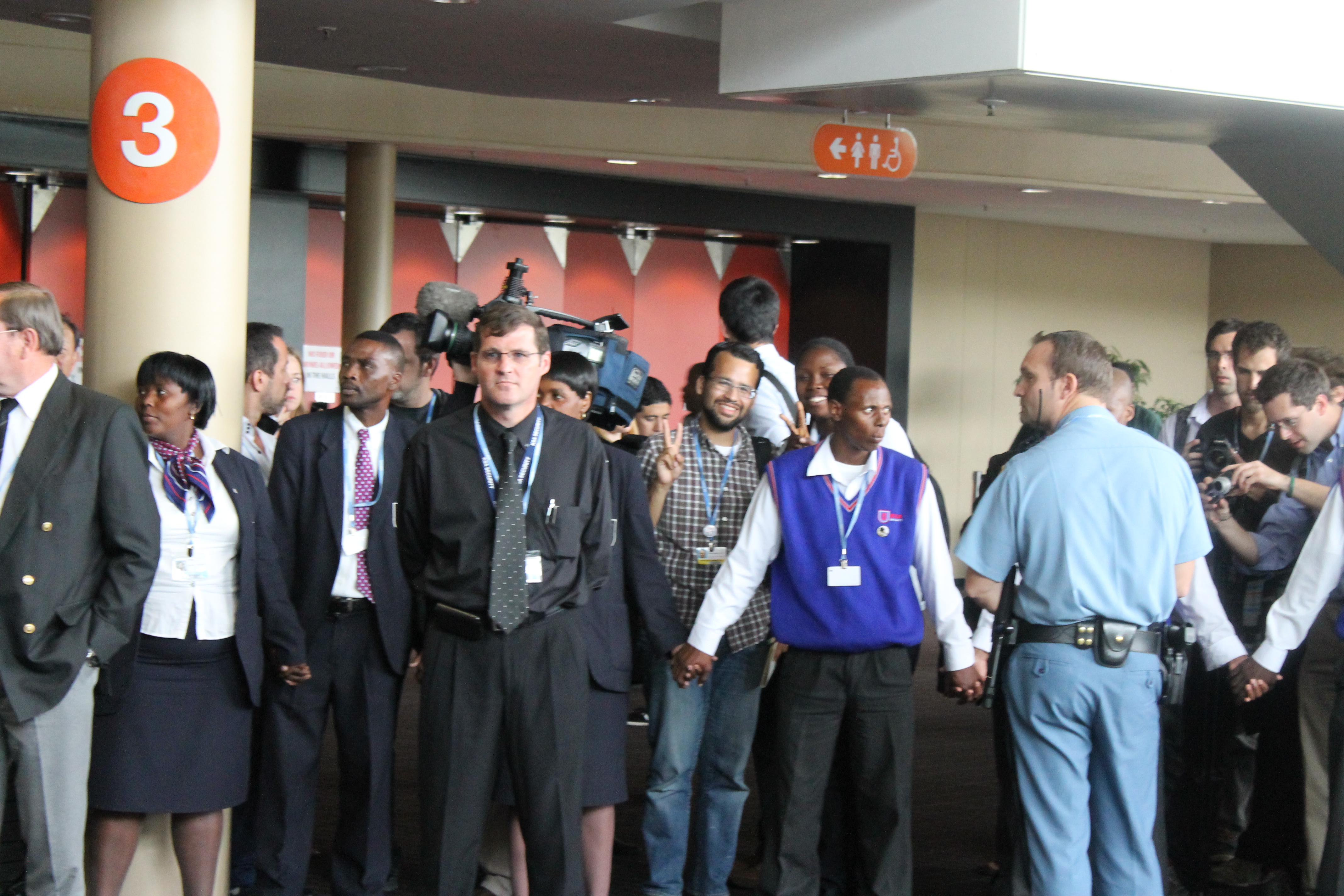
Hierald (USA and El Salvador) and Njideka (Nigeria) at the protest

The protest

A media frenzy
When I was leaving the ICC, I saw this simple message written on the pavement in chalk.

Yes – why??
In the end, the negotiations ended in a type of deal. Negotiations went into Sunday, and, essentially:
The conference agreed to start negotiations on a new accord that would put all countries under the same legal regime to enforce their commitments to control greenhouse gases, according to Maite Nkoana-Mashabane, South Africa’s foreign minister and headn of the 194-party conference.
The agreement would take effect by 2020 at the latest.
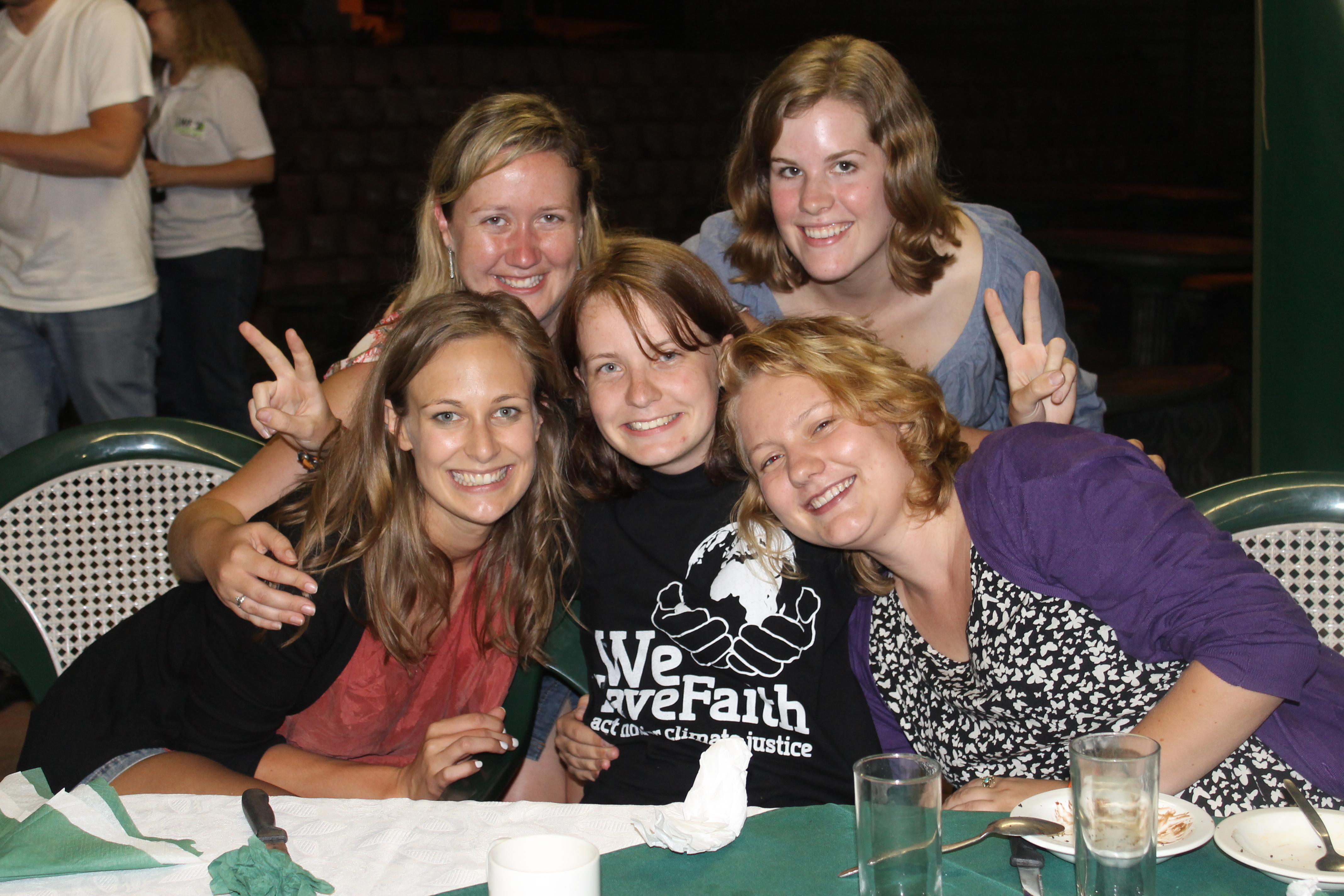
Friday night party
We spent Friday night with a celebratory dinner and party. Perhaps we were a bit premature in the celebrations, since we didn’t yet know what would come out of this COP in Durban, but we were celebrating the successful Youth for Eco-Justice program.

Caroline and I – travel buddies!

With more friends
On Saturday, we did some last-minute Christmas shopping at a market at the Moses Mabhida Stadium. That afternoon, I went to the Kwa Muhle Museum, Durban’s Apartheid museum. Interestingly, it is located in notorious building that served as the Native Administration Department under Apartheid, which controlled the affairs of the African urban population in Durban.

Kwa Muhle Museum
A wander along the beach afterwards led us to one of the cooler installations on the beachfront – a tree with lights that are powered by cyclists. It was pretty awesome.
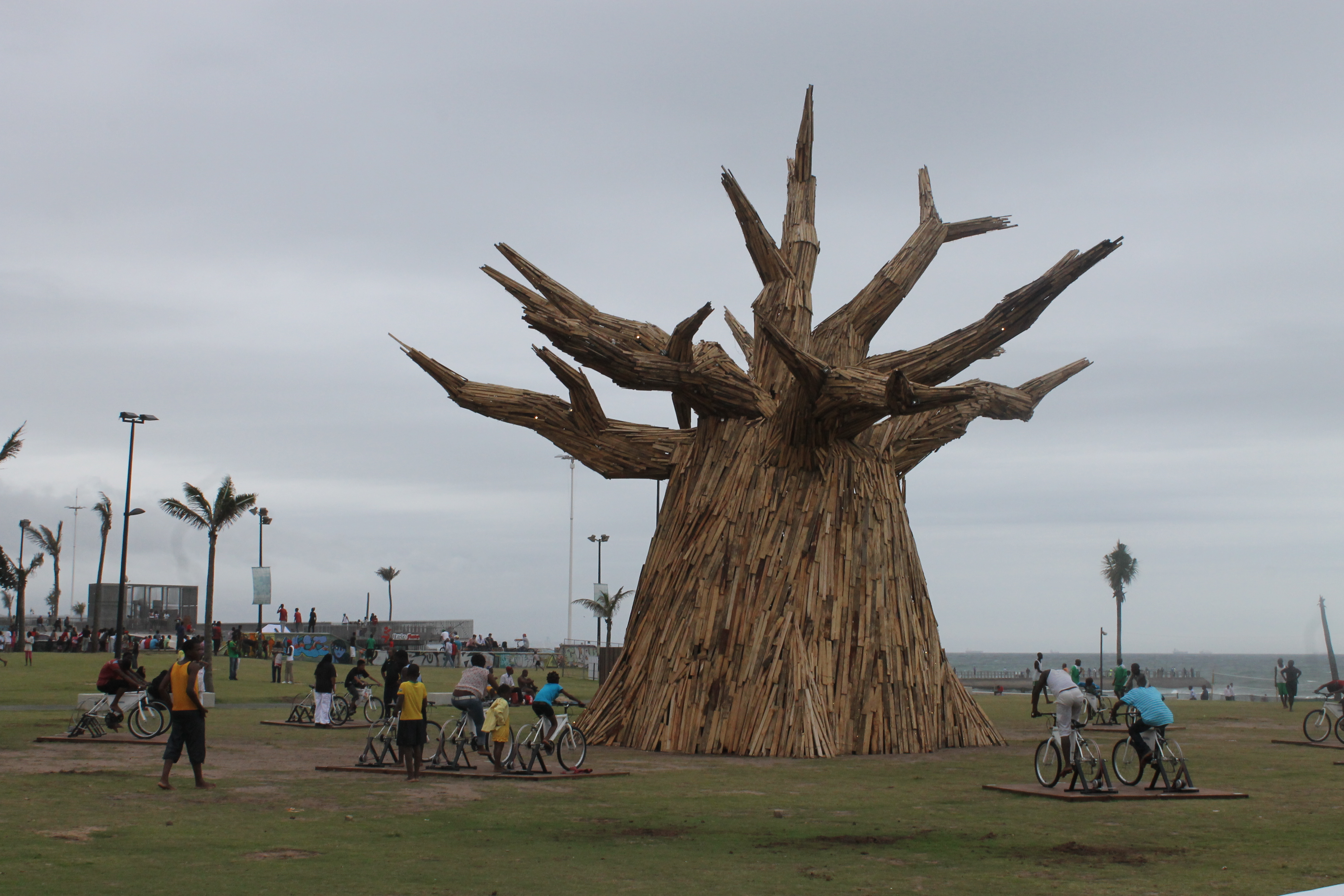
Tree lights powered by cyclists
And Sunday morning was spent communing with nature at Durban’s botanical gardens, the oldest botanical gardens in Africa. At 3 pm, I set off for my nearly 1.5 days of travel back to Toronto.
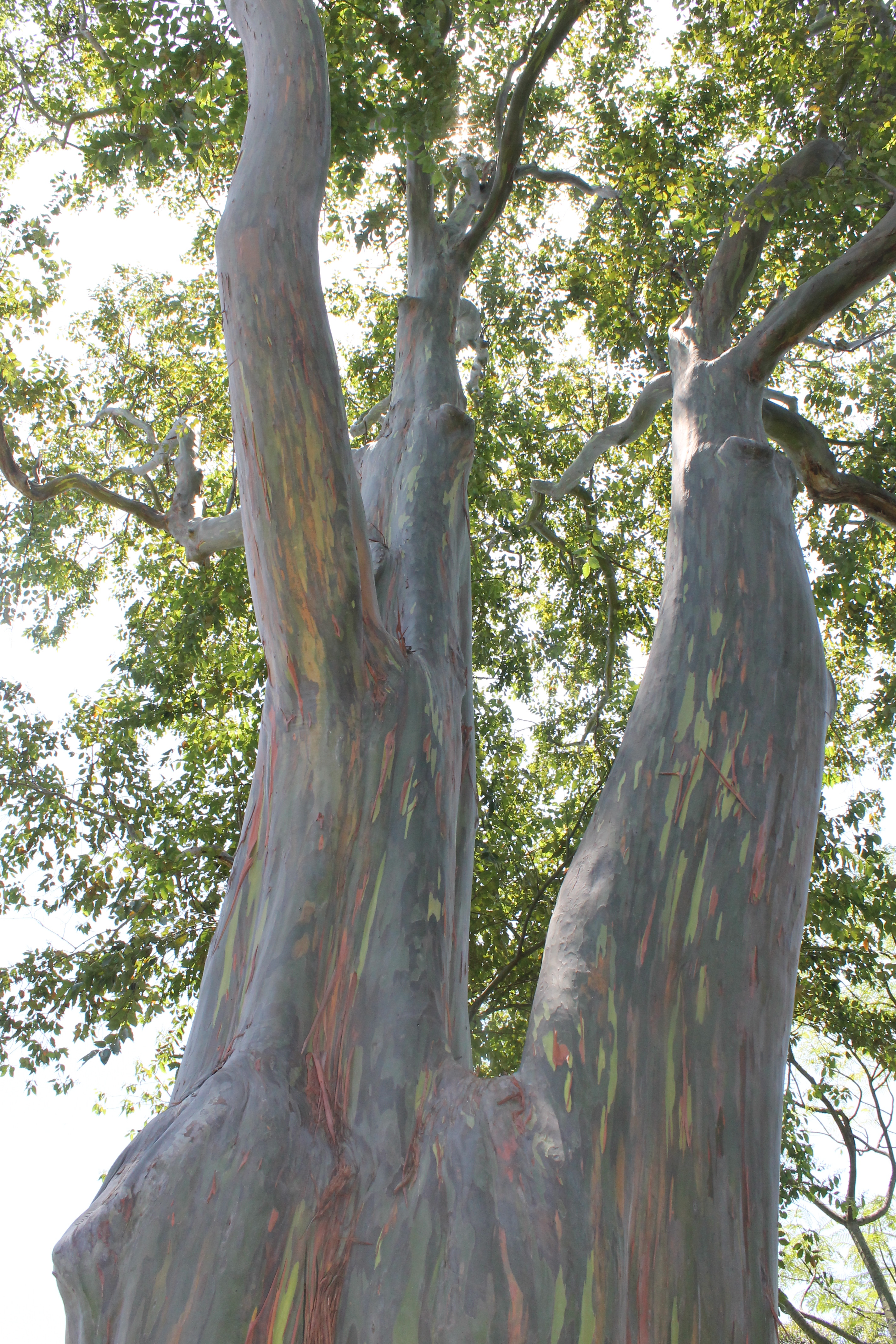
The rainbow tree

Flower
Today, Canada formally announced its withdrawal from the Kyoto Protocol. Many countries have criticized this decision.
I am beyond ashamed.
And so, I leave you with these last comments from Mardi Tindal’s last blog post about Durban:
Canada may yet choose to participate in a miracle. But clearly it will not do so on the schedule for which we have prayed, and certainly not in time for December 25th 2011. We will continue to act and pray with both the longing and hope of Mary.
 Kaitlin Geiger-Bardswich